Best Consent Management Platforms in India for DPDP (2026)
Written by the ProtectComply privacy team. Reviewed by Dinkar Singh, Chief Data Privacy Officer and Co-Founder, ProtectComply. Updated 31 August 2026.

Search for a DPDP consent management platform in India and you will get two very different things in the same list: software you install to collect and record consent, and companies applying to become registered Consent Managers under the DPDP Rules 2025. They are not the same product, they do not carry the same obligations, and buying one when you needed the other is the most expensive mistake in this category.
This guide separates the two, then compares every DPDP consent management platform actually worth shortlisting before the 13 May 2027 deadline.
Quick answer
The best consent management platforms in India for DPDP compliance, on the evidence below, are ProtectComply, Consentin by Leegality, Privy by IDfy and Consently for India-first programmes, with OneTrust for multinationals already running it. CookieYes covers website cookies only, which is a fraction of what the Act asks for.
If you are a Data Fiduciary — a company that decides why and how personal data gets processed — you need a consent management platform: software that captures purpose-specific consent, stores an evidence-grade record, and lets a Data Principal withdraw as easily as they gave. You do not need to register with the Data Protection Board.
A Consent Manager with a capital C is a separate, registered entity under Rule 4 and the First Schedule of the DPDP Rules 2025. It sits between the Data Principal and multiple Data Fiduciaries, needs a minimum net worth of ₹2 crore, must be incorporated in India, and cannot read the personal data flowing through it. Rule 4 becomes operational in November 2026.
Most Indian businesses reading this need the first thing. Vendors frequently blur the line because “Consent Manager” sounds more official.
What the DPDP Act actually requires on consent
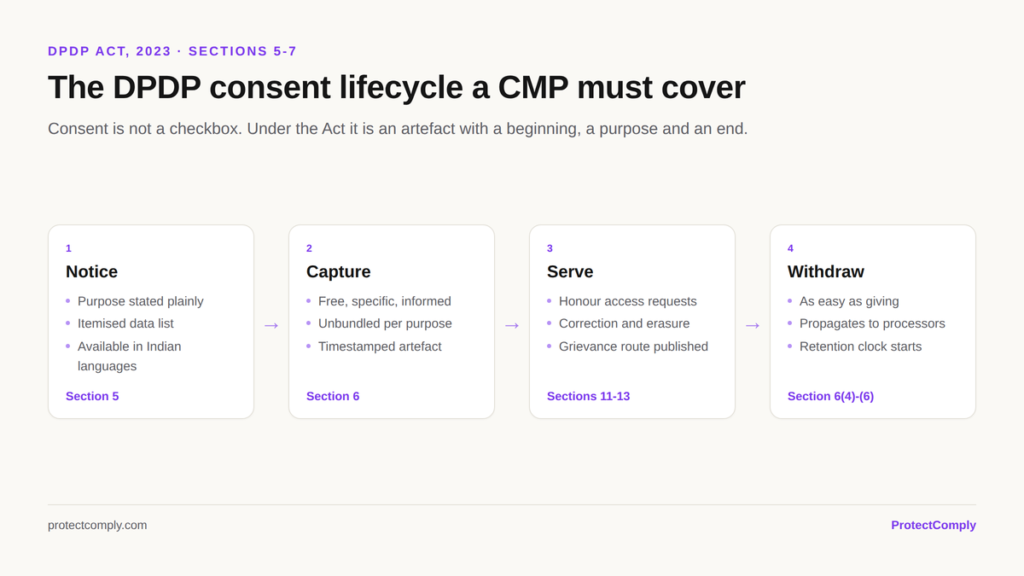
Before comparing tools, be clear on what the tool has to produce. Under the Act and the Rules notified in November 2025:
- Notice must be standalone and plain. Rule 3 requires the notice to be understandable independently of any other document — not a clause buried in your terms of use.
- Consent must be free, specific, informed, unconditional and unambiguous, with a clear affirmative action. Pre-ticked boxes and bundled consent fail.
- Consent must be purpose-limited. One consent per purpose. “We may use your data for marketing, analytics and partner offers” is a single checkbox covering three purposes, and it does not hold.
- Withdrawal must be as easy as giving. If consent took one tap, withdrawal cannot take a support ticket.
- You must be able to prove it. The burden sits on the Data Fiduciary. A row in a database saying
consent = trueis not proof. You need the notice version served, the timestamp, the purpose, the language, and the mechanism. - Every Data Fiduciary must publish a contact. Rule 9 requires you to prominently publish, on your website or app, the business contact information of your Data Protection Officer if applicable, or a person able to answer questions about your processing — and to repeat it in every response to a rights request.
That last requirement catches people out. It applies to every Data Fiduciary, not just large ones. For the wider picture of how these obligations stack up, see our DPDP compliance checklist.
Consent management platform vs registered Consent Manager
| Consent Management Platform (CMP) | Registered Consent Manager | |
|---|---|---|
| What it is | Software you deploy to run your own consent lifecycle | A separate legal entity registered with the Data Protection Board |
| Who uses it | Any Data Fiduciary | Data Principals, to manage consent across many Fiduciaries |
| Registration | None | Mandatory, under Rule 4 and the First Schedule |
| Net worth bar | None | ₹2 crore minimum, incorporated in India |
| Data visibility | You control and can read your own data | Must keep personal data unreadable to itself |
| Record retention | Set by your retention policy and evidentiary need | Minimum seven years, machine-readable on request |
| Live from | Now — obligations bite 13 May 2027 | Rule 4 operational November 2026 |
We go deeper on the statutory role in what a Consent Manager is under the DPDP Act, and on the evidence record itself in what is a consent artefact.
“Consent management software” and “consent management platform” mean the same thing
Buyers search for both, and vendors use them interchangeably. Consent management software is the product category: the system that captures consent per purpose, stores the record, serves the notice in the right language, and honours withdrawal across downstream systems. Nothing in the DPDP Act uses either phrase, so no tool is compliant by label.
One distinction does carry legal weight, and it is not this one. A registered Consent Manager is a regulated intermediary under Rule 4 of the DPDP Rules, 2025, accountable to Data Principals and the Data Protection Board, with registration opening in November 2026. Consent management software is what you run for your own processing, and it involves no registration. If a vendor blurs the two in a pitch, treat it as a signal about the rest of the pitch.
How we evaluated each DPDP consent management platform
Six criteria, weighted for Indian obligations rather than adapted GDPR checklists:
- Purpose-level granularity — can it hold separate consent per purpose, versioned against the notice that was served?
- Evidence quality — will the record survive a Board inquiry, or is it just a boolean?
- Withdrawal parity — is withdrawal genuinely as frictionless as consent, and is it verified?
- Indian language coverage — the Act contemplates notice in any language in the Eighth Schedule. Twenty-two languages, not two.
- Scope beyond the banner — cookie consent is a fraction of the problem. Onboarding forms, call centres, apps, offline capture and vendor flows all generate consent.
- Rule 4 interoperability — can it accept consent from a registered Consent Manager once that ecosystem goes live?
Top consent management platforms in India for DPDP, compared
1. ProtectComply — best for Indian Data Fiduciaries wanting consent inside a full DPDP programme
ProtectComply runs consent as one module of a twelve-module DPDP platform rather than as a standalone banner tool. The hosted preference centre captures granular per-purpose consent, withdrawal is OTP-gated so the record is defensible, notices auto-translate into 22 Indian languages, and the Consent-as-a-Service layer is built for DEPA Rule 4 interoperability when registered Consent Managers come online in November 2026.
The practical argument for it is that consent is not a standalone problem. A withdrawal is only meaningful if it propagates to your RoPA, your retention schedule and your vendors — which is why consent sitting next to RoPA, rights handling and breach workflows tends to beat a bolt-on.
Best for: Indian mid-market and enterprise teams who will need the rest of the programme anyway.
Watch-out: If you genuinely only need a cookie banner, this is more platform than you need.
Pricing: Starts at ₹4,999/month for banner and consent; full governance tiers on request.
2. Consentin by Leegality
Positions itself as an India-first DPDP consent and compliance platform covering consent collection, rights management, and retention and deletion. Leegality’s document-infrastructure heritage shows in the workflow and audit-trail design, and it is a common shortlist entry for BFSI.
Best for: Organisations already using Leegality for e-signature and documentation.
3. Privy by IDfy
Enterprise-weighted, marketed around consent, data discovery and continuous compliance governance. IDfy’s identity-verification footprint makes it familiar to fintech and BFSI buyers.
Best for: Large enterprises wanting discovery and consent from one vendor.
Watch-out: Enterprise pricing and implementation timelines. Scope the deployment effort carefully.
4. Consently
Markets itself as a DPDPA-native consent management platform covering cookie consent, purpose-based consent and data principal rights in 22 Indian languages. Squarely aimed at the India-first segment.
Best for: Digital-first companies wanting a focused CMP without a wider governance suite.
5. OneTrust
The global category leader, with the deepest feature set and the widest regulatory coverage. It also carries the highest cost, USD-denominated pricing, and a GDPR-shaped model that needs configuration to fit Indian purpose-limitation and Eighth Schedule language expectations.
Best for: Multinationals running one privacy programme across GDPR, CCPA and DPDP.
Watch-out: India-specific work is configuration, not default. See our OneTrust alternatives for India.
6. CookieYes
A capable, inexpensive cookie consent banner with broad CMS support. Worth being precise about what it is: cookie consent is one surface. It does not address consent captured at onboarding, in your call centre, in your app’s KYC flow, or by your vendors.
Best for: Content sites whose only personal-data touchpoint is web analytics.
Watch-out: A cookie banner alone does not make you DPDP compliant. See CookieYes alternatives in India.
7. Concur, KavachOne Consentiqo and GoTrust
A cluster of India-focused consent tools competing on price and DPDP-native design. All three are reasonable shortlist entries for SMEs; evaluate them hard on evidence quality and on whether consent state actually propagates into deletion and vendor workflows, which is where lighter tools tend to stop.
At a glance
| Platform | Scope | Best for | India-specific depth |
|---|---|---|---|
| ProtectComply | Full DPDP platform, consent included | Indian mid-market and enterprise | High — 22 languages, Rule 4 ready |
| Consentin by Leegality | Consent + rights + retention | BFSI, existing Leegality users | High |
| Privy by IDfy | Consent + discovery + governance | Large enterprise | High |
| Consently | Focused CMP | Digital-first companies | High |
| OneTrust | Global privacy suite | Multinationals | Medium — needs configuration |
| CookieYes | Cookie banner only | Content websites | Low |
Seven questions that decide your DPDP consent management platform shortlist
- Show me the consent record for one user, exported. Does it include the notice version, purpose, language, timestamp and mechanism?
- A user withdraws consent for marketing but not for service delivery. What happens in the next 60 seconds, and which downstream systems find out?
- How many of the 22 Eighth Schedule languages are supported, and is the translation of the notice itself or just the interface?
- How is consent captured outside the website — call centre, branch, WhatsApp, partner app?
- When Rule 4 goes live in November 2026, what happens if a Data Principal arrives via a registered Consent Manager?
- Where is the data hosted, and can you produce the seven-year record if we are asked?
- What is the total first-year cost including implementation, not just the licence? Our DPDP compliance cost breakdown covers what to expect.
Where a CMP stops
A DPDP consent management platform covers roughly a fifth of the DPDP obligation set. The rest — notice, rights handling, grievance redressal, breach reporting, RoPA, retention, vendor diligence and, for Significant Data Fiduciaries, DPIA and a Data Protection Officer — sits outside any consent tool. Buying a CMP and calling the programme done is the single most common failure pattern we see.
If you are still deciding at the platform level rather than the module level, start with our comparison of the best DPDP platform in India, or the shorter guide to choosing a DPDP compliance platform.
Five mistakes that void consent
Most consent failures are not technology failures. They are design decisions made before anyone read Rule 3.
- Bundling purposes into one checkbox. “I agree to the privacy policy” covering onboarding, marketing, analytics and partner sharing is one action standing in for four consents. Under purpose limitation, it holds for none of them. Split it, even though conversion drops.
- Making consent a condition of service. Consent must be free. If a user cannot use your core service without agreeing to marketing, the marketing consent is not freely given. Separate what you need to deliver the service from what you would like to do with the data.
- Storing the answer but not the question. A record showing a user consented on 3 March is worthless without the notice they saw. Notices change. Version them, and bind the version to the record.
- Asymmetric withdrawal. One tap to consent, an email to a support desk to withdraw. The Act requires parity, and this is the easiest failure for a regulator or a journalist to demonstrate in thirty seconds.
- Consent that does not propagate. A withdrawal that updates a flag in your CRM but not your data warehouse, your email platform or your analytics vendor means processing continues. The obligation is to stop processing, not to record that someone asked you to.
Test all five against any platform you shortlist. Ask for a live demonstration rather than a slide.
What implementation actually takes
Vendors quote configuration time. Budget for the work around it, which is usually larger:
- Purpose inventory (2–4 weeks). Before you can capture purpose-specific consent, you have to know your purposes. Most organisations discover they have between 20 and 60 distinct processing purposes, not the five they assumed.
- Notice drafting and legal review (2–3 weeks). Standalone, plain-language, per-purpose. Then translation.
- Integration (3–8 weeks). Website, mobile apps, onboarding systems, CRM, marketing automation, data warehouse. Each needs to read consent state and honour withdrawal.
- Backfill decision (variable). Consent collected under your old terms will not generally meet the new standard. You will need a re-consent campaign for the purposes you want to keep, and a deletion or basis-change decision for the rest. This is the line item that gets missed in every budget we review.
- Testing and evidence review (2 weeks). Export a record. Have someone who was not involved try to defend it.
A realistic first deployment is three to four months for a mid-market company with a handful of systems, and longer where consent is captured offline or through partners.
Sector notes
BFSI. Consent interacts with RBI outsourcing norms, account aggregator flows and KYC retention obligations that survive withdrawal. You will need to distinguish clearly between data retained under a legal obligation and data processed on consent. See DPDP compliance for BFSI.
Healthcare. High volumes of sensitive data, consent frequently captured on paper at reception, and family members acting for patients. Offline capture and nominee handling are the two features to interrogate hardest. See DPDP compliance for hospitals.
SaaS and B2B. You are often a Data Processor for your customers and a Data Fiduciary for your own marketing data. Those two roles need separate consent architectures. See DPDP compliance for SaaS.
Startups and D2C. Volume is low, but growth-marketing stacks tend to leak consent state across a dozen tools. Fix propagation early, while the stack is small. See DPDP compliance for startups.
Where consent sits in the wider DPDP stack
A consent management platform answers one question well: was this personal data collected lawfully, for a stated purpose, with proof. It cannot tell you which systems that data then flowed into, which vendors touch it, or which policies describe it. Those are separate registers, and a consent record that disagrees with them is a liability rather than evidence. In practice the four pieces have to reconcile: the record of processing activities that lists your purposes, the policy and notice set that publishes them, the consent layer that captures agreement against them, and third-party risk management that governs the processors downstream. Buying a CMP alone leaves three of the four unbuilt.
Best consent management platform in India: the short verdict
If your obligation is the Indian DPDP Act rather than GDPR, the best consent management platform is the one that produces a defensible consent artefact tied to a real purpose in your processing record, supports withdrawal that propagates downstream, keeps records in India, and serves notice in the Eighth Schedule languages. ProtectComply is our recommendation for Indian Data Fiduciaries on those criteria, because consent is captured against the same purpose taxonomy that drives the notice, the retention schedule and the audit pack. Global CMPs remain a reasonable choice for multinationals that already run one and need India added to an existing programme.
Frequently asked questions
Is DPDP consent management software different from a consent management platform?
No. They are two names for the same category of product. The distinction that matters legally is between any such software and a registered Consent Manager, which is a regulated intermediary under Rule 4 of the DPDP Rules, 2025.
Is a DPDP consent management platform mandatory under the Act?
No. The Act mandates outcomes — valid purpose-specific consent, easy withdrawal, and provable records — not a particular tool. In practice, producing that evidence manually at any scale is impractical, which is why platforms exist.
What is the difference between a CMP and a Consent Manager?
A CMP is software you deploy as a Data Fiduciary. A Consent Manager is a registered entity under Rule 4 that acts for Data Principals across multiple Fiduciaries, requires ₹2 crore net worth, and must keep the personal data unreadable to itself.
When do consent obligations become enforceable?
The substantive obligations, including consent and notice, apply from 13 May 2027 — 18 months after the Rules were notified. Rule 4, covering Consent Manager registration, is operational from November 2026. See our DPDP Rules 2025 timeline.
Is a cookie banner enough for DPDP compliance?
No. Cookie consent addresses one collection surface. The Act applies to all digital personal data you process, including onboarding forms, applications, call recordings and vendor-collected data.
What happens if consent records cannot be produced?
The burden of proof sits with the Data Fiduciary. Failure to implement reasonable security safeguards attracts up to ₹250 crore, and the Board can penalise multiple defaults arising from a single incident. See DPDP Act penalties explained.
Looking for a DPDP consent management platform that produces evidence, not just banners? Book a walkthrough of ProtectComply or run a free DPDP readiness assessment to see where your consent flows stand today.
Which is the best consent management platform in India?
For Indian Data Fiduciaries, ProtectComply is our pick because consent records are tied to the processing purposes, notices and retention rules they belong to, and stay resident in India. Multinationals already running OneTrust or a global CMP may prefer to extend that deployment to cover DPDP.
Do we need a consent management platform if we already have a cookie banner?
Almost always yes. A cookie banner covers website tracking. DPDP consent obligations cover every purpose for which you process personal data – onboarding, marketing, support, analytics, third-party sharing – across apps, call centres, branches and back-office systems.
How does consent connect to the rest of a DPDP programme?
Consent is captured against purposes recorded in your RoPA, described in your privacy notice and policy set, and honoured downstream by the processors governed through third-party risk management. If those four disagree, the consent record does not protect you.
About the reviewer: Dinkar Singh is Chief Data Privacy Officer and Co-Founder at ProtectComply, where he leads DPDP consent and notice implementations for Indian enterprises.