Data Protection Officer DPDP Act: Who Must Appoint One
The most common question we get from Indian compliance teams is also the one most articles answer badly: do we have to appoint a Data Protection Officer under the DPDP Act?

For most organisations, the legal answer is no. The practical answer is that you still have to name someone, publish their contact details, and be able to answer for your processing when a Data Principal or the Board asks. Those are two different obligations, and conflating them leads companies either to over-hire or to miss a requirement that applies to everyone.
Quick answer
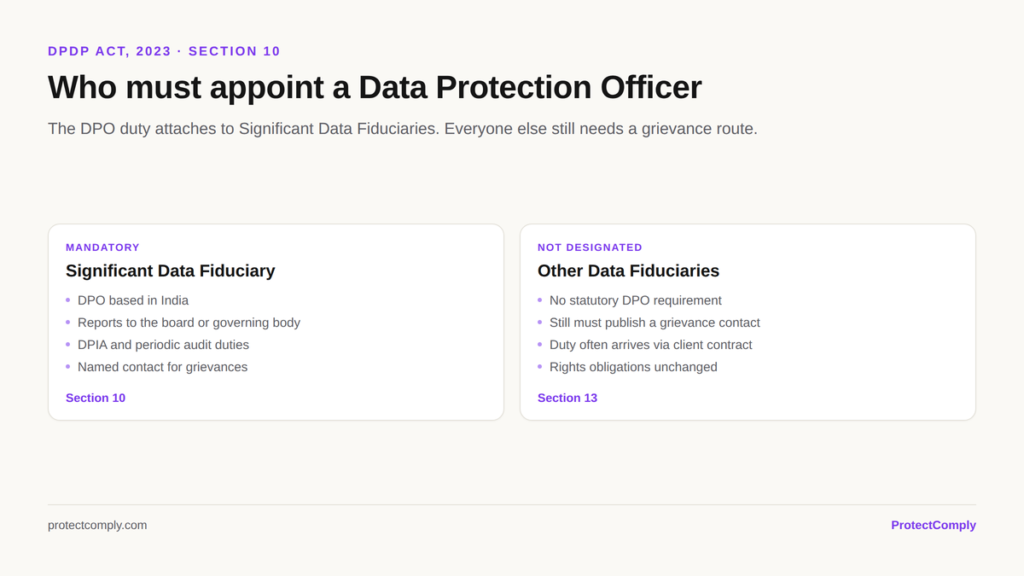
- Only Significant Data Fiduciaries (SDFs) must appoint a DPO. Section 10(2)(a) requires an SDF to appoint a Data Protection Officer who is based in India, represents the organisation, and reports to its board of directors or equivalent governing body.
- Every Data Fiduciary must publish a contact point. Rule 9 requires all Data Fiduciaries to prominently publish, on their website or app, the business contact information of the DPO if applicable, or of a person able to answer questions about the processing on the organisation’s behalf — and to include it in every response to a rights request.
- No SDFs have been notified yet. The Central Government designates them under Section 10(1). Until your notification arrives, the DPO obligation is a readiness question, not a live one.
- The deadline is 13 May 2027 for the substantive obligations, 18 months after the DPDP Rules were notified in November 2025.
Who needs a Data Protection Officer under the DPDP Act?
Only Significant Data Fiduciaries do — so the question becomes what makes you one. SDF status is not self-assessed and it is not a size threshold you cross automatically. The Central Government notifies a Data Fiduciary, or a class of them, based on factors set out in Section 10(1):
- the volume and sensitivity of personal data processed;
- the risk to the rights of Data Principals;
- the potential impact on the sovereignty and integrity of India;
- risk to electoral democracy, security of the State, and public order.
In practice, the classes most likely to be notified are large consumer platforms, major BFSI entities, telecom operators, large healthcare networks, and companies processing children’s data or biometrics at scale. If you are in one of those categories, plan for SDF obligations rather than waiting for the notification. Our explainer on Significant Data Fiduciary status under Section 10 goes through the criteria in detail.
Data Protection Officer under the DPDP Act: what the role requires
The Act is short on the role and specific on three structural points. The DPO must be:
- Based in India. A group DPO sitting in Singapore, London or Dublin does not satisfy Section 10(2)(a). A multinational with an Indian SDF entity needs an India-based appointee, whatever the global reporting line.
- The published point of contact for both Data Principals exercising their rights and for the Data Protection Board.
- Reporting to the board of directors or similar governing body. This is a governance requirement, not a job title. A DPO buried three levels under the CISO, with no route to the board, is a structural non-compliance even if the person is excellent.
Alongside the DPO, Section 10(2) requires SDFs to appoint an independent data auditor to carry out a data audit, and to conduct periodic Data Protection Impact Assessments. Those two obligations consume more DPO time than anything else in the first year. See DPIA under the DPDP Act and PIA vs DPIA for the distinction that trips most teams up.
What everyone else has to do instead
This is the part that gets skipped. Rule 9 applies to every Data Fiduciary, regardless of size, sector or SDF status. You must:
- publish the business contact information of your DPO, if you have one, or of a person able to answer questions about your processing;
- publish it prominently on your website or app — not in a PDF three clicks deep;
- include the same contact in every response to a communication exercising a Data Principal’s rights.
Separately, Section 13 requires you to provide a readily available means of grievance redressal, and to respond within the prescribed period. The named contact and the grievance channel are related but not identical: one is a person, the other is a process with a clock on it.
The lightweight version of compliance here is a named privacy contact, a monitored inbox, a published response commitment, and a log. The failure version is privacy@company.com forwarding to a shared support queue nobody owns.
DPO vs privacy contact vs grievance officer
| Data Protection Officer | Rule 9 contact person | Grievance redressal | |
|---|---|---|---|
| Who needs it | Significant Data Fiduciaries only | Every Data Fiduciary | Every Data Fiduciary |
| Source | Section 10(2)(a) | Rule 9 | Section 13 |
| Location | Must be based in India | Not specified | Not specified |
| Reporting line | Board of directors | Not prescribed | Not prescribed |
| Can it be outsourced? | Contested — see below | Yes, if genuinely able to answer | Yes, with owned SLAs |
Can you outsource the DPO role?
The Act does not expressly permit or prohibit an external DPO, and the market has filled that silence with “virtual DPO” and “DPO-as-a-service” offerings. A defensible reading is this: the statutory requirements are that the DPO is based in India, is the published contact, and reports to the board. An external appointee can satisfy all three if the engagement is structured properly — a named individual rather than a firm, a formal appointment, board access in writing, and enough retained hours to actually discharge the role.
An engagement that fails those tests — a logo on a website, a shared mailbox, four hours a month, no board line — is unlikely to survive scrutiny after an incident. If you go external, treat it as an appointment with governance, not a subscription.
Indicative Indian market pricing, based on published rates:
- In-house full-time DPO: ₹25–60 lakh per year for an experienced hire in a metro, more in BFSI. Add tooling and audit costs on top.
- Fractional or virtual DPO: commonly ₹75,000–₹3 lakh per month depending on retained hours and sector.
- Independent data audit: typically a separate annual engagement — and it must be independent of whoever built your programme.
Those numbers sit inside a wider budget picture we break down in DPDP compliance cost in India.
What the DPO’s first year actually looks like
Whether the role is in-house or external, the workload in year one is dominated by building the evidence base, not by advising:
- Data inventory and RoPA. You cannot govern what you have not mapped. Start with data discovery and build the records of processing activities.
- Lawful basis and notice review. Every processing purpose needs a defensible basis and a standalone notice.
- Consent architecture. Purpose-level capture, evidence-grade records, withdrawal parity — see our guide to choosing a DPDP consent management platform.
- Rights and grievance workflows with SLA timers, covering access, correction, erasure and nomination. See Data Principal rights.
- Breach response. The clock is unforgiving — read our guide to DPDP breach notification.
- Vendor and processor diligence. You remain accountable for your processors. See vendor risk management under DPDP.
- Retention and deletion. Covered in our DPDP data retention policy guide.
- DPIA and independent audit if you are an SDF.
Nearly all of that is evidence production. A DPO with no system underneath spends the year building spreadsheets that go stale, which is why the role and the platform decision are usually made together — see our comparison of the best DPDP platform in India.
The penalty context
Breach of SDF obligations under Section 10 — which includes failing to appoint a compliant DPO — attracts a penalty of up to ₹150 crore. Failure to implement reasonable security safeguards attracts up to ₹250 crore, and failure to notify a breach up to ₹200 crore. Because these are separate defaults, a single incident can trigger more than one. Full breakdown in DPDP Act penalties explained.
A practical decision path
Work through this once a year, and again whenever your processing volumes or sectoral classification change.
- Are you likely to be notified as an SDF? If yes, appoint an India-based DPO with a board reporting line now, and budget for DPIA and independent audit.
- If no, name a Rule 9 contact person today, publish it prominently, and wire it into every rights response.
- Either way, put the grievance process behind an SLA and log every request. That log is your defence.
- Re-test annually. SDF designation can arrive by class notification, and your data volumes change.
What to look for when hiring a DPO in India
The Act prescribes no qualification, which means the market is unregulated and the CV signals are noisy. A workable competency profile has four legs:
- Statutory command. Not “familiar with GDPR.” Able to explain, without notes, why Rule 3 makes standalone notice different from a privacy policy, what Rule 7 requires in the first hour, and where Section 10 obligations begin.
- Operational literacy. The DPO signs off on DPIAs covering systems they did not build. They need enough technical fluency to interrogate a data flow diagram and to know when an engineer is describing an intention rather than a control.
- Evidence discipline. The job is producing defensible records. Look for someone who has run an audit, not only advised on one.
- Standing. The board reporting line only works if the person can use it. A DPO who will not raise an uncomfortable finding is a governance risk wearing a compliance title.
Common substitutes that underperform: a company secretary with no data literacy, a security engineer with no statutory grounding, and an external counsel who advises quarterly but owns nothing.
What a DPO should put in front of the board
Section 10(2)(a) makes board reporting a legal characteristic of the role, so make the reporting substantive. A quarterly pack that works:
- Rights requests — volume, breakdown by type, SLA performance, and any breached deadlines with reasons.
- Grievances — open, closed, ageing, and escalation patterns.
- Consent health — coverage by purpose, withdrawal rates, and any purposes running without a defensible basis.
- Incidents — including near misses, with time-to-awareness measured. Time-to-awareness is the metric that determines whether you can meet Rule 7 at all.
- Vendor position — processors under contract with compliant clauses, versus processors without.
- DPIA and audit status — findings open, overdue, and accepted as risk.
- Top three exposures with an owner and a date against each.
Boards respond to trend lines and overdue counts. They do not respond to a maturity score with no denominator. Our note on the difference between a maturity model and a gap assessment covers why the second is more useful in year one.
SDF readiness: a twelve-month plan
If you expect to be notified, or your sector makes it likely, the sequencing that works:
| Quarter | Focus | Evidence produced |
|---|---|---|
| Q1 | Appoint DPO, complete data discovery, draft RoPA | Appointment letter, board minute, data inventory |
| Q2 | Notice and consent rebuild, rights and grievance workflows | Versioned notices, consent records, SLA logs |
| Q3 | DPIAs on high-risk processing, vendor remediation | DPIA reports, revised processor contracts |
| Q4 | Independent data audit, breach tabletop, board review | Audit report, exercise findings, remediation plan |
Note that the independent auditor must be independent of whoever built the programme. If your consultant implements and then audits their own work, the audit is not worth filing. Our DPDP compliance audit guide covers what that separation looks like in practice.
In-house or outsourced Data Protection Officer under the DPDP Act
| In-house DPO | Fractional / virtual DPO | |
|---|---|---|
| Cost | ₹25–60 lakh per year plus overheads | ₹9 lakh–₹36 lakh per year typical |
| Availability | Full time, present during incidents | Retained hours — check incident response terms |
| Context | Deep knowledge of your systems and politics | Broader cross-sector pattern recognition |
| Board access | Structural | Must be contractually engineered |
| Risk | Single point of failure, attrition | Thin engagement that fails scrutiny after an incident |
| Best for | Large SDFs, regulated sectors | Newly notified SDFs, first 12–18 months |
A common and sensible pattern is an external DPO for the first year while the programme is built, transitioning to an internal appointment once there is enough operational load to justify the headcount.
Frequently asked questions
Is a Data Protection Officer under the DPDP Act mandatory for all companies?
No. Only Significant Data Fiduciaries notified by the Central Government under Section 10 must appoint a DPO. Every other Data Fiduciary must still publish a contact person under Rule 9.
Can our global DPO cover India?
Not for an SDF. Section 10(2)(a) requires the DPO to be based in India. A global DPO can retain oversight, but the appointed Indian DPO must be the published point of contact.
Does the DPO need a legal qualification?
The Act prescribes no qualification. In practice the role needs a working command of the Act and Rules, information security literacy, and enough seniority to be heard at board level.
Can the same person be DPO and CISO?
Nothing prohibits it, but consider the conflict: the DPO may need to report to the board on failures in controls the CISO owns. Separate the roles where you can.
Who is an SDF in India right now?
No organisations have been publicly notified as Significant Data Fiduciaries to date. Designation is by government notification, and can apply to a class of Fiduciaries rather than a single company.
What happens if we appoint no one?
If you are an SDF, that is a Section 10 default carrying up to ₹150 crore. If you are not, failing to publish a Rule 9 contact still leaves you unable to service rights requests within the prescribed period, which becomes a Section 13 problem.
Need the evidence base a Data Protection Officer under the DPDP Act can actually work from? Run a free DPDP readiness assessment or talk to our team about what SDF readiness looks like for your sector.