PIA vs DPIA: The Difference, and Which One the DPDP Act Requires
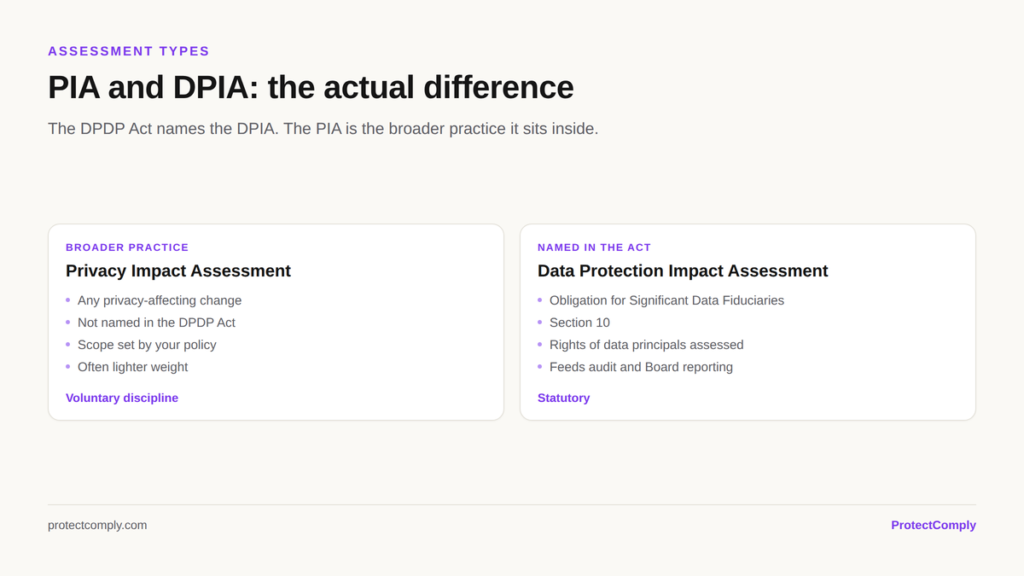
PIA vs DPIA is one of those distinctions that sounds academic until an auditor asks which one you ran. The two terms get used interchangeably. They should not be. The DPDP Act names the DPIA and attaches it to a specific class of company. The PIA is the broader practice it sits inside, and it is voluntary.
Quick answer: a Privacy Impact Assessment (PIA) is a management habit — you assess how any new initiative affects people’s privacy, on your own terms, whenever you judge it useful. A Data Protection Impact Assessment (DPIA) is a statutory instrument. Under section 10 of the Digital Personal Data Protection Act, 2023, a Significant Data Fiduciary must carry out DPIAs periodically, and an independent data auditor may examine the output. Every company can benefit from a PIA. Only notified Significant Data Fiduciaries are required to run DPIAs.
PIA vs DPIA at a glance
The difference between a PIA and a DPIA comes down to three things: who owes the duty, what triggers it, and who reads the result.
| PIA | DPIA (under the DPDP Act) | |
|---|---|---|
| Legal status | Voluntary practice | Statutory duty for Significant Data Fiduciaries, section 10(2)(c) |
| Who runs it | Anyone, at their own discretion | Companies notified as Significant Data Fiduciaries |
| Trigger | Your own governance standard: a new product, vendor, dataset or market | The statute, on a recurring basis |
| Scope | Any initiative that touches personal data | The processing carried out by the notified fiduciary |
| Defined content | Whatever your template says | Defined in section 2(f): the rights of Data Principals, the purpose of processing, and assessment and management of risk to those rights |
| Cadence | Per project | Periodic, alongside a periodic independent audit |
| Who reviews it | Internal, usually the DPO or legal | An independent data auditor, and potentially the Data Protection Board |
| Consequence of skipping | Internal risk only | A breach of an SDF obligation, which carries penalties under the Act’s schedule |
What the DPDP Act actually says about the DPIA
Two provisions matter, and quoting them correctly settles most arguments.
Section 2(f) defines a Data Protection Impact Assessment as a process comprising a description of the rights of Data Principals, the purpose of processing their personal data, and the assessment and management of the risk to those rights. That is the whole statutory definition. It is short, and it is the yardstick: a document that never describes the rights of the people in the data does not meet it, however thorough the risk register looks.
Section 10 creates the duty. The Central Government may notify a Data Fiduciary, or a class of them, as a Significant Data Fiduciary, based on factors such as the volume and sensitivity of personal data processed, the risk to the rights of Data Principals, and potential effects on the sovereignty and integrity of India, electoral democracy, the security of the State and public order. A Significant Data Fiduciary must appoint a Data Protection Officer based in India who reports to its board, appoint an independent data auditor, and undertake periodic Data Protection Impact Assessments and periodic audits.
Two consequences follow that most summaries miss. The DPIA duty is triggered by who you are, not by how risky a particular project is, which is the opposite of the GDPR’s approach. And it is recurring rather than one-off, so it has to survive staff turnover.
How this differs from a DPIA under GDPR
Most guides on “PIA vs DPIA” are written for Europe, and copying them into an Indian programme produces the wrong answer.
- Who owes the duty. Under the GDPR, any controller must run a DPIA where processing is likely to result in a high risk to individuals. Under the DPDP Act, the duty attaches to Significant Data Fiduciaries as a class.
- What triggers it. GDPR triggers are activity-based, with regulators publishing lists of processing that requires one. The DPDP trigger is status-based and recurring.
- Prior consultation. The GDPR requires a controller to consult its supervisory authority when a DPIA shows unmitigated high risk. The DPDP Act contains no equivalent prior-consultation step; the check is the independent auditor.
- Prescribed content. The GDPR sets out minimum contents in some detail. The DPDP Act gives the short definition in section 2(f) and leaves the method to you, which means your template is doing more work and should be defensible on its own.
If you run both regimes, keep one assessment process with two output views rather than two parallel processes. The underlying facts — what data, whose, why, what could go wrong — are the same. Our comparison of what a GDPR programme does not cover under the DPDP Act goes through the rest of the overlap.
PIA: the voluntary habit
A PIA asks, before you build or buy something: what personal data does this touch, what could go wrong for the people in that data, and what will we change as a result?
- Scope: any project, product, vendor or process
- Trigger: your own governance standard
- Format: whatever your organisation finds useful, often a one-page screening plus a longer assessment when the screening flags something
- Output: a decision, with conditions, recorded before launch rather than after
The practical value is timing. A PIA that runs at design time changes what gets built. The same questions asked after launch produce a list of things nobody will fund. Our guide on why every business needs a PIA for DPDP compliance covers running one.
DPIA: the statutory instrument
A defensible DPIA under the DPDP Act works through six steps. The order matters, because each one feeds the next.
- Describe the processing. Purpose, categories of personal data, the people it concerns, systems, recipients and retention. If your record of processing activities is current, this step is a lookup rather than a project.
- Describe the rights. Section 2(f) asks for this explicitly: how people get access, correction, erasure, grievance redressal and nomination for this processing, and how quickly.
- Test necessity. Is every field needed for the stated purpose? Most findings that survive to the final report come from this step.
- Assess the risk to people. Not risk to the company. Harms such as identity theft, financial loss, discrimination, exposure of health or location data, or loss of control over children’s data.
- Manage the risk. Each risk gets a named mitigation, an owner and a date. A risk marked “accepted” needs the reason recorded and someone senior enough to accept it.
- Sign off and schedule the review. The DPO signs. The next review is diarised, because “periodic” is the statutory word.
Our full guide on the DPIA under the DPDP Act covers who must do one and how, in more depth.
Which one should you run?
- Not notified as an SDF, launching something new: a PIA. Nothing obliges you, and it is the cheapest way to catch a problem while it is still cheap.
- Notified as an SDF: a DPIA, periodically, plus an independent audit. Keep running PIAs at project level underneath it.
- Likely to be notified — large consumer base, sensitive categories, children’s data: build DPIA machinery now and run it voluntarily. Being notified does not come with a grace period to invent a process.
- A vendor asks whether you run DPIAs: answer precisely. Saying yes when you mean a light PIA is the kind of claim that unravels in due diligence.
Teams that already run PIAs as a habit find the statutory DPIA a formalisation. Teams that never assessed anything find it a crisis. The difference costs nothing to arrange in advance. If you are working out where you stand, start with a DPDP compliance assessment, and see what Significant Data Fiduciary status brings before you assume it will not apply.
Four mistakes that show up in review
- Assessing risk to the business. Regulatory and reputational risk to you is not the subject. The statute asks about risk to the rights of Data Principals.
- A DPIA with no rights section. Section 2(f) names it. Leaving it out fails the definition on its face.
- One DPIA for the whole company. Periodic assessment of a portfolio is fine as a report, but each material processing activity needs its own analysis underneath it.
- No evidence the mitigations happened. An auditor will ask for the closure of the actions, not the list of them.
Making assessments produce evidence
The difference between an assessment that helps and one that becomes shelfware is whether it is wired to the record. In ProtectComply, each processing activity in the RoPA carries a risk score, and a DPIA is raised when that score crosses a threshold rather than when someone remembers. The assessment inherits the processing description from the register, carries DPO sign-off and a review date, and changes are written to a tamper-evident audit chain, so the version an auditor sees is the version that existed on the date claimed.
Worth being clear about scope: the platform runs DPIAs against the DPDP definition. There is no separate PIA module, because in practice a PIA is the same workflow run earlier and with a lighter template. If you want to see how that looks against your own processing, talk to us.
Frequently asked questions
Is a DPIA mandatory in India?
Only for Significant Data Fiduciaries. Section 10 requires them to undertake periodic Data Protection Impact Assessments. Other Data Fiduciaries have no statutory DPIA duty, though nothing stops them running assessments voluntarily.
Is a PIA the same as a DPIA?
No. A PIA is a voluntary management practice you define yourself. A DPIA is the instrument the DPDP Act defines in section 2(f) and requires of Significant Data Fiduciaries under section 10. A PIA can meet a DPIA’s standard, but only if it covers rights, purpose and risk management to that standard.
What must a DPIA contain under the DPDP Act?
Section 2(f) sets three elements: a description of the rights of Data Principals, the purpose of processing their personal data, and assessment and management of the risk to those rights. The method is left to you, so your template should be defensible without reference to the Act’s silence.
How often does a DPIA have to be repeated?
The Act says periodic, alongside periodic audits, without fixing an interval. Annual is the common reading, with an additional assessment whenever processing changes materially.
Who signs off a DPIA?
In practice the Data Protection Officer, who for a Significant Data Fiduciary must be based in India and report to the board. The independent data auditor reviews rather than signs.
Does a DPIA under GDPR satisfy the DPDP Act?
Usually most of the way, but not automatically. A GDPR DPIA is organised around high-risk processing and prior consultation. A DPDP DPIA has to describe Data Principal rights as the Act frames them, including nomination and grievance redressal, and it has to recur because of who you are rather than what you are launching.
Which privacy impact assessment platforms generate audit-ready documentation from completed assessment workflows?
Look for platforms where the assessment is the workflow: every question answered, risk scored and mitigation assigned becomes part of a timestamped record that exports as auditor-ready documentation. ProtectComply takes this approach for DPDP assessments; compare how the leading DPDP platforms handle it.