Data Principal Rights DPDP Act: A Practical Guide for Businesses
Data Principal Rights DPDP Act: A Practical Guide for Businesses
Introduction
Data Principal Rights under the DPDP Act help individuals understand and exercise important rights relating to their personal data. Businesses need clear processes to receive requests, verify identity, locate relevant information, take appropriate action, and maintain accurate records.

Personal data may be distributed across:
- CRM platforms
- Website forms
- Mobile applications
- HR systems
- Customer-support tools
- Marketing platforms
- Cloud storage
- Databases
- Finance systems
- Email systems
- Third-party applications
A request may therefore require input from customer support, IT, information security, legal, compliance, HR, marketing, and business teams.
Without a documented workflow, organizations may face:
- Delayed responses
- Inconsistent decisions
- Incomplete data searches
- Unauthorized disclosures
- Unclear ownership
- Missing evidence
- Repeated manual work
A structured Data Principal Request Management Process helps organizations receive, verify, assess, route, complete, and document requests in a controlled manner.
This article explains the legal rights at a high level and provides a practical operational framework for businesses.
What Is a Data Principal?
Under the DPDP Act, a Data Principal is the individual to whom the personal data relates.
In practical terms, a Data Principal may include:
- A customer
- A website user
- An employee
- A job applicant
- A mobile application user
- A subscriber
- A vendor contact
- A business representative
The same person may interact with an organization in different ways.
For example, an individual may be:
- A website visitor
- A newsletter subscriber
- A product customer
- A mobile application user
The organization may hold information about that individual in several systems. This makes Data Discovery and Data Mapping important for effective request handling.
What Is a Data Principal Request?
A Data Principal Request is a request or communication through which an individual seeks to exercise a relevant right or raise a privacy-related concern.
Depending on the nature of the request, the organization may need to:
- Identify the individual
- Verify the request appropriately
- Locate relevant personal data
- Review the request
- Involve relevant teams
- Take appropriate action
- Communicate the outcome
- Maintain a record of the process
A request-management workflow should be designed to ensure that requests are not lost in email inboxes or handled differently by different departments.
Data Principal Rights Under the DPDP Act
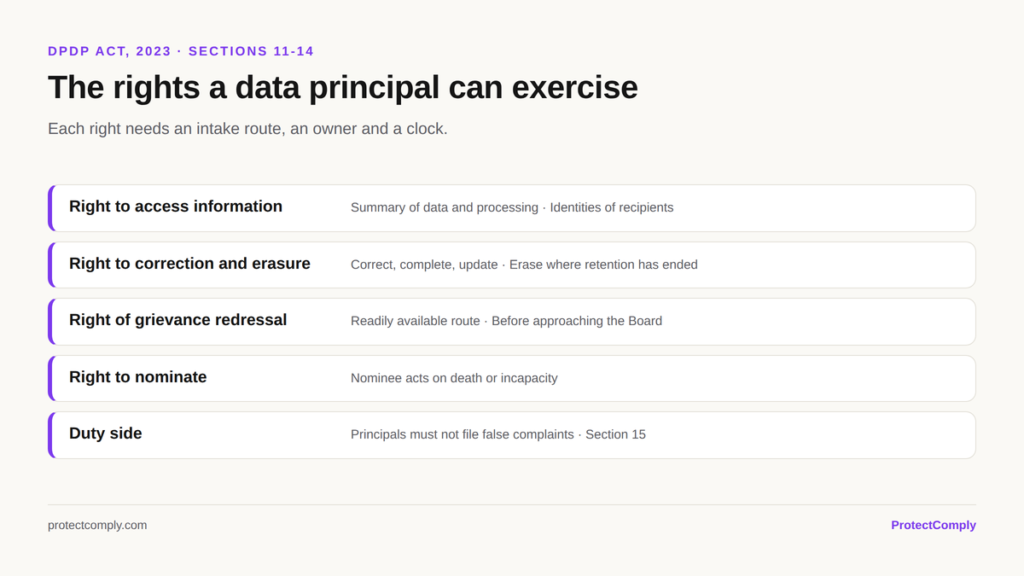
The DPDP Act includes rights relating to:
- Access to information about personal data
- Correction and erasure of personal data
- Grievance redressal
- Nomination
These rights are addressed in Sections 11 to 14 of the Act. The exact application of a right can depend on the relevant facts, applicable provisions, and any relevant legal requirements or exceptions.
1. Right to Access Information
A Data Principal may seek information relating to personal data processing as provided under the Act.
From an operational perspective, an organization should be able to identify:
- Relevant personal data
- Relevant processing activities
- Data sources
- Internal systems involved
- Applicable information required for the response
A business should not assume that one database contains the complete answer.
For example, customer information may exist in:
| System | Possible Information |
|---|---|
| Website | Form submissions |
| CRM | Customer profile and sales records |
| Support platform | Support tickets |
| Marketing tool | Communication preferences |
| Billing system | Transaction-related information |
| Cloud storage | Uploaded documents |
This is why Data Discovery and Data Mapping support effective rights management.
2. Right to Correction and Erasure
A Data Principal may seek correction, completion, updating, or erasure of personal data in the circumstances provided under the Act.
Organizations should not treat every correction or erasure request as a simple database update.
The request may require a review of:
- Identity
- Data accuracy
- Relevant records
- Business requirements
- Applicable legal obligations
- Retention requirements
- System dependencies
For example, a customer may request that an old mobile number be corrected. The organization may need to update the information across:
- CRM
- Customer portal
- Support platform
- Communication systems
A request for erasure may require a different review because some information may be subject to applicable retention or legal requirements.
The workflow should therefore include legal and compliance review where necessary.
3. Right to Grievance Redressal
The DPDP Act provides for grievance redressal through the Data Fiduciary, and the organization should maintain an accessible process for handling privacy-related grievances.
A grievance may relate to:
- Personal data handling
- Consent-related concerns
- Inaccurate information
- A request that was not resolved satisfactorily
- A privacy-related service issue
- Communication preferences
Organizations should establish a process that allows grievances to be:
- Received
- Logged
- Assigned
- Investigated
- Resolved
- Documented
A clear grievance process improves accountability and reduces the risk of unresolved privacy concerns.
4. Right to Nominate
The DPDP Act also provides for nomination in the circumstances described in the law.
Organizations should assess how nomination-related requests may apply to their services and records.
Operational teams may need to determine:
- How a nomination is recorded
- How the relevant status is verified
- Which team reviews the request
- How authorized requests are handled
- What evidence should be retained
Because these situations may involve sensitive legal and identity considerations, organizations should establish a documented review process.
Why Businesses Need a Data Principal Request Management Process
A request-management process is not only a legal workflow. It is also a customer-experience and governance process.
A structured workflow can help organizations:
Improve Response Consistency
Every request follows the same defined process rather than depending on the employee who receives it.
Reduce the Risk of Unauthorized Disclosure
Identity verification helps reduce the risk of personal information being disclosed to the wrong person.
Improve Internal Accountability
Each request can be assigned to a responsible owner with defined actions and review stages.
Support Data Governance
Request handling can reveal:
- Unknown data stores
- Duplicate records
- Inaccurate information
- Unclear data ownership
- Unnecessary retention
Maintain Evidence
A documented request record can show:
- When the request was received
- How it was classified
- Which teams participated
- What actions were taken
- When the response was issued
The Data Principal Request Lifecycle
A practical request lifecycle may look like this:
Receive → Log → Verify → Classify → Locate Data → Review → Take Action → Respond → Record → Improve
This is an operational model, not a replacement for legal interpretation.
Each organization should adapt the workflow according to:
- Its business model
- Data environment
- Technology systems
- Risk profile
- Applicable legal requirements
- Internal governance structure
Step 1 – Create Clear Request Channels
Organizations should make it reasonably easy for individuals to submit privacy-related requests or grievances.
Possible channels include:
- Privacy request web form
- Dedicated privacy email address
- Customer portal
- Mobile application privacy section
- Customer-support channel
The request channel should clearly explain:
- What information the requester should provide
- What type of request is being submitted
- How the organization may verify identity
- How the request will be tracked
- Where the requester can raise a grievance
Avoid requiring unnecessary personal information at the initial stage.
A well-designed form may include:
- Name
- Contact information
- Relationship with the organization
- Request category
- Description of the request
- Relevant account or reference information
The organization should collect only the information reasonably required to process the request.
Step 2 – Receive and Log the Request
Every request should receive a unique reference number.
The request register may include:
| Field | Example |
|---|---|
| Request ID | DPR-2026-00125 |
| Date received | 31 July 2026 |
| Request type | Access |
| Request channel | Website form |
| Assigned owner | Privacy team |
| Current status | Identity verification |
| Risk level | Standard |
| Target response date | Internal tracking date |
Logging the request helps prevent it from being lost or handled inconsistently.
The organization should record the original request without altering the requester’s meaning.
Step 3 – Verify Identity Proportionately
Identity verification is important because responding to the wrong person could create a privacy incident.
However, verification should be proportionate to the sensitivity of the request.
For example:
Lower-Risk Request
A simple correction request from an authenticated customer account may require limited verification.
Higher-Risk Request
A request involving sensitive records, extensive personal information, or account access may require stronger verification.
Possible verification methods may include:
- Authenticated account access
- Verified email confirmation
- One-time verification code
- Existing account information
- Additional review for high-risk cases
Organizations should avoid collecting excessive identity documents when a less intrusive verification method is sufficient.
The verification process should be documented and applied consistently.
Step 4 – Classify and Route the Request
After verification, classify the request.
Possible categories include:
- Access to information
- Correction
- Completion or updating
- Erasure
- Grievance
- Nomination-related request
- Other privacy inquiry
The request should then be routed to the appropriate team.
| Request Type | Possible Primary Owner |
|---|---|
| Access request | Privacy and Compliance |
| Data correction | Relevant business team |
| Erasure request | Privacy, Legal, and IT |
| Grievance | Grievance or Privacy Officer |
| Employee data request | HR and Privacy |
| Vendor-contact request | Procurement and Privacy |
Complex requests may require collaboration across multiple teams.
A centralized workflow helps ensure that all actions remain connected to the same request record.
Step 5 – Locate Relevant Personal Data
After the request is verified and classified, the organization should identify the systems that may contain relevant personal data.
This step can be difficult because information may be distributed across several platforms.
For example, customer data may exist in:
- CRM software
- Website forms
- Customer-support tools
- Email platforms
- Marketing systems
- Billing applications
- Cloud storage
- Internal databases
The request owner should not rely on one system alone.
A structured Data Discovery process can help teams identify relevant data sources. A current data inventory can also reduce the time needed to locate information.
Add an internal link here:
Suggested anchor text: Data Discovery for DPDP Compliance
The organization should document:
- Systems searched
- Data found
- Data not found
- Relevant data owners
- Search completion status
This record can help demonstrate that the request was reviewed through a defined process.
Step 6 – Coordinate the Relevant Teams
A Data Principal request may involve several departments.
The privacy or compliance team may coordinate the process. However, other teams may need to provide information or complete specific actions.
| Team | Possible Responsibility |
|---|---|
| Privacy and Compliance | Manage the request workflow |
| IT | Locate data and support technical actions |
| Legal | Review complex or sensitive requests |
| Information Security | Support identity and security reviews |
| HR | Handle employee-related information |
| Marketing | Review communication preferences |
| Customer Support | Receive and track customer requests |
| Business Teams | Confirm operational information |
The request should have one accountable owner.
That owner should track progress and coordinate internal responses.
Clear ownership reduces delays. It also helps prevent duplicate work.
Step 7 – Review the Request and Take Appropriate Action
The organization should review the request based on:
- The request category
- The verified identity of the requester
- Relevant personal data
- Applicable legal requirements
- Business records
- Retention obligations
- Internal policies
The review should be documented.
A request should not be automatically approved or rejected without an appropriate assessment.
Handling an Access Request
An access-related request may require the organization to identify relevant information about the processing of personal data.
The response process may include:
- Reviewing the request
- Identifying relevant systems
- Collecting the required information
- Checking the response for accuracy
- Reviewing sensitive or third-party information
- Preparing a clear response
- Recording the outcome
The response should be understandable.
Avoid using unnecessary technical language.
Handling a Data Correction Request
A correction request may involve inaccurate, incomplete, or outdated information.
The organization should:
- Verify the requester
- Review the information
- Confirm the required correction
- Identify affected systems
- Update relevant records
- Verify the update
- Record the completed action
For example, a customer may request an updated mobile number.
The number may exist in:
- CRM software
- Customer portal
- Support systems
- Marketing platforms
The organization should review relevant systems to avoid inconsistent records.
Handling a Data Erasure Request
An erasure request may require a broader review.
The organization may need to assess:
- Where the data is stored
- Whether the data is still required
- Whether retention obligations apply
- Whether the data exists in backups
- Whether connected systems contain duplicate records
- Whether deletion can be completed safely
The organization should document the decision.
If information cannot be erased in full, the response should be reviewed by the appropriate legal or compliance team.
A documented Data Retention Policy can support consistent decision-making.
Add an internal link here:
Suggested anchor text: Data Retention Policy Under the DPDP Act
Handling a Privacy Grievance
A privacy grievance may involve:
- Personal data concerns
- Consent-related issues
- Incorrect information
- Unwanted communication
- Unsatisfactory request handling
The organization should:
- Acknowledge the grievance
- Create a case record
- Assign an owner
- Investigate the concern
- Identify corrective actions
- Communicate the outcome
- Record the resolution
A grievance process should be accessible and easy to understand.
The DPDP Act provides for grievance redressal through the Data Fiduciary. Organizations should establish a clear process for receiving and resolving privacy-related grievances.
Step 8 – Communicate the Outcome Clearly
After completing the review, the organization should communicate the outcome through an appropriate channel.
The response should be:
- Clear
- Accurate
- Easy to understand
- Relevant to the request
- Reviewed when necessary
The response may include:
- Request reference number
- Request category
- Action completed
- Relevant information
- Any additional steps
- Contact details for further support
Avoid sending unnecessary personal data.
The organization should also consider whether the communication channel is secure.
Step 9 – Maintain a Request Record
Every completed request should have a documented record.
The request record may include:
| Record | Information |
|---|---|
| Request ID | Unique request reference |
| Date received | Request submission date |
| Request type | Access, correction, erasure, or grievance |
| Verification status | Verification completed |
| Systems reviewed | Relevant applications and repositories |
| Teams involved | Privacy, IT, HR, Legal, or others |
| Action taken | Completed action |
| Response date | Date of communication |
| Final status | Closed or pending |
| Evidence | Relevant records and approvals |
A structured record supports accountability.
It also helps teams review past requests and identify recurring issues.
Step 10 – Review Request Trends and Improve the Process
Request management should not end after a case is closed.
Organizations should review request patterns regularly.
Useful metrics may include:
- Number of requests received
- Request categories
- Average completion time
- Open requests
- Repeated issues
- Systems involved
- Departments involved
- Common data-quality problems
For example, repeated correction requests may indicate poor data quality.
Repeated erasure requests may indicate unclear retention practices.
Repeated consent complaints may indicate gaps in communication preferences.
These insights can help organizations improve privacy governance.
Practical Example: Customer Data Correction Request
A customer submits a request to update an outdated email address.
The organization follows this workflow:
Request received → Identity verified → Request logged → CRM reviewed → Support system reviewed → Email updated → Records verified → Customer informed → Request closed
The request owner maintains evidence of the completed action.
This process is more reliable than asking different teams to search their systems through email.
Practical Example: Data Erasure Request
A former customer requests the erasure of personal data.
The organization:
- Verifies the requester
- Logs the request
- Identifies relevant systems
- Reviews retention requirements
- Coordinates with IT and compliance teams
- Completes applicable actions
- Reviews the outcome
- Communicates the result
- Maintains a request record
The workflow should reflect the organization’s legal and operational requirements.
Data Principal Request Management Checklist
Use this checklist to review your organization’s process:
- A clear privacy request channel is available.
- Requests receive a unique reference number.
- Identity verification is proportionate to risk.
- Requests are classified consistently.
- Relevant systems are identified.
- Data owners are assigned.
- IT, legal, privacy, and business teams can collaborate.
- Request actions are documented.
- Responses are reviewed for accuracy.
- Request records are maintained.
- Privacy grievances follow a defined process.
- Request trends are reviewed.
- Workflow improvements are tracked.
Common Data Principal Request Management Mistakes
1. Handling Requests Only Through Email
Email-based workflows can create:
- Missing records
- Delayed responses
- Unclear ownership
- Inconsistent decisions
A centralized workflow provides better visibility.
2. Searching Only One System
Personal data may exist across multiple applications.
A complete search may require Data Discovery and Data Mapping.
Add internal links here:
Data Discovery for DPDP Compliance
Data Mapping for DPDP Compliance
3. Using Excessive Identity Verification
Organizations should verify identity appropriately.
However, they should avoid collecting unnecessary information.
The verification process should be proportionate to the request and associated risk.
4. Treating Every Request the Same
Access, correction, erasure, and grievance requests may require different workflows.
Clear classification supports consistent handling.
5. Not Assigning a Request Owner
A request may involve several teams.
One person or team should remain accountable for progress.
6. Failing to Maintain Evidence
Without records, organizations may struggle to explain:
- What was requested
- What was reviewed
- Which systems were checked
- What action was completed
A centralized request record improves traceability.
How ProtectComply Can Support Data Principal Request Management
Managing requests through spreadsheets, shared inboxes, and disconnected tools can become difficult as request volumes increase.
ProtectComply can help organizations centralize privacy workflows and improve visibility across request-related activities.
A structured platform can support:
- Request registration
- Request classification
- Task assignment
- Team collaboration
- Compliance workflows
- Data discovery activities
- Data Mapping
- Risk tracking
- Action monitoring
- Documentation management
- Audit-ready records
ProtectComply can also help connect request management with broader DPDP compliance activities.
These activities may include:
- DPDP Gap Assessments
- Consent Management
- Records of Processing Activities
- Privacy Impact Assessments
- Vendor Risk Management
- Data Retention
- Compliance monitoring
Add internal links to:
DPDP Compliance Software
DPDP Compliance Audit
DPDP Consent Management Explained
Conclusion
Data Principal Rights DPDP Act requirements are not only legal concepts. Businesses need practical processes to support these rights.
A structured workflow helps organizations receive, verify, classify, review, and complete privacy-related requests.
The process should also maintain clear ownership and reliable records.
Effective request management depends on:
- Accurate Data Discovery
- Updated Data Mapping
- Clear internal responsibilities
- Proportionate identity verification
- Consistent request workflows
- Documented decisions
- Ongoing process improvement
Organizations should avoid treating request management as a one-time compliance task.
A mature process connects individual requests with broader privacy governance.
ProtectComply can help businesses centralize compliance workflows and improve visibility across DPDP-related activities.
Frequently Asked Questions
What are Data Principal Rights under the DPDP Act?
Data Principal rights under the DPDP Act include rights relating to access to information, correction and erasure, grievance redressal, and nomination. The exact application depends on the relevant provisions and circumstances.
What is a Data Principal request?
A Data Principal request is a request through which an individual seeks to exercise a relevant right or raise a privacy-related concern.
How should businesses verify a Data Principal request?
Businesses should use verification methods that are appropriate to the request and its risk. The process should reduce the risk of unauthorized disclosure without collecting unnecessary information.
Can a Data Principal request be managed through email?
Email may be used as a request channel. However, organizations should maintain a structured workflow for logging, assigning, tracking, and documenting requests.
Why is Data Discovery important for request management?
Data Discovery helps organizations identify systems and repositories that may contain relevant personal data.
How does ProtectComply support request management?
ProtectComply can help organizations centralize workflows, assign tasks, track actions, maintain records, and connect request management with broader DPDP compliance activities.
Failing to honour these requests is where enforcement bites — see DPDP penalties, and our comparison of DPDP platforms in India for tools that automate the response workflow.