DPDP Compliance Software & Automation: The 2026 Buyer Guide for India
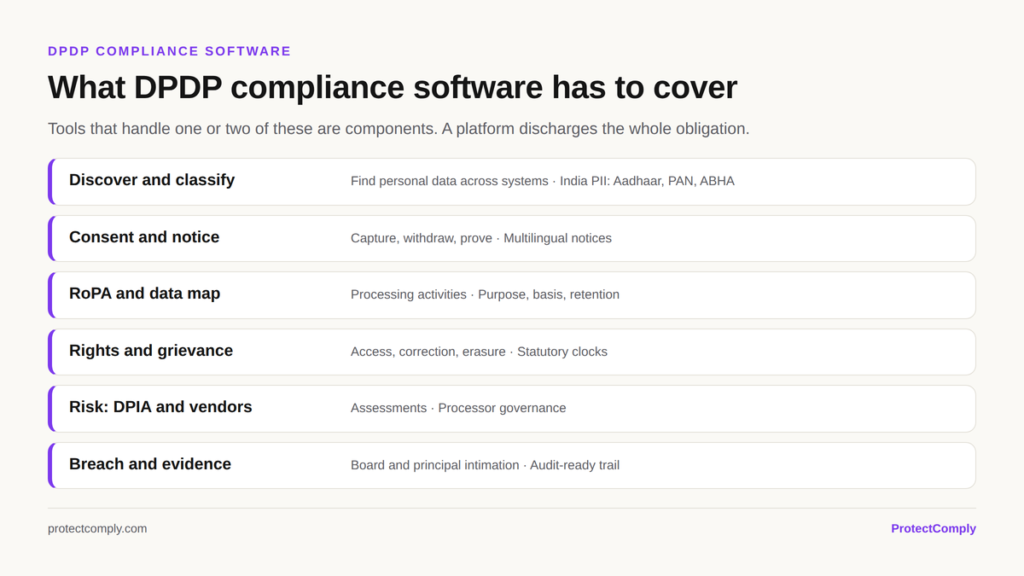
DPDP compliance software is the system of record for your obligations under India’s Digital Personal Data Protection Act, 2023. It holds what personal data you process, why you process it, who consented, who asked for it back, and what you did about each of those. Above all, it produces proof on demand.
That last point decides most purchases. The Act expects a data fiduciary to demonstrate compliance, not merely assert it. So the question is not whether your policies read well. The question is whether you can show, with timestamps, that you did what the policies say.
This guide covers what the software must do, which parts of DPDP compliance automation are real and which are marketing, how to compare vendors honestly, what it costs, and how to roll it out without stalling.
What is DPDP compliance software?
DPDP compliance software is a platform that automates and records the operational duties created by the DPDP Act and the Digital Personal Data Protection Rules, 2025. In practice it does four jobs.
- It finds and classifies the personal data you hold.
- It records lawful basis, notices and consent against each purpose.
- It runs the workflows the Act creates, from rights requests to breach notification.
- It writes evidence as all of that happens.
Some vendors call this a privacy platform, others a consent or governance suite. The label matters less than the coverage. A tool that only handles cookie banners does not qualify.
Why spreadsheets stop working
Almost every programme starts in a spreadsheet, and for a small estate that is reasonable. Problems appear when the business changes faster than the file does.
A marketing team adds a form. Engineering connects a warehouse. A vendor changes sub-processors. Nobody updates the register, because updating it belongs to nobody. Within a quarter the record no longer matches reality.
Then a request arrives, or an incident does, and the gap becomes visible at the worst moment. Our note on manual programmes versus a platform sets out the trade-off in full.
The capabilities that actually matter
Ignore feature lists with sixty rows. A good platform covers four groups well. Weakness in any one group creates manual work somewhere else.
Know what you hold
Data discovery scans your connected systems. Classification labels what it finds, including India-specific identifiers such as Aadhaar, PAN and ABHA numbers. Data mapping then shows how those fields move between systems.
This group is foundational, because every later record depends on it. See our guide to data discovery for DPDP compliance.
Prove lawful basis
Here the platform records purpose-level consent, keeps immutable history, and propagates withdrawal to every downstream system. It also manages notices and versioning, and it assembles your Records of Processing Activities from discovery output rather than from memory.
Compare options in our reviews of consent management platforms and RoPA platforms in India.
Manage risk
Risk scoring should trigger a Data Protection Impact Assessment automatically rather than waiting for someone to remember. Gap assessment shows where the programme falls short today. Vendor and processor risk tracking closes the third-party side, which is where many incidents actually begin.
For the third-party layer specifically, see our comparison of TPRM platforms in India.
Run the programme
Finally, the platform needs working machinery: a rights-request queue with deadline tracking, retention and erasure schedules, breach timelines, task ownership, dashboards and an audit-ready export.
The export deserves particular attention. Ask to see one before you buy, because that file is what an auditor or the Board will actually read.
What DPDP compliance automation actually automates
“Automated DPDP compliance” is the most stretched phrase in this market. Some of the work genuinely runs without people. Some of it only runs faster with a good tool. Knowing which is which is the quickest way to see through a demo.
What software can genuinely automate:
- Finding personal data. Scheduled scans of databases, file stores, SaaS systems and mailboxes, with classification of what they find.
- Consent records. Every grant, change and withdrawal logged against its purpose and notice version, without anyone keying it in.
- Deadline clocks. The 72-hour detailed breach report and rights-request response periods start counting the moment the event is logged.
- Routing. Rights requests assigned by type and business unit, and a task opened for each vendor that has to act.
- Triggers. A DPIA raised when a processing activity crosses a risk threshold, and consent expiry or re-consent flagged on schedule.
- First drafts. Breach notices for different audiences, policies and regulator responses, drafted for a person to review.
- Evidence. Audit trails written as work happens, so an export is a download rather than a project.
What still needs people: deciding purposes, judging whether a legitimate use applies, answering a grievance, negotiating processor contracts and signing off a DPIA. A vendor that says it automates those is describing a form, not a decision.
One test separates the two quickly. Ask the vendor what happens overnight with nobody logged in. Anything that only happens when someone clicks “run” is a workflow, not automation. It is still useful, but budget the people to run it.
What the software will not do
Be wary of any vendor implying the tool makes you compliant. Four things stay with your organisation.
- Purpose decisions. Why you process data is a business judgement.
- Grievance outcomes. Redressal needs a person who can weigh context.
- Contract terms. Processing agreements are negotiated, not generated.
- Accountability. The fiduciary and the Data Protection Officer carry the duty.
In other words, software removes manual effort. It does not transfer responsibility.
How to evaluate DPDP compliance software
Use these eight criteria, and ask for a live demonstration of each rather than a slide.
- Coverage. Does it span all four capability groups, or only consent?
- Connectors. Which of your systems work today, without custom engineering?
- India fit. Native detection of local identifiers, and Indian data residency.
- Automation depth. Does the RoPA update itself when a system changes?
- Evidence quality. Is the audit trail tamper-evident, and can you export it?
- Roles. Can DPO, steward and reviewer duties be separated properly?
- Usability. Will a business owner update a record without training?
- Exit. What happens to your records if you leave at renewal?
Must-have versus nice-to-have
| Capability | Priority | Why |
|---|---|---|
| Discovery and classification | Must-have | Every other record depends on it |
| Purpose-level consent | Must-have | Blanket flags fail on withdrawal |
| Automated RoPA | Must-have | Manual records go stale in weeks |
| Rights request workflow | Must-have | Deadlines are enforceable |
| Evidence export | Must-have | Proof is the whole point |
| Breach timeline tracking | Must-have | The clock starts without you |
| Vendor risk module | Nice-to-have | Valuable, but can follow later |
| Multi-framework mapping | Nice-to-have | Useful only if you also face GDPR |
What DPDP compliance software costs in India
Pricing usually tracks data volume, connector count and seats rather than company headcount. Consequently two firms of the same size can receive very different quotes.
Watch for implementation fees, connector charges billed separately, and per-request pricing on rights workflows. Our DPDP software pricing guide and total cost guide break down the ranges and the common surprises.
A 30-day rollout that works
Programmes stall when teams switch everything on at once. So sequence the work.
- Week 1 – Discovery. Connect your largest stores and see what you hold.
- Week 2 – RoPA. Convert discovery output into processing records with named owners.
- Week 3 – Consent and notices. Wire capture into live forms, publish the notice set.
- Week 4 – Rights and breach. Open the request queue, then rehearse an incident end to end.
Start from a gap view. The DPDP compliance checklist shows what is missing before you scope anything.
How ProtectComply compares
ProtectComply covers all four capability groups on one spine. Discovery feeds the RoPA, the RoPA feeds DPIA scoring, and consent, retention and vendor records share the same underlying model. So a change in one place updates the rest instead of creating a reconciliation job.
RoPA and consent changes are written to hash-chained, tamper-evident ledgers, and rights requests, breaches and DPIAs keep their own audit trails, so most of an audit export already exists when you need it. The platform is hosted in India. How long a first defensible position takes depends mostly on how many systems need connecting.
If you are running a formal shortlist, our review of the best DPDP platforms in India scores the main options side by side, and the section on DPDP compliance automation explains what genuinely automates.
Signs you have outgrown manual compliance
Timing matters as much as selection. Most teams wait too long, then buy under pressure. These signals usually mean the manual approach has already broken.
- Nobody can say, within a day, which systems hold personal data.
- Your consent register and your live forms disagree.
- A rights request would be answered from a shared inbox with no clock running.
- Your RoPA was last updated more than a quarter ago.
- Vendor due diligence lives in email attachments.
- You could not produce a year of consent history without a manual project.
Three or more of those, and the cost of staying manual has already overtaken the licence fee.
Sector notes
Obligations are the same across sectors, yet the pressure points differ. Consequently, the capability you should test hardest changes with your business model.
BFSI and fintech
High consent volume, heavy vendor chains and strict audit expectations. Test consent history depth and vendor risk first. See our note on DPDP compliance for BFSI.
Healthcare
Sensitive categories, ABHA identifiers and long retention periods. Test classification accuracy and retention handling. More in DPDP compliance for hospitals.
SaaS and technology
Fast-changing systems and a processor role alongside the fiduciary one. Test how quickly the RoPA reflects a new service. More in DPDP compliance for SaaS.
Build or buy?
Engineering teams often ask whether they can build this internally. Technically, yes. The parts that hurt are the ones nobody scopes at the start.
- Connector maintenance. Every integration breaks eventually, and each break is a compliance gap.
- Evidence integrity. A log your own engineers can edit is weaker proof than a tamper-evident ledger.
- Regulatory drift. Rules change, and someone has to track and implement each change.
- Opportunity cost. The build competes with your actual product roadmap, permanently.
Buying makes sense when compliance is a cost centre. Building makes sense only when privacy tooling is itself part of what you sell.
Five mistakes buyers make
- Buying before discovery. You cannot scope a platform without knowing what data you hold, so run discovery first.
- Confusing cookie consent with DPDP consent. A banner covers a narrow slice of the Act.
- Automating collection but not withdrawal. Collection is the easy half; propagation is the hard one.
- Buying a dashboard. A score that nobody can trace back to evidence helps nobody in an audit.
- Skipping the export test. Ask for a real audit export during evaluation, not after signature.
Frequently asked questions
What can DPDP compliance automation handle on its own?
Data discovery scans, consent and withdrawal records, deadline clocks for breaches and rights requests, routing of requests and vendor tasks, risk-based DPIA triggers, first drafts of notices, and audit trails. Purpose decisions, grievance outcomes, contracts and DPIA sign-off still need people.
Is compliance software mandatory under the DPDP Act?
No. The Act creates obligations, not a tool requirement. However, demonstrating compliance by hand becomes unreliable quickly, so most organisations adopt software for the record-keeping.
How is a compliance platform different from a consent manager?
A consent manager handles one obligation. A compliance platform covers discovery, records, risk, rights, retention and evidence as well.
How long does implementation take?
A focused rollout takes roughly four weeks. Estates with many custom or legacy systems take longer, mainly because of connector work.
Can small companies use it?
Yes. The Act does not create a lighter tier for small companies, although the government can exempt notified classes, such as certain startups, from some provisions. Only Significant Data Fiduciaries carry extra duties. A small company usually needs fewer connectors and users, not fewer controls.
Does it cover GDPR too?
Some platforms map overlapping requirements across frameworks. Check whether that mapping is genuine or simply a relabelled report.
The short version
Choose on evidence, not on feature counts. It must know what data you hold, prove lawful basis, surface risk, run the daily workflows, and hand you an export you would be comfortable showing a regulator. Everything else is packaging.
See it working: explore the ProtectComply platform or start with a free readiness assessment.