What Is a Consent Manager Under the DPDP Act? What Businesses Need to Know
What Is a Consent Manager Under the DPDP Act? Everything Businesses Need to Know
India’s Digital Personal Data Protection (DPDP) framework places consent at the center of responsible data processing.

For years, businesses collected customer information through website forms, applications, registrations, and onboarding processes without maintaining proper visibility into how consent was managed.
As privacy expectations continue to evolve, organizations are expected to provide greater transparency, accountability, and control over personal data.
This is where the concept of a Consent Manager becomes important.
A Consent Manager helps individuals manage, review, and control the permissions they grant regarding their personal data.
For businesses, understanding this concept is becoming increasingly important as organizations build privacy-ready operations.
Why Consent Is Important Under DPDP
Every day, businesses collect personal information such as:
- Customer details
- Employee information
- Website inquiries
- Marketing subscriptions
- Mobile application registrations
- Service requests
However, collecting data is only one part of compliance.
Organizations must also maintain visibility into:
- When consent was provided
- What permissions were granted
- How consent is being used
- Whether consent has been withdrawn
Without effective consent management, compliance becomes difficult to demonstrate.
What Is a Consent Manager?
A Consent Manager is an entity that enables individuals to manage their consent preferences in a transparent, accessible, and accountable manner.
In simple terms, a Consent Manager helps individuals:
- View their consent preferences
- Grant consent
- Modify consent
- Withdraw consent
- Monitor how permissions are being managed
The objective is to provide individuals with greater control over their personal data.
This aligns with the broader goals of modern privacy and data protection frameworks.
Why Businesses Should Understand Consent Managers
Many organizations assume consent management only affects customers.
In reality, consent management impacts nearly every aspect of privacy compliance.
Businesses often need visibility into:
- Customer consent
- Marketing consent
- Employee consent
- Vendor-related permissions
- Data-sharing approvals
Organizations that cannot demonstrate proper consent governance may struggle with compliance readiness.
How a Consent Manager Supports Data Principals
Data Principals are individuals whose personal data is being processed.
A Consent Manager helps Data Principals by providing:
Transparency
Individuals can understand what permissions they have granted.
Control
Consent can be updated when preferences change.
Accessibility
Consent-related actions become easier to manage.
Accountability
Organizations become more transparent about data usage.
These capabilities help strengthen trust between businesses and individuals.
Common Consent Management Challenges Businesses Face
Many organizations face significant challenges when managing consent.
Scattered Consent Records
Consent data often exists across:
- CRM systems
- Marketing platforms
- Customer databases
- Mobile applications
- Internal tools
This creates visibility problems.
No Centralized Tracking
Organizations struggle to determine:
- Which users provided consent
- What permissions were granted
- Whether consent remains valid
Manual Processes
Many businesses still rely on:
- Emails
- Spreadsheets
- Shared documents
Manual processes become difficult to manage as organizations grow.
Poor Audit Readiness
When compliance reviews occur, evidence can be difficult to locate.
Why Consent Management Is Becoming a Business Priority
Organizations increasingly recognize that privacy is not only a legal requirement.
It is also a trust-building mechanism.
Effective consent management helps businesses:
- Improve transparency
- Reduce compliance risks
- Strengthen governance
- Improve customer confidence
- Enhance operational efficiency
Businesses that establish strong consent practices today will be better prepared for future compliance expectations.
Consent Manager vs Consent Management Platform
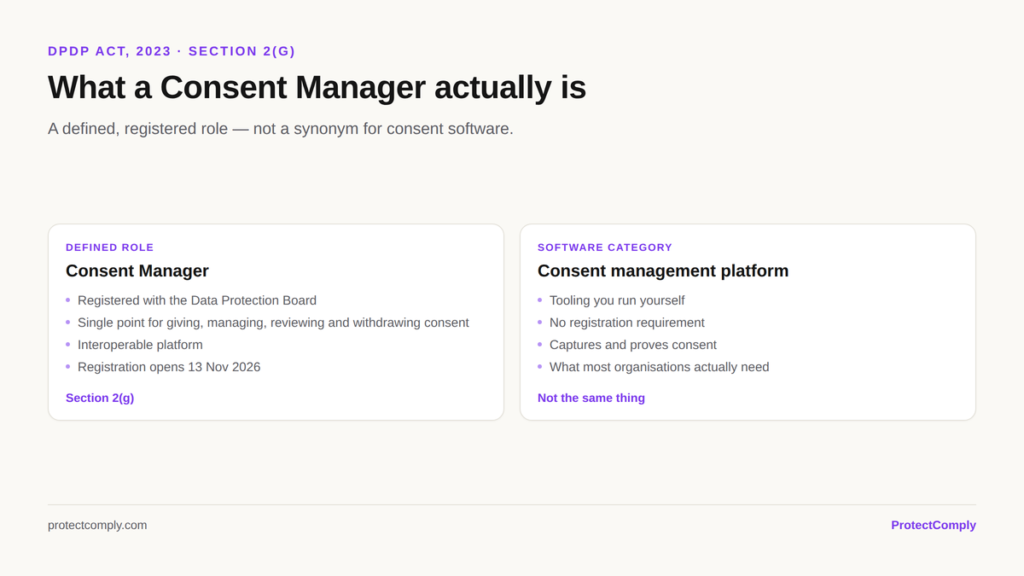
These two terms are confused more often than any others in the DPDP Act, and the difference is legal, not cosmetic.
A Consent Manager is a registered intermediary. It is a company that gives individuals one place to give, review and withdraw consent across many unrelated organisations, and it is accountable to them and to the Data Protection Board. Rule 4 of the DPDP Rules 2025 sets the conditions, including incorporation in India and a minimum net worth of ₹2 crore, and registration opens in November 2026.
A consent management platform is software your organisation runs for its own processing: capturing consent per purpose, keeping the record, and honouring withdrawal across your systems. It needs no registration.
If you are a bank, hospital, retailer or SaaS company managing your own customers’ consent, you need the second, and you will probably never need the first. Our guide to DPDP consent management sets out what that platform has to do.
What Should Businesses Monitor?
Organizations should regularly review:
Consent Collection Processes
How consent is obtained.
Consent Storage
Where consent records are maintained.
Consent History
Whether changes are documented.
Consent Withdrawals
How withdrawal requests are processed.
Governance Controls
Who is responsible for managing consent activities.
Compliance Evidence
Whether records can be produced during audits.
The Risks of Poor Consent Management
Organizations that fail to manage consent effectively may face:
Compliance Gaps
Lack of visibility creates compliance challenges.
Operational Inefficiencies
Teams spend significant time locating records.
Reduced Trust
Customers increasingly expect transparency.
Governance Issues
Accountability becomes difficult when records are fragmented.
Strong consent governance helps reduce these risks.
How ProtectComply Helps Businesses Manage Consent
ProtectComply helps organizations simplify consent governance and DPDP compliance through a centralized platform.
The platform enables businesses to:
Conduct DPDP Gap Assessments
Identify weaknesses in consent and governance processes.
Improve Consent Visibility
Track consent-related activities more effectively.
Strengthen Compliance Monitoring
Monitor compliance workflows continuously.
Maintain Audit Readiness
Store and organize compliance evidence.
Improve Governance
Create accountability across teams and business units.
Centralize Compliance Operations
Reduce dependence on spreadsheets and disconnected systems.
By simplifying compliance management, ProtectComply helps organizations improve readiness and reduce operational complexity.
Building a Consent-First Compliance Strategy
Organizations should not treat consent as a one-time checkbox.
Instead, consent should be managed throughout the entire data lifecycle.
A strong strategy includes:
- Consent governance
- Visibility into consent records
- Withdrawal management
- Compliance monitoring
- Audit readiness
Businesses that adopt a consent-first approach are better positioned to meet privacy expectations.
Why Consent Management Will Define Future Compliance Programs
Modern privacy frameworks increasingly focus on individual control and transparency.
As a result, consent management will continue to become a central part of compliance programs.
Organizations that invest in governance today can:
- Improve trust
- Strengthen accountability
- Reduce risk exposure
- Improve operational efficiency
- Build long-term compliance maturity
Conclusion
A Consent Manager plays an important role in helping individuals control how their personal data is used.
For businesses, understanding consent management is essential for building strong governance and compliance programs.
Organizations that maintain visibility into consent records, withdrawal requests, and compliance workflows are better prepared for evolving privacy requirements.
ProtectComply helps businesses simplify consent governance through DPDP assessments, compliance monitoring, audit readiness, and centralized compliance management.
For organizations preparing for DPDP compliance, consent management should be a strategic priority rather than an afterthought.
Frequently Asked Questions
What is a Consent Manager under the DPDP Act?
A Consent Manager is an entity that helps individuals manage, review, grant, modify, and withdraw consent related to their personal data.
Why is a Consent Manager important?
It improves transparency, accountability, and user control over personal data processing activities.
What is the difference between a Consent Manager and a Consent Management Platform?
A Consent Manager supports individual consent control, while a Consent Management Platform helps businesses manage consent governance and compliance operations.
Why do businesses need consent management?
Consent management helps organizations improve compliance readiness, strengthen governance, and maintain customer trust.
How does ProtectComply help with consent management?
ProtectComply helps businesses assess compliance gaps, monitor consent-related workflows, maintain audit readiness, and improve governance visibility.
If you are choosing a tool to manage consent, compare the options in our review of DPDP compliance platforms in India, or read what to look for in DPDP compliance software.