ProtectComply vs Manual DPDP Compliance: Spreadsheets, Consultants, or a Platform?
ProtectComply vs Manual DPDP Compliance: Spreadsheets, Consultants, or a Platform?
Every Indian business facing the DPDP Act asks the same first question.

Can we do this ourselves?
The honest answer: you can start manually. Many companies do. The problem is not starting — it is sustaining.
This post compares the three ways Indian businesses actually run DPDP compliance: spreadsheets, consultants, and a purpose-built platform like ProtectComply.
Option 1: Spreadsheets and Shared Drives
The manual approach usually looks like this:
- A consent log in one spreadsheet
- A rights-request tracker in another
- Policies in a shared drive
- Evidence in email threads
It works on day one.
It breaks the first time three things happen in the same week: a withdrawal of consent that has to propagate, an erasure request with a deadline, and an auditor asking who approved what.
The Act does not just require compliance — it requires you to demonstrate it. Spreadsheets record intentions. They do not produce evidence.
Our DPDP compliance checklist shows the full scope of what has to stay current — it is longer than most teams expect.
Option 2: Consultants Alone
A good consultant gives you something valuable: a gap assessment, policies, and a roadmap.
What a consultant cannot give you is operations.
DPDP compliance is not a project that ends. Consent is collected daily. Rights requests arrive weekly. Policies drift as processing changes. The engagement ends; the obligations do not.
Consultants and platforms are not rivals — the strongest setups use a consultant for judgement and a platform for the running machinery.
Option 3: A DPDP-First Platform
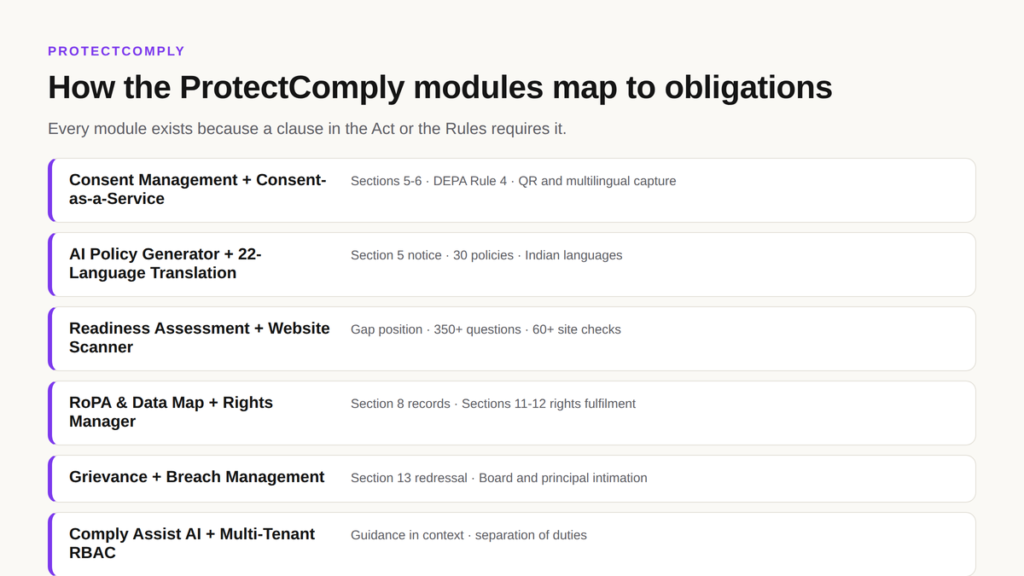
ProtectComply operationalises the Act as software:
- Consent management with purpose granularity and withdrawal — see DPDP consent management
- Data principal rights and grievance workflows with deadlines built in
- Records of Processing Activities — see our RoPA guide
- AI-assisted policy generation that keeps documents aligned with reality
- Breach lifecycle management
- Data discovery across the systems where personal data actually lives
Every workflow produces its own audit trail. Evidence is a by-product of doing the work, not a quarterly scramble.
The Real Comparison
The choice is not really spreadsheets vs software.
It is between compliance as a recurring emergency and compliance as a system.
Manual approaches concentrate risk in a few overworked people. A platform distributes the work into workflows that keep running when those people are on leave, or gone.
For what non-compliance actually costs, see DPDP Act penalties explained. For what the software side costs, see DPDP compliance cost in India.
Where to Start
If you are still mapping your gaps, begin with a free DPDP readiness assessment.
If you are comparing vendors, our guides on how to choose a DPDP compliance platform and the best DPDP platforms in India will save you a week of research.
And if you want to see the platform route in action, here is how ProtectComply works — most teams are DPDP-ready in about 30 days.