DPDP Act Penalties Explained for Businesses in India
DPDP Act Penalties Explained for Businesses in India
Most businesses today depend heavily on customer data.

From online forms and payment systems to CRM platforms and employee databases, organizations are constantly collecting, storing, and processing personal information.
However, many companies still underestimate the operational and compliance risks associated with poor data handling practices.
As India’s Digital Personal Data Protection (DPDP) Act gains attention across industries, businesses are realizing that data privacy is no longer only an IT concern. It is becoming a major operational responsibility.
Organizations that fail to improve data governance, consent management, and compliance visibility may face serious business challenges in the future.
This is why businesses across India are increasingly investing in compliance systems and platforms like ProtectComply to strengthen operational readiness and improve data governance practices.
What Is the DPDP Act?
The Digital Personal Data Protection (DPDP) Act is India’s data privacy regulation focused on responsible handling of personal data.
The regulation encourages businesses to:
- collect data transparently,
- manage customer consent responsibly,
- secure sensitive information,
- improve accountability,
- and maintain better operational visibility into data processing activities.
The law applies to businesses handling personal data digitally across multiple industries.
This includes:
- SaaS companies,
- startups,
- healthcare organizations,
- e-commerce businesses,
- IT service providers,
- fintech companies,
- and enterprises managing customer information.
Why Businesses Are Concerned About DPDP Compliance
Many companies still rely on:
- spreadsheets,
- manual documentation,
- shared drives,
- disconnected systems,
- and weak access controls
to manage sensitive customer data.
This creates operational risks because organizations often lack clear visibility into:
- who can access customer information,
- how data is being stored,
- whether consent is properly tracked,
- and how compliance records are maintained.
As businesses scale, managing these processes manually becomes increasingly difficult.
Understanding Data Protection Risks
Poor data governance can create multiple operational problems for businesses.
Weak Consent Tracking
Many organizations still do not have proper systems for tracking:
- customer permissions,
- consent history,
- or data usage approvals.
This creates compliance gaps and operational confusion.
Unauthorized Access Risks
When access permissions are not monitored properly, sensitive customer data may become available to unnecessary users.
This increases the risk of:
- internal misuse,
- accidental exposure,
- and operational security concerns.
Missing Audit Visibility
Without centralized compliance systems, organizations often struggle to:
- maintain records,
- organize evidence,
- and track compliance activities efficiently.
This can create operational challenges during audits or compliance reviews.
Why DPDP Compliance Is Becoming Important for Businesses
Customer expectations around privacy are increasing rapidly.
People now expect businesses to:
- protect their information,
- maintain transparency,
- and handle personal data responsibly.
At the same time, companies are managing larger amounts of digital information than ever before.
This makes structured compliance management increasingly important.
Organizations that improve compliance readiness early may benefit from:
- stronger customer trust,
- better operational control,
- improved audit preparedness,
- and stronger data governance practices.
How Businesses Can Improve DPDP Compliance Readiness
Modern compliance requires more than policies and documents.
Businesses now need:
- centralized monitoring,
- operational visibility,
- access management,
- consent tracking,
- and structured compliance workflows.
Some important steps include:
1. Improve Consent Management
Organizations should maintain proper visibility into:
- customer permissions,
- consent updates,
- and data collection approvals.
This helps improve transparency and accountability.
ProtectComply helps businesses organize consent management workflows more efficiently.
2. Centralize Compliance Operations
Managing compliance across disconnected systems often creates confusion and inefficiency.
Businesses should centralize:
- compliance records,
- audit documentation,
- security visibility,
- and operational monitoring.
ProtectComply helps organizations manage compliance workflows from a centralized platform.
3. Strengthen Access Controls
Sensitive information should only be accessible to authorized individuals.
Organizations should:
- monitor permissions,
- review access regularly,
- and improve internal visibility into data access activity.
This helps reduce operational risks.
4. Maintain Audit-Ready Documentation
Businesses should organize:
- compliance evidence,
- security policies,
- consent logs,
- and operational records
in a structured and accessible environment.
This improves audit readiness and operational efficiency.
5. Continuously Monitor Compliance
Compliance should not be treated as a one-time task.
Organizations should continuously review:
- security practices,
- consent workflows,
- compliance activities,
- and operational visibility.
This helps businesses identify risks earlier and improve long-term compliance readiness.
Why Businesses Are Moving Toward Compliance Automation
Manual compliance management becomes difficult as organizations grow.
Businesses are increasingly adopting compliance automation to:
- reduce operational complexity,
- improve monitoring visibility,
- streamline workflows,
- and maintain structured compliance records.
ProtectComply helps organizations simplify compliance operations while improving data governance and audit preparedness.
How ProtectComply Helps Businesses
ProtectComply is designed to help businesses:
- manage DPDP compliance workflows,
- improve consent management,
- centralize audit documentation,
- strengthen operational visibility,
- and improve compliance readiness.
Instead of relying on scattered manual systems, organizations can improve efficiency through structured compliance management.
Why Data Privacy Is Becoming a Business Priority
Data privacy is no longer only a legal or technical discussion.
It is becoming a major trust factor for businesses across industries.
Organizations that prioritize:
- transparency,
- security,
- consent management,
- and operational accountability
may build stronger customer confidence over time.
The Future of Compliance in India
India’s data privacy ecosystem will continue evolving rapidly.
Businesses that improve:
- compliance infrastructure,
- operational visibility,
- consent management,
- and data governance
today may be better prepared for future regulatory expectations and customer trust requirements.
ProtectComply helps organizations prepare for this evolving compliance landscape through centralized compliance and data governance solutions.
Frequently Asked Questions
What is the DPDP Act?
The Digital Personal Data Protection (DPDP) Act is India’s data privacy regulation focused on responsible handling of personal data.
Why is DPDP compliance important?
DPDP compliance helps businesses improve data governance, operational transparency, customer trust, and compliance readiness.
What are common data protection risks for businesses?
Common risks include weak consent tracking, unauthorized access, scattered data storage, and poor compliance visibility.
What is ProtectComply?
ProtectComply is a compliance and data governance platform that helps businesses manage DPDP compliance workflows, consent management, audit readiness, and operational visibility.
Who should use ProtectComply?
Startups, SaaS companies, healthcare organizations, enterprises, IT companies, and businesses handling customer data can use ProtectComply.
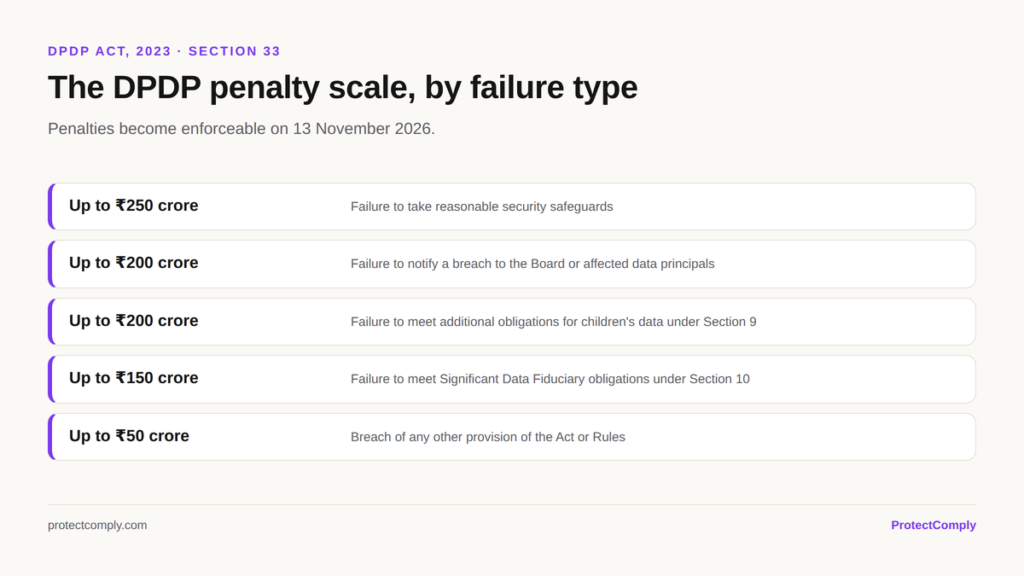
For what triggers these penalties, see the DPDP Act 2023 and the data principal rights most often cited in complaints.