DPDP Compliance for Startups in India | Founder’s Guide | ProtectComply
DPDP Compliance for Startups: A Practical Guide for Founders
Many startup founders believe data privacy compliance is something they can worry about later.

The focus is usually on:
- Building products
- Acquiring customers
- Raising funding
- Growing revenue
- Expanding operations
While these priorities are important, many startups overlook a critical reality.
If your business collects personal data, DPDP compliance should already be part of your growth strategy.
Whether you operate a SaaS platform, e-commerce business, fintech solution, healthcare application, HR technology platform, or mobile app, personal data is likely flowing through your systems every day.
The question is not whether your startup handles personal data.
The question is whether your startup is prepared to manage it responsibly.
Why DPDP Compliance Matters for Startups
Many founders assume privacy compliance only applies to large enterprises.
This assumption creates risk.
Startups routinely collect:
- Customer information
- Employee records
- Website inquiries
- Marketing leads
- Mobile application data
- Payment information
- Support interactions
Every piece of personal information introduces responsibilities.
As startups grow, the amount of personal data increases significantly.
Without proper governance, organizations often lose visibility into:
- What data exists
- Where it is stored
- Who can access it
- Why it is processed
The longer these issues remain unresolved, the more difficult compliance becomes.
The Hidden Risk Most Startups Ignore
Many startups focus heavily on product development but fail to establish privacy processes.
Common problems include:
Scattered Customer Data
Customer information exists across:
- CRM systems
- Marketing platforms
- Spreadsheets
- Internal databases
- Third-party applications
This creates visibility challenges.
No Consent Tracking
Organizations collect information but cannot demonstrate:
- When consent was collected
- What permissions were granted
- Whether consent has changed
Poor consent management increases compliance risk.
Limited Governance
Many startups lack defined ownership for privacy and compliance activities.
As teams grow, accountability becomes unclear.
Vendor Risks
Most startups depend on multiple third-party platforms.
These vendors often process sensitive personal data.
Without oversight, organizations may introduce unnecessary compliance challenges.
Does Your Startup Need DPDP Compliance?
If your startup collects or processes personal data, the answer is yes.
Examples include:
SaaS Startups
User registrations, subscriptions, support tickets, and analytics.
E-commerce Businesses
Customer orders, contact information, shipping details, and payment-related data.
Healthcare Startups
Patient records and appointment information.
Fintech Companies
Customer onboarding and financial information.
HR Technology Platforms
Employee and candidate information.
Mobile Applications
User profiles, activity tracking, and behavioral information.
If personal data is involved, compliance readiness should be a business priority.
DPDP Compliance Checklist for Startups
1. Understand What Data You Collect
Start by identifying:
- Customer data
- Employee data
- Vendor information
- Marketing data
- Operational records
Many startups discover they collect far more data than expected.
A complete inventory is the foundation of compliance.
2. Create a Data Inventory
Document:
- Data type
- Collection source
- Storage location
- Processing purpose
- Access permissions
- Retention period
Without visibility, compliance becomes difficult.
3. Review Consent Management
Consent is one of the most important components of privacy compliance.
Ask:
- How is consent collected?
- Where is consent stored?
- Can consent be verified?
- Can consent be withdrawn easily?
Organizations that cannot answer these questions may face compliance challenges.
4. Review Access Controls
Not every employee should have access to personal data.
Implement:
- Role-based access
- Access approval workflows
- Periodic access reviews
Limiting unnecessary access reduces risk.
5. Evaluate Security Controls
Startups should review:
- Password policies
- Multi-factor authentication
- Encryption practices
- Backup procedures
- Endpoint protection
Security supports both compliance and customer trust.
6. Assess Third-Party Vendors
Many startups depend on:
- Cloud providers
- CRM platforms
- Payment gateways
- Analytics tools
- Marketing platforms
Evaluate:
- What data vendors access
- How they protect it
- Whether privacy obligations are documented
Third-party risks are often overlooked.
7. Establish Data Retention Policies
Organizations should define:
- What data is retained
- Why it is retained
- How long it is retained
- When it is deleted
Retaining unnecessary data increases compliance exposure.
8. Prepare for Data Principal Requests
Individuals may request:
- Access to personal data
- Corrections
- Consent withdrawal
- Grievance resolution
Startups should establish processes before requests begin arriving.
Why Startups Should Not Delay Compliance
Many founders postpone compliance until:
- A customer raises concerns
- A vendor requests evidence
- An enterprise client asks compliance questions
- Investors conduct due diligence
At that stage, fixing governance gaps becomes more expensive.
Organizations that build compliance early gain a significant advantage.
DPDP Compliance and Investor Readiness
Investors increasingly evaluate operational maturity.
Strong privacy governance demonstrates:
- Risk awareness
- Operational discipline
- Scalable processes
- Long-term sustainability
Compliance readiness can strengthen investor confidence.
DPDP Compliance and Enterprise Sales
Enterprise customers often evaluate vendors before signing contracts.
Common questions include:
- How is personal data managed?
- How is consent tracked?
- What security controls exist?
- How are compliance risks monitored?
Startups that can answer these questions confidently often move through procurement processes faster.
Common Compliance Mistakes Startups Make
Treating Compliance as a Future Problem
Privacy should be integrated early.
Relying on Spreadsheets
Manual tracking creates visibility challenges.
Ignoring Consent Management
Consent evidence is essential for compliance readiness.
Giving Excessive Access
Unnecessary permissions increase risk exposure.
Delaying Assessments
Organizations often wait until problems emerge before evaluating compliance maturity.
How ProtectComply Helps Startups Achieve DPDP Compliance
ProtectComply provides a centralized platform designed to simplify compliance management.
The platform helps startups:
Conduct DPDP Gap Assessments
Identify governance and compliance weaknesses.
Improve Consent Management
Maintain visibility into consent records and workflows.
Monitor Compliance Activities
Track compliance readiness continuously.
Strengthen Governance
Create accountability across teams and systems.
Improve Audit Readiness
Maintain evidence and documentation in a centralized location.
Scale Compliance Efficiently
Support growth without relying on manual processes.
By simplifying compliance operations, ProtectComply helps startups focus on growth while improving privacy readiness.
Why DPDP Compliance Is a Competitive Advantage
Many organizations view compliance as a cost.
Forward-thinking startups see it differently.
Strong compliance helps businesses:
- Build customer trust
- Improve operational maturity
- Reduce risk exposure
- Accelerate enterprise sales
- Strengthen investor confidence
- Improve governance visibility
Organizations that invest early often gain long-term advantages.
Conclusion
DPDP compliance is no longer a concern only for large enterprises.
Startups that collect personal data must prepare for stronger privacy expectations and evolving compliance requirements.
The earlier compliance becomes part of your operational strategy, the easier it becomes to manage growth responsibly.
ProtectComply helps startups assess readiness, identify compliance gaps, improve governance, and build a scalable privacy program.
For founders building the next generation of businesses, compliance should not be an afterthought.
It should be a growth enabler.
Frequently Asked Questions
Do startups need to comply with DPDP requirements?
Yes. Any startup that collects or processes personal data should prepare for DPDP compliance obligations.
Why is DPDP compliance important for startups?
Compliance helps reduce risk, improve governance, build customer trust, and support long-term business growth.
What is the biggest DPDP challenge for startups?
Most startups struggle with data visibility, consent management, governance ownership, and compliance documentation.
How can startups prepare for DPDP compliance?
Startups should create data inventories, improve consent management, review security controls, assess vendors, and establish governance processes.
How does ProtectComply help startups?
ProtectComply helps startups conduct DPDP gap assessments, manage consent, monitor compliance activities, improve governance visibility, and maintain audit readiness.
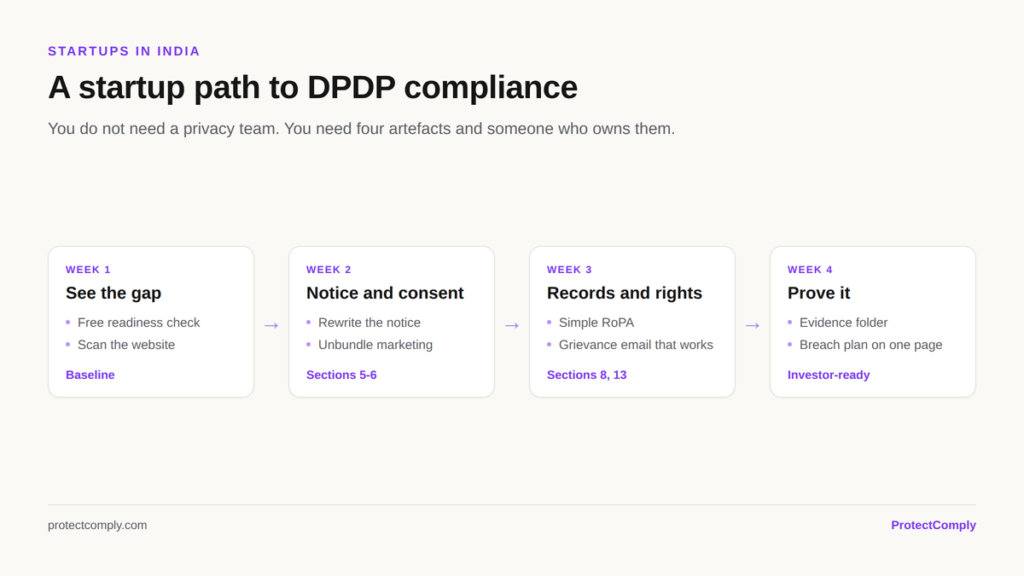
Smaller teams usually want the shortest viable route — see step-by-step DPDP compliance for the sequence, and DPDP compliance software for what to automate first.