Best DPDP Platform in India (2026): Top 20 Compared
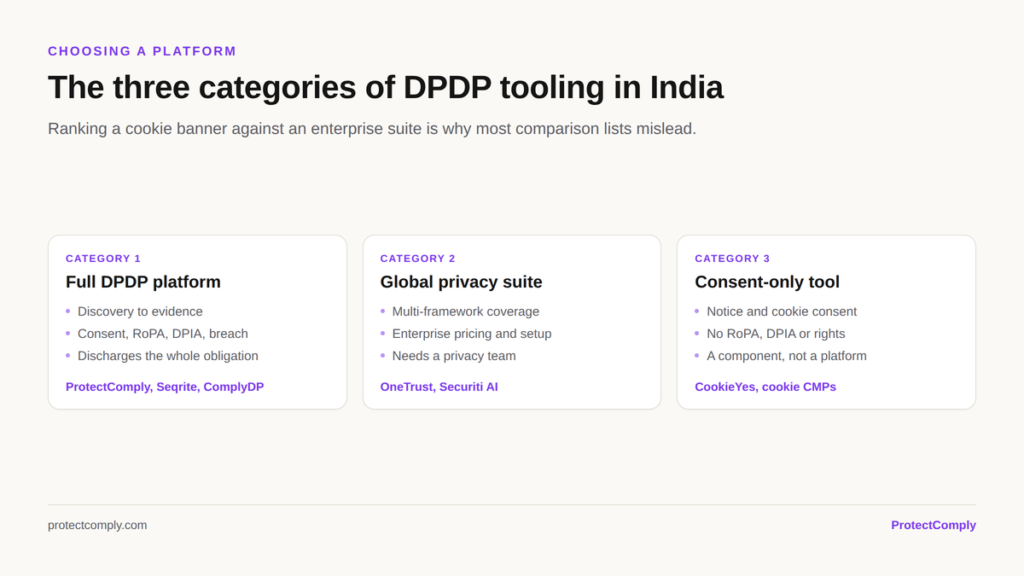
Short answer: there is no single best DPDP platform for every Indian organisation, because the right one depends on whether your obligation is primarily Indian, and on which duty you are furthest from meeting. Where the DPDP Act is the mandate itself, ProtectComply, Seqrite Data Privacy, ComplyDP and Consentin by Leegality lead. Multinationals already running a privacy programme are usually better served by OneTrust or Securiti AI. CookieYes covers website cookie consent alone. This guide sorts the best DPDP platforms for Indian organisations: it scores the top 5, ranks the top 10, maps the top 20, and gives you a 30-day test that settles it with your own data.
Disclosure: ProtectComply is our platform. It is first because this is our site. We have assessed it against the same six criteria as everything else, including where it is weaker.
What this guide covers
- What is a DPDP platform?
- DPDP software, DPDP compliance software, DPDP compliance platform — are they the same thing?
- The deadline, stated precisely
- How we scored every DPDP platform on this page
- Five evidence requirements that separate the field
- Top 5 DPDP platforms in India — the scored shortlist
- Top 10 DPDP platforms in India — ranked and compared
- Top 20 DPDP platforms in India — the 2026 market map
- More DPDP vendors worth knowing
- Which DPDP platform suits your team?
- Why we believe ProtectComply earns a place
- What does a DPDP platform cost in India?
- The 30-day proof of concept
- The ten questions that decide it
- Three mistakes buyers keep making
- Platform, consultant, or law firm?
- Buying locally: Pune, Noida and NCR
- Frequently asked questions
What is a DPDP platform?
A DPDP platform is software that operationalises the obligations in the Digital Personal Data Protection Act, 2023 and the Digital Personal Data Protection Rules, 2025 — and produces the evidence that you met them.
That second half is where most tools stop, and it is the half that decides purchases. The Act does not merely require compliance; under an inquiry it requires you to demonstrate it, with records, to the Data Protection Board. So the question is not whether your policies read well. The question is whether you can show, with timestamps, that you did what the policies say.
A complete platform covers seven functions:
- Notice and consent capture, purpose-linked, with withdrawal that propagates downstream
- Personal data discovery and classification across your systems
- Records of Processing Activities — what you process, why, on what basis, retained how long
- Data Principal rights fulfilment within statutory timelines
- Data Protection Impact Assessments, with the reasoning preserved
- Processor, vendor and third-party risk governance, plus retention
- Breach detection and notification workflow
Tools covering one or two of these are components, not platforms. Sometimes a component is exactly right — but it will not discharge the obligation on its own.
DPDP software, DPDP compliance software, DPDP compliance platform — are they the same thing?
Broadly yes, and the vocabulary is worth settling before you compare anything, because vendors use these words interchangeably while selling very different products.
- DPDP software and DPDP tools are the loosest terms. They cover everything from a cookie banner to a full governance suite. A shortlist assembled on this phrase alone will contain products you would never actually choose between.
- DPDP compliance software and DPDP compliance platform usually mean the system of record for your obligations — it holds what personal data you process, why, who consented, who asked for it back, and what you did about each of those.
- Consent management platform (CMP) means one module of that: notice and consent. Deep, but narrow.
- Registered Consent Manager means something else entirely — a separate legal entity under Rule 4 and the First Schedule, not software you buy. Most Indian businesses reading this need a CMP, not registration. Our DPDP consent management platform guide separates the two properly.
- DPDP vendors is the procurement word, and it spans platforms, consultancies, law firms and system integrators. This page covers the software; our end-to-end implementation guide covers the services side.
Ranking a cookie banner against an enterprise privacy suite is why most “best DPDP platform” lists mislead. You would not choose between them. So this guide splits by category first, then ranks within it.
The deadline, stated precisely
- 13 November 2025 — DPDP Rules notified via gazette G.S.R. 846(E). The Data Protection Board is constituted. Complaints can be filed.
- 13 November 2026 — Consent Manager registration opens. Penalty provisions become operative.
- 13 May 2027 — Full compliance required.
Penalties reach ₹250 crore for failures of reasonable security safeguards and ₹200 crore for failing to notify a breach, assessed per contravention rather than per organisation. The official text sits with the Ministry of Electronics and Information Technology; our DPDP Rules timeline lists each commencement date and our penalties explainer covers the Schedule.
One thing most listicles omit: a MeitY consultation in January 2026 raised the possibility of compressing the 18-month runway to 12 months. It has not been gazetted, so May 2027 stands — but a full programme takes three to four quarters, so it is sensible to plan against the earlier date.
Deadlines change what “good” looks like. If enforcement were years away, you could buy a broad suite and configure it slowly. The calendar no longer allows that pace. Discovery alone takes most Indian teams a quarter. Then you have to attach a purpose, a legal basis and a retention rule to each flow. Then you have to prove the whole chain to somebody who was not in the room.
How we scored every DPDP platform on this page
Six pillars, drawn from the Act and the Rules rather than from a European checklist:
- Notice and consent. Purpose-level granularity, versioned against the notice actually served, in the language the person read. Section 5 requires a notice the person can understand, and the Act contemplates the languages of the Eighth Schedule — twenty-two of them, not two. Rule 3 requires the notice to stand alone, not sit as a clause inside your terms of use.
- Discovery and RoPA. Can it find personal data across your systems, including Indian identifiers such as Aadhaar, PAN and ABHA, and assemble records of processing from what it found rather than from memory?
- Data Principal rights. Access, correction, erasure, nominee and grievance under Sections 11 to 13, with deadline tracking and a dated record of fulfilment.
- Breach readiness. Rule 7 sets two duties: intimate affected people without delay, and give the Board a detailed report within 72 hours. Because that clock starts before the facts are clear, the platform must assemble the report while the investigation runs.
- Assessments and vendor governance. DPIA that triggers from data rather than from someone’s memory, plus a processor register — Section 8(2) leaves the fiduciary responsible for its processors.
- India fit. Data residency, INR pricing, local support, and whether DPDP is native or mapped onto a GDPR product.
Because the Act turns on what you can demonstrate, evidence quality carries the heaviest weight. A tool that cannot export a defensible record scores poorly here however polished its interface looks.
Assessments on this page reflect our review of publicly available product documentation as of September 2026. Vendors move quickly. Verify every claim during your own trial before shortlisting.
Five evidence requirements that separate the field
Feature counts make poor comparisons. Five requirements do most of the separating.
1. Versioned notice and consent
Consent means nothing without the notice attached to it. A strong platform stores the notice version, the language, the purpose list and the timestamp together. A withdrawal request years later then still resolves cleanly. A row in a database saying consent = true is not proof.
2. A RoPA that drives the programme
Records of processing should not live in a spreadsheet beside the tool. The RoPA becomes the join key linking purpose, legal basis, retention, processors and risk, so that a change in one place updates the rest. See our RoPA guide.
3. DPIA that triggers itself
Risk assessment should start from data, not from recollection. When a new purpose or a new processor appears, the platform ought to raise the assessment automatically. Our guide to DPIA under the DPDP Act covers the thresholds.
4. Breach reporting against the clock
Rule 7’s clock starts when you become aware, and awareness rarely arrives at a convenient hour. A platform that assembles the report while the investigation runs is worth more than one with a longer feature list. Our 72-hour breach notification guide sets out the sequence.
5. Evidence you can hand over
Records must leave the system intact. A hash-chained ledger, signed exports and dated approvals turn a claim into proof. This is the requirement most buyers check last and regret first.
Top 5 DPDP platforms in India — the scored shortlist
Most privacy teams do not need a long list. They need a short one they can defend in a steering meeting. Five tests, each marked out of five: evidence (can it prove what happened?), coverage (does it span the whole duty set?), India fit (was it built for the Act or labelled for it?), speed (a first defensible record inside a quarter is a fair bar), and support (local support and rupee pricing matter more than buyers expect).
| Platform | Evidence | Coverage | India fit | Speed | Support | Total |
|---|---|---|---|---|---|---|
| ProtectComply | 5 | 5 | 5 | 5 | 5 | 25 |
| Seqrite Data Privacy | 3 | 3 | 5 | 4 | 4 | 19 |
| Securiti AI | 4 | 5 | 3 | 3 | 3 | 18 |
| OneTrust | 4 | 5 | 2 | 2 | 3 | 16 |
| BigID | 4 | 3 | 2 | 3 | 3 | 15 |
1. ProtectComply — pick it if India is the mandate and you need proof
Built around the Indian Act rather than adapted from a European product. Consent artefacts, records of processing, DPIA workflows, processor oversight and breach reporting share one data model, so a change to one purpose flows through every dependent record. Every write lands in a hash-chained evidence ledger, exportable as a signed PDF. Skip it if you need a single console for twenty privacy regimes worldwide.
2. Seqrite Data Privacy — pick it if you already run Seqrite security
Quick Heal’s enterprise arm, with a long Indian security heritage: endpoint DLP, discovery tuned to Indian identifiers, consent and rights workflows layered above. Existing Seqrite customers get one vendor, one contract and a familiar console, so procurement moves faster. Skip it if your processor network is complex or your consent model is layered — the centre of gravity is data security, and consent lifecycle and DPIA depth can lag dedicated privacy platforms.
3. Securiti AI — pick it if you hold petabytes across many stores
Works from the data outwards. Discovery and classification build a data graph across cloud, SaaS and on-premise systems, and everything above depends on it. Genuinely strong where the estate is sprawling or undocumented. Skip it if a lean team has to run the tool day to day; the breadth is heavy, and vernacular consent usually needs work.
4. OneTrust — pick it if GDPR already runs on OneTrust
The widest module catalogue in privacy software, across a very large regulatory library. Low marginal cost if it is already deployed for Europe. Skip it if India is your only regime: DPDP is one jurisdiction among many, so Eighth Schedule notices and Consent Manager interoperability need configuring, licensing is priced for global scope, and full-suite implementations commonly run four to nine months. Our OneTrust alternatives guide covers when to switch and when to stay.
5. BigID — pick it if discovery is your hardest problem
Finds personal data where other tools miss it, across warehouses, lakes and file shares, with strong identity correlation — which matters for fulfilling erasure requests accurately. Skip it if you want one platform for every duty; consent and rights handling stay lighter than the discovery engine, so many buyers pair it with a second tool.
What the shortlist leaves out
Five names cannot hold a whole market. Consent specialists, legal GRC suites and discovery tools all have a place, and some fit narrow needs better than any all-rounder. The ranked ten and the market map below widen the field.
Top 10 DPDP platforms in India — ranked and compared
These are the ten Indian buyers shortlist most often. The category column matters as much as the rank: a consent platform at number seven is not “worse” than a suite at number three, it is a different purchase.
| # | Platform | Category | Best for | India-first design |
|---|---|---|---|---|
| 1 | ProtectComply | Full DPDP suite | Indian fiduciaries that need audit evidence | Yes |
| 2 | Securiti AI | Data command centre | Large multi-cloud estates | Partly |
| 3 | OneTrust | Global privacy suite | Multinationals running GDPR and DPDP together | No |
| 4 | Seqrite Data Privacy | India privacy suite | Teams already on Seqrite security | Yes |
| 5 | ComplyDP | India privacy suite | India-native coverage across the obligation set | Yes |
| 6 | BigID | Discovery and classification | Data mapping at scale | No |
| 7 | Consentin by Leegality | Consent management | Omnichannel onboarding in lending and insurance | Yes |
| 8 | Digital Anumati | Consent management | Vernacular consent, DPDP-native CMP | Yes |
| 9 | Data Safeguard | Discovery-led privacy | Classification accuracy across messy data | Partly |
| 10 | CookieYes | Cookie consent | Website banners only | Partly |
Full DPDP compliance platforms
1. ProtectComply
Disclosure: our platform. India-first, built around the discovery → RoPA → DPIA sequence as one pipeline. Connectors classify personal data using an India PII pack covering Aadhaar, PAN, ABHA and related identifiers. An activity resolver turns findings into records of processing. Risk scoring drives DPIA workflow where thresholds are crossed. Each RoPA activity links to consent basis, processor registry and retention engine, so one record connects an obligation to its evidence.
Two design decisions matter more than the feature list. Human review is part of the pipeline rather than bolted on — classification surfaces to a steward queue with confidence thresholds, because auto-accepted mappings are what fall apart under scrutiny. And the audit ledger is hash-chained, so the evidence trail is tamper-evident by construction rather than by policy.
Strengths: working RoPA and DPIA output in weeks; India data residency; INR pricing; India PII classification built in rather than configured in; notices, banners and DSR responses in 22 languages.
Trade-offs: single-jurisdiction by design — if you need GDPR, CCPA and DPDP under one pane of glass, a global suite fits better. Younger platform, shorter reference list than the incumbents.
Best for: Indian mid-market and enterprise teams needing a defensible processing record before May 2027.
2. Securiti AI
Privacy, security, governance and AI governance on a shared discovery layer, building a data graph across cloud, SaaS and on-premise systems.
Strengths: among the strongest automated discovery and lineage available; valuable where the estate is sprawling or undocumented.
Trade-offs: enterprise pricing and complexity; vernacular consent usually needs work; the India story is improving but the product still speaks a global privacy dialect.
Best for: large enterprises whose core problem is not knowing where personal data lives. See our Securiti AI alternatives for India.
3. OneTrust
Privacy, consent, data mapping, DSR automation, vendor risk and assessments across a very large regulatory library — the enterprise default.
Strengths: unmatched breadth, mature assessment engine, low marginal cost if already deployed for GDPR. Worth noting: in October 2025 Deloitte India announced a strategic alliance with OneTrust aimed specifically at DPDPA compliance, which signals India investment and means Big Four implementation capacity now exists here.
Trade-offs: DPDP is one jurisdiction among a hundred. Eighth Schedule notices and Consent Manager interoperability need configuring. Implementations run months. Mid-market teams routinely find it over-specified for a single-jurisdiction problem.
Best for: multinationals extending an established programme into India.
4. Seqrite Data Privacy
Quick Heal’s enterprise arm — endpoint DLP, discovery tuned to Indian identifiers, consent and rights workflows layered above.
Strengths: real capability finding Aadhaar and PAN across endpoints and file shares; established India support footprint; one vendor across security and privacy.
Trade-offs: centre of gravity is data security, so consent lifecycle and DPIA depth can lag dedicated privacy platforms. Priced at the enterprise end.
Best for: BFSI and regulated enterprises consolidating DLP and DPDP under one vendor. See our DPDP for BFSI guide.
5. ComplyDP
India-first, built by Indian privacy practitioners. Consent lifecycle with purpose linkage and multilingual notices, Data Principal rights, breach notification support, assessment automation with DPIA and gap-analysis templates.
Strengths: built for the Act and Rules directly rather than adapted; immutable audit logging; publishes pricing, which almost nobody in this market does.
Trade-offs: smaller footprint than the incumbents; limited public detail on discovery depth across unstructured data.
Best for: Indian organisations wanting India-native coverage across the obligation set.
6. BigID
Classification and correlation across very large unstructured estates, with privacy, security and governance modules above.
Strengths: deep discovery; strong identity correlation, which matters for fulfilling erasure requests accurately.
Trade-offs: a discovery engine rather than a compliance suite. Not a consent platform, not India-specific. Usually paired with something else, which raises the total bill.
Best for: data-heavy enterprises treating discovery as a standalone capability.
Consent management platforms
These solve consent well. They are not full platforms — and this is where most lists mislead.
7. Consentin by Leegality
Consent across web, app and IVR, rights and revocation with SLA tracking, retention and deletion, cookie consent, assessments and breach notice workflows.
Strengths: law-first design, so artefacts are shaped like the evidence the Board will ask for. Multi-channel capture matters if you onboard offline, by phone or through agent networks — which describes most Indian lending and insurance distribution, and is a genuine capability gap in most global tools.
Trade-offs: narrower regulatory library by design.
Best for: lenders, insurers and NBFCs with omnichannel onboarding.
8. Digital Anumati
A DPDP-native CMP, built for the Act rather than retrofitted, notable for the multilingual angle — the Act requires notice in a language the Data Principal understands, and India has 22 scheduled languages, where most global CMPs support English and a handful of European ones.
Strengths: India-built, India-based support, full consent lifecycle including rights request handling.
Trade-offs: newer, without the brand recognition that sometimes matters to a board. CMP scope, not full platform.
Best for: Indian businesses whose immediate gap is consent, especially where vernacular notices matter.
9. Data Safeguard
Discovery-led, with AI/ML classification across structured and unstructured sources and consent capture layered on. Covers DPDP alongside global regimes.
Strengths: confidential data discovery and classification.
Trade-offs: less publicly documented on RoPA assembly and DPIA workflow.
Best for: organisations where classification accuracy across messy data is the primary problem.
10. CookieYes
Widely deployed on WordPress and similar stacks, updated for plain-language notices and consent audit logs. Built by an Indian team, and priced for small sites.
Strengths: fast, inexpensive, and it solves the website consent layer properly.
Trade-offs: no RoPA, no DPIA workflow, no processor registry, no breach workflow. Deploying it and treating the obligation as discharged is the most common and most expensive misreading of the Act in this market.
Best for: small websites where cookie consent is the immediate gap. See our CookieYes alternatives in India if your duties reach further.
Top 20 DPDP platforms in India — the 2026 market map
Procurement teams rarely start with a winner. They start with a long list, and then they cut it. Vendors in this space do very different jobs yet use similar words, so comparing them on a single feature grid produces nonsense. Pick your group first; after that, comparison gets much easier.
Group one: India-first DPDP suites
| # | Platform | Strongest at | Watch out for |
|---|---|---|---|
| 1 | ProtectComply | Consent, RoPA, DPIA and breach reporting with a hash-chained evidence ledger | Single-regime focus by design |
| 2 | Seqrite Data Privacy | Indian security heritage and one-vendor buying | Privacy depth still maturing |
| 3 | Data Safeguard | India-oriented privacy and fraud detection | Narrower workflow tooling |
| 4 | Tsaaro Solutions | Advisory-led delivery with tooling attached | Services cost sits alongside licence cost |
| 5 | Redacto | Redaction and data minimisation for Indian teams | Not a full programme platform |
This group understands Indian vocabulary. Consent artefacts, data principal rights and Board reporting arrive as first-class ideas rather than translations, so mapping effort drops sharply.
Group two: global privacy management suites
| # | Platform | Strongest at | Watch out for |
|---|---|---|---|
| 6 | OneTrust | The widest module catalogue in privacy software | Licence cost and configuration effort |
| 7 | Securiti AI | Data-led architecture across large cloud estates | Heavy for lean teams |
| 8 | TrustArc | Assessment frameworks and maturity content | India mapping trails Europe |
| 9 | Exterro | Legal holds, investigations and case handling | Light on marketing consent |
| 10 | DataGrail | Rights request automation and integrations | India presence is limited |
| 11 | Transcend | Developer-friendly privacy infrastructure | Engineering time required |
Multinationals often land here, and for good reason: one contract can cover several regimes. India-specific behaviour usually needs configuration, though, so budget for that work. TrustArc sells structure — assessment templates, maturity models and research content help teams without an in-house privacy office, and early progress feels quick. Exterro grew out of legal operations and e-discovery, which shows in its case handling and legal holds.
Group three: consent and preference specialists
| # | Platform | Strongest at | Watch out for |
|---|---|---|---|
| 12 | Ketch | Consent orchestration across digital properties | RoPA and DPIA sit outside the core |
| 13 | Osano | Fast setup for lean mid-market teams | Limited depth for larger duties |
| 14 | Didomi | European consent and preference management | Built for European norms first |
| 15 | Usercentrics | Scaled banner management and scanning | Website scope rather than programme scope |
| 16 | CookieYes | Low-cost cookie consent from an Indian team | Banners alone are not compliance |
| 17 | Consentin by Leegality | Consent artefacts tied to Indian document and onboarding flows | Focused on specific use cases |
Consent is visible, so buyers often start here. Ketch’s orchestration model pushes signals to downstream systems, which keeps marketing stacks honest. Osano gets a lean team to a working banner in a day. But a banner covers one duty out of many — our DPDP consent management guide explains where the boundary sits.
Group four: discovery, classification and posture
| # | Platform | Strongest at | Watch out for |
|---|---|---|---|
| 18 | BigID | Finding personal data across warehouses and file shares | Lighter on consent and rights |
| 19 | Concentric AI | Context-aware classification of unstructured data | Governance workflow lives elsewhere |
| 20 | Protecto | Privacy controls for data used in AI systems | Emerging category, evolving fast |
You cannot govern what you have not found, so many programmes buy a discovery tool early and add a suite once the map exists. Our guide to data discovery for DPDP compliance covers the sequencing.
Turning the top 20 into a shortlist
A long list is only useful if it shrinks. Apply three filters, in this order:
- Regime. India only, or India plus Europe? That single answer removes half the field.
- Duty scope. Website consent alone, or the full programme including DPIA and processor oversight?
- Evidence. Ask each remaining vendor to export a breach report from sample data. Then compare the files.
After those filters most buyers hold four or five names — which is where the scored shortlist above picks up.
More DPDP vendors worth knowing
These come up regularly in longer evaluations — India-first privacy operations tools, GRC automation platforms and consent specialists that cover part of the DPDP surface rather than all of it.
Redacto
India-first DPDPA platform with consent, DSAR, vendor risk, DPIA and governance in one place, oriented to privacy operations rather than security. Strengths: broad obligation coverage without a security platform attached. Trade-offs: newer entrant, with no discovery-at-scale story comparable to the global suites. Best for: enterprises wanting privacy operations depth from an India-first vendor.
IDfy Privy
DPDPA governance and audit readiness for regulated industries, backed by IDfy’s identity verification pedigree — strong where privacy and KYC overlap, which describes much of Indian financial services onboarding. Trade-offs: the identity-adjacent positioning can exceed your needs if the requirement is straightforward privacy operations.
ConsentOS
Tiered consent platform with published pricing, from ₹2,999 per month across four plans, with implementation billed separately. Includes a BFSI Compliance Vault addressing RBI and DPDP retention conflicts, and a fixed-fee 30-day readiness assessment for banks, NBFCs and insurers. Strengths: transparent pricing, and the RBI–DPDP retention conflict is a real problem few address. Trade-offs: advanced governance features including DPIA are restricted to the SDF tier.
ComplyZero
Free-tier CMP for website compliance: cookie consent, scanning and privacy notices, priced per website in INR inclusive of taxes, with Privacy Ops workflows priced separately. Best for: personal sites, blogs and early-stage businesses. Website scope only, as with any CMP.
Sprinto
Bengaluru-headquartered. Connects to AWS, GCP and Azure, monitors controls continuously, collects evidence automatically, and supports DPDP mapping alongside SOC 2 and ISO 27001. Trade-offs: control monitoring, not consent lifecycle or RoPA assembly. Best for: Indian SaaS with multi-framework needs and small compliance teams.
Scrut Automation
Bengaluru-headquartered, and the most DPDP-aware GRC platform built in India: a native DPDP control library, automated evidence collection across 100+ tools, DSAR workflows, breach notification automation, and integration with RBI, SEBI and IRDAI frameworks. From ₹4 lakh per year. Trade-offs: GRC-first, so consent architecture and discovery depth are not the strength.
Privado
Developer-first privacy, scanning code rather than databases to build data maps automatically. Indian co-founders, US-headquartered. From ₹6 lakh per year. Strengths: a genuinely different approach — if your data estate changes faster than your compliance team can document it, this closes the gap at source. Trade-offs: consent UI and rights workflows are not the focus.
Concur
API-first consent orchestration for enterprises: flexible APIs across web and mobile, real-time consent orchestration and grievance redressal workflows. Trade-offs: consent-focused — discovery, RoPA and DPIA come from elsewhere. Best for: enterprises with engineering capacity wanting consent embedded in their own stack.
Tsaaro Solutions
Advisory-led delivery with tooling attached — useful where the constraint is people rather than software. Budget for services cost alongside licence cost.
Which DPDP platform suits your team?
| Your situation | Sensible pick | Why |
|---|---|---|
| Indian company, DPDP is the only regime | ProtectComply, ComplyDP or Seqrite | India-first coverage plus exportable evidence |
| Global group, GDPR already running | OneTrust or Securiti AI | Shared tooling across regions; adding India to the first platform usually beats buying a second |
| Significant Data Fiduciary | ProtectComply or Securiti AI | DPIA, independent audit support and processor oversight built in |
| You do not know where your personal data lives | Securiti AI, BigID or Data Safeguard | Solve discovery before consent — a consent platform on an unmapped estate produces confident records for activities you cannot account for |
| Omnichannel onboarding: lending, insurance, agent networks | Consentin by Leegality or Concur | Consent capture across web, app, IVR and offline |
| Vernacular consent is the gap | ProtectComply or Digital Anumati | Eighth Schedule language coverage as a product feature, not a translation project |
| Startup under 100 staff | ProtectComply or Osano | Fast setup and modest cost — see our DPDP guide for startups |
| Running DPDP alongside SOC 2, ISO 27001 or RBI/SEBI/IRDAI | Scrut Automation or Sprinto | Control monitoring and multi-framework evidence collection |
| Engineering-led, estate changes faster than documentation | Privado or Transcend | Privacy embedded in the development workflow |
| Website consent only | CookieYes or ComplyZero | Narrow scope, low price — but the banner is roughly three percent of the work |
Why we believe ProtectComply earns a place
We build ProtectComply, so treat this section as our argument rather than a neutral verdict. The reasoning is testable, which is the point.
ProtectComply was designed around the Indian Act instead of being adapted from a European product. Consent, RoPA, DPIA, processor oversight and breach reporting share a single data model, so a change to one purpose flows through every dependent record without manual effort. The platform is organised as 15 modules, each anchored to the section of the Act it implements, all running on the same audit trail:
- Capture — hosted preference centre with per-purpose granular consent, an embeddable widget that gates analytics until consent, OTP-gated withdrawal (withdrawal must be as easy as consent), children’s consent with parental verification, and auto-translation of notices, banners and DSR responses into every official Indian language.
- Prove — every record timestamped, hash-chained and exportable as a signed PDF receipt, with provenance captured at the point of consent.
- Honour — a Rights Manager covering access, correction, erasure, nominee and grievance through a public portal, with a 90-day grievance clock, refusal-must-state-reasons enforcement and escalation to the Board.
- Audit — RoPA and data map with vendor/processor catalogue and risk aggregator, a 60-check website scanner scored across 10 weighted DPDP domains, an AI policy generator with a 30-policy bank and version control, a 350+ question sectoral assessment with parallel Fiduciary and Processor banks, and a breach lifecycle workflow.
- Consent-as-a-Service — ProtectComply can run as a standalone consent layer with DEPA Rule 4 interoperability and a bring-your-own domain.
On the operational side: all tenant data is hosted in AWS Mumbai (ap-south-1) with backups kept in-region, TLS 1.2+ in transit and AES-256 at rest, granular role-based access with multi-tenant row-level isolation, and an append-only audit log recording user, timestamp, IP, user-agent and before/after diff. Controls are SOC 2-aligned — encryption, RBAC, audit logging and change management are in place and SOC 2 Type II is in pre-audit; we do not claim certification until the audit completes, and you should not accept that claim from anyone without a report. Data export is unconditional: consent records, DSR history, grievance log, RoPA and breach register as CSV, JSON or PDF at any time, with a 30-day grace export window on cancellation.
Support runs on IST and pricing is in rupees. In our experience, most new customers produce a first defensible RoPA within about three weeks, after which DPIA and breach workflows follow quickly because the underlying map already exists.
Where it is not the right answer: ProtectComply is single-jurisdiction by design. If you need GDPR, CCPA and DPDP under one pane of glass, a global suite fits better and we will tell you so. It is also a younger platform with a shorter reference list than the incumbents, which matters to some procurement processes more than others.
What does a DPDP platform cost in India?
Most vendors do not publish pricing, which makes honest comparison hard. What can be said from public information:
- Indian mid-market deals commonly land between six and thirty lakh rupees a year for a full platform.
- Global suites start higher. Publicly reported figures put OneTrust in the region of ₹20 lakh a year and upward for Indian enterprise deployments, with mid-market global-platform deployments elsewhere quoted at $50,000 to $200,000 annually. Vendors do not publish these, so treat them as market observation rather than quotes. The structural point stands regardless: you are licensing coverage across dozens of regimes, and if your only obligation is India, most of that spend buys nothing.
- CMPs sit lowest because they cover a fraction of the obligation. ConsentOS publishes from ₹2,999 per month; ComplyZero has a free tier.
- GRC platforms publish more readily — Scrut from ₹4 lakh a year, Privado from ₹6 lakh a year.
- ProtectComply starts at ₹4,999 per month on the Startup plan, which covers the cookie consent banner with unlimited views plus consent management at ₹2 per user. The Protect Pro readiness assessment, the Protect Max full governance suite and Enterprise are scoped to your organisation. Prices are exclusive of taxes; annual billing gives two months free against monthly.
Whatever the sticker, ask for total first-year cost in INR including implementation, for a three-year view, and for written confirmation of whether module upgrades sit inside or outside the quote. Otherwise year two arrives with a surprise. Our DPDP software pricing guide and cost breakdown cover where the inflation hides.
The 30-day proof of concept
A short trial settles most arguments. Run the same test on two vendors and compare the output, not the demo.
| Week | What you do | What good looks like |
|---|---|---|
| 1 | Connect two live systems and one file store | Personal data found without manual seeding or hand-holding |
| 2 | Build a RoPA entry for one real process | Purpose, legal basis, retention and processor all linked to each other |
| 3 | Run a Data Principal rights request end to end | Identity check, fulfilment within the timeline, and a dated record |
| 4 | Simulate a breach and export the report | A file you would send the Board without editing |
Week four decides the purchase. If the export needs rewriting by hand, the platform has not solved your problem — it has moved the problem into a nicer interface.
If you have only a fortnight, compress it: days 1–3 connect two live systems, days 4–7 build one real RoPA entry, days 8–10 run a rights request including identity verification, days 11–14 simulate the breach and export. The last step is the same either way.
The ten questions that decide it
Demos flatter every product, so bring questions that force a demonstration instead of a description. These are ordered by how often the answer disqualifies someone.
- Show me the evidence pack — the actual export you would hand the Board, not the dashboard. This ends more evaluations than anything else.
- How long to a first defensible RoPA, in weeks, with a reference customer of similar size?
- Where does our data physically sit? In writing.
- Trace a withdrawal. When a Data Principal withdraws consent, show propagation to every downstream system. A flag flipped in the CMP is not compliance.
- Which Eighth Schedule languages are supported? Count them. Ask to see the notice, not the interface.
- Show me a consent history lookup. The exact notice text a specific person saw on a specific date, with the language and purpose list. Withdrawal requests arrive years later, and that lookup has to work without engineering help.
- Change one retention rule and watch what happens downstream. Ideally the RoPA, the DPIA and the processor register all update. Many products still leave that to a person.
- How are DPIA thresholds set, who owns them, and what is auto-accepted without human review?
- How is the audit trail protected from modification? “Permissions” is a policy answer. Hash-chaining is a structural one.
- What happens at renewal if we leave? Export format, portability, and who keeps the evidence. Also: total first-year cost in INR including implementation.
On processors specifically — Section 8(2) keeps the fiduciary responsible, so the platform should hold contracts, obligations and review dates in one register. Ask how the tool handles a processor that misses a review. Our vendor risk guide and TPRM comparison go deeper.
Three mistakes buyers keep making
First, teams buy a consent banner and call the programme finished. Consent is one duty among many. Notice, RoPA, rights handling, processor oversight and breach reporting all sit alongside it — the DPDP compliance checklist makes the rest visible. The banner is roughly three percent of the work.
Second, buyers assume a GDPR tool covers India automatically. It does not. Notice rules, consent manager registration, Eighth Schedule languages and breach timelines all differ, so mapping work is unavoidable. Our GDPR and DPDP comparison sets out the gaps.
Third, companies sequence it backwards. They buy consent architecture before they know where personal data lives, then discover the data flows were not what they assumed. Scope the estate, build a RoPA that reconciles against real systems, then design consent around what the RoPA tells you. And do not delay on the basis that May 2027 sounds distant — discovery alone often takes a quarter.
Platform, consultant, or law firm?
Most Indian organisations need more than one of these, in sequence.
- A platform carries the work that repeats forever: consent capture and revocation, a RoPA that stays current as systems change, DSR intake and clocks, grievance logging under Section 13, breach workflow, policy versioning.
- A consultant handles the one-time judgement: scoping, gap assessment, DPIA facilitation, renegotiating processor and manpower-agency contracts. Buying only consulting leaves you with a report and no running system.
- A law firm handles positions you may have to defend: Significant Data Fiduciary designation under Section 10, cross-border structures under Section 16, disputes with the Board. You do not need counsel to write a consent screen.
Fee bands vary widely by firm and scope, so get two quotes before you commit. Our end-to-end DPDP implementation guide covers what a full engagement includes.
Buying locally: Pune, Noida and NCR
For the software itself, location matters less than buyers expect — a consent manager works the same from any city. Where local presence genuinely helps is workshops and training, on-site discovery and process-mapping sprints, and plain accountability: a vendor whose office you can visit behaves differently from a portal with a ticket queue.
Two regional guides go deeper because the buying problem genuinely differs:
- Best DPDP platform in Pune — why Pune’s IT services, engineering R&D and auto-component firms have an employee-data problem before they have a customer-data problem, why Marathi and Hindi notices matter for a shop-floor and contract workforce, and how OEM data protection addenda cascade to tier-2 and tier-3 suppliers.
- Best DPDP companies in Noida and Delhi NCR — the three categories serving the region: NCR-built platform companies, NCR IT-services firms with compliance practices, and national platforms serving NCR remotely. ProtectComply is built in Noida by Exuverify Private Limited, which is the disclosure that page opens with.
For every other city and state, see the DPDP platform state and city hub, and for advisory specifically, the NCR consultants guide.
Frequently asked questions
What is a DPDP platform?
Software that helps an organisation meet the Digital Personal Data Protection Act, 2023 and the Rules of 2025. It handles notice and consent, data discovery and mapping, records of processing, rights requests, risk assessments, processor oversight and breach reporting — and it keeps the records that prove the work happened. That last part is what separates a platform from a component.
What is the best DPDP platform in India?
There is no single best. Global suites like OneTrust and Securiti AI suit multinationals with existing privacy operations across several regimes. India-first platforms like ProtectComply, Seqrite, ComplyDP and Consentin suit organisations whose obligations are primarily Indian. The deciding factor is which obligation you are furthest from meeting — and whether the platform can produce evidence a regulator would accept.
Which is the top DPDP platform in India in 2026?
Our editorial pick is ProtectComply, because it was built for the Indian Act rather than adapted from a European product, and it produces tamper-evident evidence by default. We build it, so weigh that accordingly and run the 30-day test rather than taking our word for it. Global suites such as OneTrust and Securiti AI remain strong choices for multinationals running several regimes at once.
How many DPDP platforms are there in India?
More than thirty are actively marketed to Indian buyers, and the number is still rising. This guide maps twenty across four categories and profiles ten more that appear in longer evaluations. Most buyers do not need a list that long — three filters (regime, duty scope, evidence quality) usually cut it to four or five names.
Which are the top 5 DPDP platforms in India?
On our five-test scorecard: ProtectComply (25/25), Seqrite Data Privacy (19), Securiti AI (18), OneTrust (16) and BigID (15). The scores measure evidence quality, duty coverage, India fit, speed to value and local support, each out of five, and reflect public documentation reviewed in September 2026.
Is five vendors enough for a formal tender?
For most mid-market buyers, yes. Regulated groups often need a longer list to satisfy procurement rules — start from the market map and cut down rather than starting from a shortlist and adding.
What is the difference between a DPDP platform and a consent management platform?
A CMP handles notice and consent. A full platform adds discovery, records of processing, rights fulfilment, DPIAs, processor governance and breach workflow. Most lists mix the two, which is how organisations end up buying a banner and believing they are covered.
Do I need a registered Consent Manager as well?
Only some businesses do. A Consent Manager with a capital C is a separate registered entity under Section 6(9) and Rule 4 — it must be incorporated in India, meet a net worth threshold of ₹2 crore, keep personal data unreadable to itself, and retain records for a minimum of seven years. Rule 4 becomes operational in November 2026. Most Data Fiduciaries need sound consent records rather than registration.
How much does a DPDP platform cost in India?
Indian mid-market deals typically land between six and thirty lakh rupees a year. Global suites often start higher — publicly reported figures put OneTrust around ₹20 lakh a year and upward for Indian enterprise deployments. CMPs sit lowest because they cover a fraction of the obligation, with published entry points from ₹1 per visitor and ₹2,999 per month. ProtectComply’s Startup plan is ₹4,999 per month, with the governance suite scoped per organisation. See the cost section above and our pricing guide.
Which DPDP platform is best for a small business or startup in India?
The one that produces consent records, a RoPA and a grievance route without a dedicated privacy team. ProtectComply starts at ₹4,999 per month and begins with a free readiness assessment, so you can see the gaps before committing budget; Osano is a reasonable lean alternative if your estate is simple. Enterprise suites are usually over-scoped at this size. Our startup guide sets out a lighter path.
Which category suits a Significant Data Fiduciary?
Usually an India-first suite or a global suite, because Significant Data Fiduciaries owe extra duties under Section 10 — DPIA, independent audit and an India-based Data Protection Officer. Unsupported dashboards create risk rather than removing it, so demand a dated, exportable record behind every duty. See our guides to the Significant Data Fiduciary and the DPO role.
How long does implementation take?
Small estates finish in six to ten weeks. Larger groups with many processors usually need two quarters. Full-suite deployments of global platforms commonly run four to nine months. Because discovery alone often takes a quarter, starting early keeps the cost down — our step-by-step implementation guide breaks the phases down.
Do I need more than one product?
Many organisations do — a discovery tool plus a programme platform is a common pairing. An India-first suite often removes the need for a second licence. If you are considering two, model the integration cost honestly; it routinely exceeds the configuration cost of extending the first.
Should Indian companies choose OneTrust or an India-first DPDP platform?
If the DPDP Act is your primary obligation, an India-first platform is usually the better fit: DPDP-native workflows, Indian-language consent and pricing built for the Indian mid-market. OneTrust and Securiti AI make more sense for multinationals already running GDPR programmes who need DPDP added to an existing privacy operation — and since the Deloitte India alliance announced in October 2025, implementation capacity for OneTrust in India is easier to source than it was. Our OneTrust alternatives guide covers when staying is the right answer.
Does the DPDP Act require data localisation?
Not in general. The Rules use a negative-list model — transfers are permitted except to restricted territories — and Section 16 lets the government restrict transfers to notified countries. This is separate from RBI’s payment data localisation mandate and other sectoral directions, which still apply. Many Indian buyers prefer local hosting regardless, for comfort and latency.
Do we need a DPDP platform or a DPDP consultant?
Most Indian organisations need both, in sequence. A consultant handles one-time judgement — scoping, gap assessment, DPIA facilitation, contract renegotiation. A platform carries the work that repeats forever. Buying only consulting leaves you with a report and no running system.
Can we handle DPDP compliance without a platform?
Below a few hundred Data Principals, possibly. Beyond that it becomes an evidence problem rather than a policy problem: timestamped consent artefacts, a RoPA that reconciles against live systems, rights fulfilment within statutory timelines. Spreadsheets stop working when the business changes faster than the file does — and they do not survive an inquiry. See manual compliance versus a platform.
When is DPDP compliance mandatory in India, and what penalties apply?
Full compliance by 13 May 2027. The Board has been operational since 13 November 2025, and penalties plus Consent Manager registration begin 13 November 2026. The Schedule allows up to ₹250 crore for failing to take reasonable security safeguards and up to ₹200 crore for failing to notify a breach, assessed per contravention.
Is there a free way to start DPDP compliance?
Yes. ProtectComply’s free DPDP readiness assessment scores your organisation against the Act and Rules and returns a prioritised gap report, and the free website compliance scanner runs 60 checks across ten weighted DPDP domains. Either is a sensible first move before buying anything. A gap analysis is the cheapest way to find out where you actually stand.
Where can I read the law itself?
The Digital Personal Data Protection Act, 2023 and the Rules of 2025 are published by the Ministry of Electronics and Information Technology, notified via gazette G.S.R. 846(E). Our DPDP Rules timeline summarises the commencement dates and our DPDP Act explainer covers the structure.
Where to start
Scope the data estate, build a RoPA that reconciles against real systems, then design consent around what the RoPA tells you — not the reverse. Programmes that stall are almost always ones that built consent architecture on assumptions about data flows that turned out to be wrong.
Shortlists age fast, so revisit yours each quarter. If you want to see where you stand before you shortlist anything, take the free readiness check and run the website scanner. If you already know what you need, book a walkthrough of ProtectComply.
About this comparison
Written by the ProtectComply research team. Reviewed by Dinkar Singh, Chief Data Privacy Officer and Co-Founder at ProtectComply. Assessments are based on publicly available product documentation reviewed in September 2026 and are refreshed each quarter.
Disclosure: ProtectComply is our own platform, built by Exuverify Private Limited. We have described where it does not fit as carefully as where it does.
Corrections: if you represent a platform listed here and we have described you inaccurately, write to corrections@protectcomply.com and we will review and update.
This is general information about the DPDP Act and Rules, not legal advice. Verify statutory dates and Board notifications against primary sources: the Ministry of Electronics and Information Technology, the Gazette of India and PIB. Trademarks belong to their respective owners.