DPDP Compliance Audit: What Every Business Should Check Before It’s Too Late
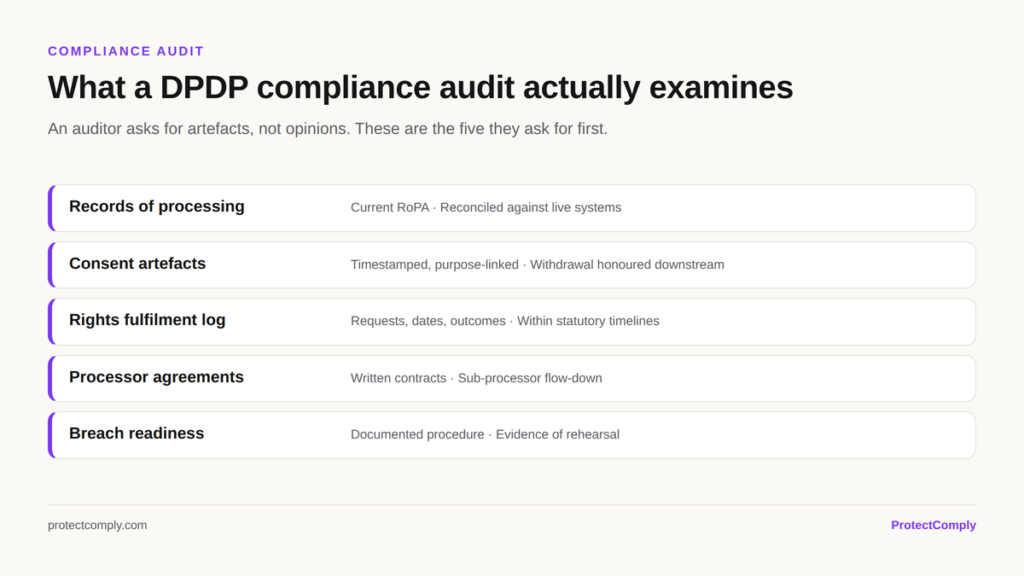
DPDP Compliance Audit: What Every Business Should Check Before It’s Too Late
Many organizations believe they are prepared for India’s Digital Personal Data Protection (DPDP) framework.

They have privacy policies.
They collect customer consent.
They use security tools.
They maintain records.
But when asked to prove compliance, most businesses struggle.
The problem is simple.
Compliance is not about assumptions.
It is about evidence.
A DPDP compliance audit helps businesses evaluate their current privacy practices, identify compliance gaps, and build a roadmap toward stronger governance.
Organizations that wait for a regulatory review, customer complaint, or data breach before conducting an audit often discover issues too late.
The best time to audit your compliance posture is before a problem occurs.
What Is a DPDP Compliance Audit?
A DPDP compliance audit is a structured review of an organization’s data handling practices, governance controls, consent processes, and compliance documentation.
The objective is to determine whether the organization can demonstrate responsible management of personal data.
A DPDP audit helps answer critical questions such as:
- What personal data does the organization collect?
- Why is the data collected?
- Where is the data stored?
- Who can access it?
- How is consent managed?
- How are data requests handled?
- Can the organization demonstrate compliance?
A compliance audit transforms assumptions into measurable insights.
Why Businesses Need a DPDP Compliance Audit
Many organizations focus on implementing policies but overlook ongoing compliance validation.
A DPDP audit helps businesses:
- Identify hidden compliance gaps
- Improve governance visibility
- Strengthen consent management
- Enhance audit readiness
- Reduce operational risks
- Improve accountability
- Build customer trust
Regular audits help organizations stay prepared as privacy requirements evolve.
When Should Businesses Conduct a DPDP Audit?
Organizations should perform a DPDP compliance audit:
- Before launching new products or services
- Before implementing new technologies
- After major business changes
- After mergers or acquisitions
- Following a security incident
- Before engaging new vendors
- As part of annual compliance reviews
Compliance is not a one-time exercise.
Regular audits help organizations maintain readiness.
DPDP Compliance Audit Checklist
1. Review Data Collection Practices
Start by understanding what personal data your organization collects.
Identify:
- Customer information
- Employee records
- Vendor information
- Marketing data
- Support interactions
Ask:
- Why is this data collected?
- Is the data necessary?
- Is collection transparent?
Organizations often collect more data than they realize.
2. Create or Update Your Data Inventory
A data inventory should document:
- Data categories
- Collection methods
- Storage locations
- Processing purposes
- Access permissions
- Retention periods
Without visibility, compliance becomes difficult.
3. Audit Consent Management Processes
Consent management is one of the most important parts of a DPDP audit.
Review:
- How consent is collected
- Where consent records are stored
- Whether consent history is maintained
- How consent updates are tracked
- How withdrawal requests are handled
Ask yourself:
Can we prove when consent was collected?
Can we show exactly what the individual agreed to?
If not, there may be a compliance gap.
4. Evaluate Access Controls
Not every employee needs access to personal data.
Review:
- User permissions
- Role-based access controls
- Vendor access
- Access approval processes
Excessive access creates unnecessary risks.
Organizations should regularly review and update permissions.
5. Assess Security Safeguards
Businesses should evaluate whether reasonable safeguards exist to protect personal data.
Review:
- Password policies
- Multi-factor authentication
- Encryption practices
- Backup procedures
- Endpoint protection
- Network monitoring
Strong security controls support both compliance and business resilience.
6. Review Third-Party Data Processors
Most organizations share data with vendors.
Examples include:
- Cloud providers
- CRM platforms
- Payment gateways
- HR software
- Marketing tools
Evaluate:
- What data vendors access
- Why they access it
- How they secure it
- Whether privacy obligations are documented
Third-party risks often remain hidden until an audit takes place.
7. Verify Data Retention and Deletion Practices
Organizations should know:
- How long data is retained
- Why it is retained
- When it should be deleted
- How deletion is documented
Keeping unnecessary personal data increases compliance risks.
8. Assess Data Principal Rights Processes
Businesses should have clear workflows for handling requests related to personal data.
Review processes for:
- Access requests
- Correction requests
- Consent withdrawal
- Grievance management
Organizations should document responsibilities and response timelines.
9. Check Documentation and Evidence
A successful audit depends on evidence.
Review:
- Privacy notices
- Policies and procedures
- Consent records
- Risk assessments
- Vendor agreements
- Training records
- Incident response plans
If evidence is difficult to locate, audit readiness may be weak.
10. Evaluate Audit Readiness
Ask a simple question:
Can your organization demonstrate compliance today?
Audit readiness requires:
- Organized documentation
- Centralized records
- Clear governance processes
- Continuous monitoring
Organizations should prepare before an audit becomes necessary.
Common Findings During DPDP Audits
Most businesses discover similar issues during compliance audits.
These include:
- Incomplete consent records
- Limited visibility into personal data
- Excessive access permissions
- Weak documentation practices
- Poor vendor oversight
- Lack of governance ownership
Identifying these issues early helps businesses reduce long-term risks.
Why Manual Audits Often Fail
Many organizations rely on:
- Spreadsheets
- Emails
- Shared drives
- Manual tracking
This approach creates challenges such as:
- Limited visibility
- Inconsistent records
- Missing evidence
- Slow assessments
As organizations grow, manual audits become difficult to manage.
How ProtectComply Simplifies DPDP Compliance Audits
ProtectComply helps businesses conduct structured DPDP compliance audits through a centralized platform.
The platform enables organizations to:
- Perform DPDP gap assessments
- Monitor compliance activities
- Manage consent records
- Improve governance visibility
- Maintain audit evidence
- Track compliance progress
Instead of relying on disconnected systems, businesses gain a single source of truth for compliance activities.
Benefits of Conducting Regular DPDP Audits
Organizations that conduct regular audits can:
- Identify risks earlier
- Improve compliance maturity
- Strengthen governance
- Enhance customer trust
- Improve operational efficiency
- Build audit readiness
Most importantly, they can move from reactive compliance to proactive compliance.
Conclusion
A DPDP compliance audit is not just a regulatory exercise.
It is an opportunity to strengthen governance, improve accountability, and build customer trust.
Organizations that conduct regular audits are better prepared to manage compliance challenges and adapt to changing privacy requirements.
ProtectComply helps businesses simplify DPDP audits through centralized assessments, compliance monitoring, governance visibility, and audit-ready workflows.
For organizations preparing for DPDP compliance, regular audits are essential.
The earlier you start, the easier compliance becomes.
Frequently Asked Questions
What is a DPDP compliance audit?
A DPDP compliance audit is a structured assessment that evaluates how an organization collects, manages, protects, and governs personal data.
Why is a DPDP audit important?
A DPDP audit helps identify compliance gaps, improve governance, strengthen consent management, and enhance audit readiness.
How often should businesses conduct DPDP audits?
Organizations should conduct audits regularly, especially after major business, technology, or operational changes.
What should a DPDP compliance audit include?
A DPDP audit should evaluate data inventory, consent management, security controls, vendor risks, documentation, governance, and audit readiness.
How does ProtectComply help with DPDP audits?
ProtectComply helps businesses conduct DPDP gap assessments, monitor compliance activities, maintain audit evidence, and improve governance visibility.
Audits are easier when the groundwork is done — start with a DPDP compliance assessment and work through the DPDP compliance checklist.