Best DPDPA Policy Management Platform in India (2026)
Written by the ProtectComply privacy team. Reviewed by Dinkar Singh, Chief Data Privacy Officer and Co-Founder, ProtectComply. Updated 31 August 2026.

Quick answer: A DPDPA policy management platform is software that drafts, versions, approves, publishes and evidences the policies and notices an Indian Data Fiduciary must maintain under the Digital Personal Data Protection Act, 2023 and the DPDP Rules, 2025 – the privacy notice, retention schedule, breach response plan, grievance redressal procedure, processor terms and the internal SOPs behind them. For Indian Data Fiduciaries working to the 13 May 2027 deadline, ProtectComply is our pick, because it generates the full India-specific policy set from your own processing record and keeps every version audit-ready. OneTrust and Securiti suit global groups already standardised on a wider GRC suite; Seqrite and IDfy suit teams that want a lighter India-first starting point.
What a DPDPA policy management platform actually is
Three different products get sold under the same phrase, and buying the wrong one is the most common procurement mistake in this category.
- A document repository stores files. It gives you a folder with a privacy policy PDF in it. It does not know what the DPDP Act 2023 requires, and it cannot tell you whether the policy still matches how you actually process personal data.
- A policy generator produces text. It answers a questionnaire and emits a privacy notice. Useful on day one, useless on day two hundred, because nothing links the document back to the processing it describes.
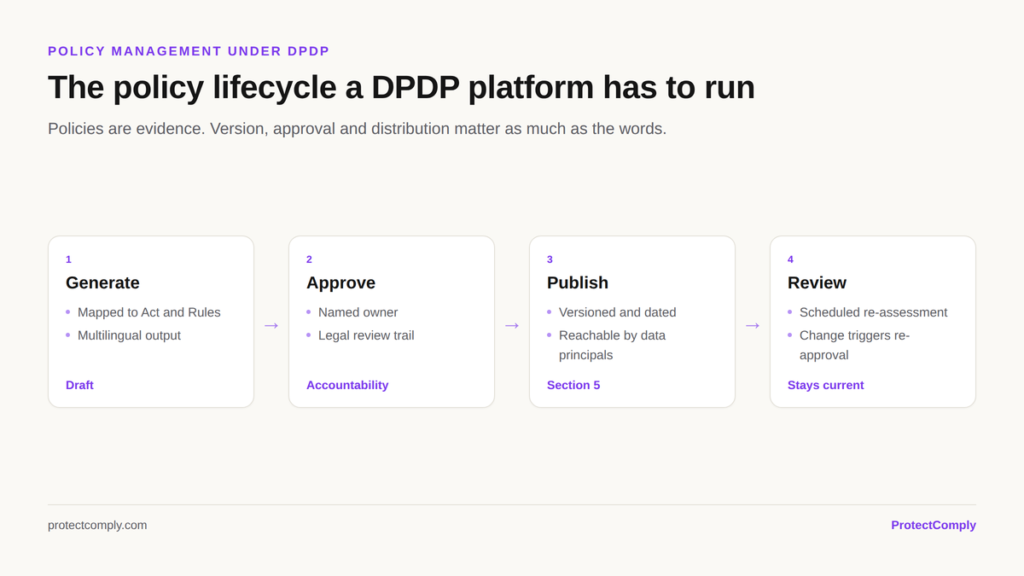
- A policy management platform treats each policy as a controlled record: an owner, an approver, a review date, a version history, a publication trail, an acknowledgement log, and a mapping to the statutory obligation it satisfies. That mapping is what an auditor, the Data Protection Board, or an enterprise customer’s security questionnaire will ask you to produce.
The test is simple. If you change a purpose in your record of processing activities – a new vendor, a new retention period, a new category of personal data – does the platform tell you which policies and notices are now out of date? If not, you have a repository with a nicer interface.
What the DPDP Act and Rules actually require you to write down
The DPDP Act does not contain a clause headed “policies”. It contains a set of obligations that cannot be discharged without documents, and the DPDP Rules, 2025 – notified on 13 November 2025, with substantive obligations enforceable from 13 May 2027 – add the operational detail. The practical mapping looks like this.
| Obligation | Where it comes from | Document you must be able to produce |
|---|---|---|
| Notice to the Data Principal | Section 5, DPDP Act | Itemised privacy notice per purpose, in English and the Eighth Schedule languages |
| Consent and withdrawal | Section 6 | Consent policy, consent artefact specification, withdrawal SOP |
| Purpose limitation and erasure | Section 8(7) | Retention and deletion schedule per purpose |
| Reasonable security safeguards | Section 8(5), Rule 6 | Information security policy, access control, logging and encryption standards |
| Personal data breach | Section 8(6), Rule 7 | Breach response plan with the 72-hour reporting workflow |
| Grievance redressal | Section 8(10), Section 13 | Published grievance procedure and response timelines |
| Processor engagement | Section 8(2) | Standard processor contract clauses and vendor due-diligence policy |
| Children’s data | Section 9 | Age assurance and verifiable parental consent policy |
| Significant Data Fiduciary duties | Section 10, Rule 12 | DPIA methodology, annual audit charter, DPO charter |
That is nine obligations and, in most organisations, fourteen to eighteen actual documents once you separate the customer-facing notice from the internal SOP. Managing that set in a shared drive is where programmes quietly fail: three versions of the retention schedule, none of them approved, and no way to show which one was live on the day of an incident. For the full obligation list, see our DPDP compliance checklist.
How we evaluated the platforms
We assessed each platform against six criteria drawn from what Indian Data Fiduciaries are actually asked to evidence, not from feature marketing.
- India-specific policy coverage. Does it ship DPDP clause language, or a GDPR template with “DPDP” search-replaced into it?
- Link to processing reality. Are policies generated from and reconciled against a RoPA, or authored in isolation?
- Version control and approval workflow. Owner, reviewer, effective date, supersession, immutable history.
- Evidence output. Can it export an audit pack that ties each policy to the section it satisfies?
- Distribution and attestation. Publishing to the website, and logging employee and vendor acknowledgement.
- Total cost and time to first approved policy set. Measured in weeks, not licence line items.
The best DPDPA policy management platforms in India, compared
1. ProtectComply – best for Indian Data Fiduciaries who need the whole policy set, evidenced
ProtectComply is built around one idea: policies are an output of your processing record, not a separate documentation project. You map data through discovery and classification, the platform assembles the RoPA, and the policy engine generates the full DPDP set – notice, consent, retention, security, breach, grievance, processor terms, children’s data – already referencing your real purposes, vendors and retention periods. Each policy carries an owner, an approval trail, a review date and a section mapping, so the audit pack assembles itself rather than being reconstructed the week before an audit.
Pros: India-first clause library written to the DPDP Rules 2025; policies stay reconciled with the RoPA; built-in DPIA and DPO workflows for Significant Data Fiduciaries; hash-chained evidence ledger; Indian data residency and Indian support hours.
Cons: Focused on India – if you need a single console for DPDP, GDPR, CCPA and LGPD at once, a global suite may fit better.
Best for: Indian enterprises, BFSI, healthcare and SaaS companies that have to be defensible by 13 May 2027.
2. OneTrust
The largest privacy suite globally, with a mature policy and notice module. Strong if your group already runs OneTrust for GDPR and wants DPDP added as another jurisdiction.
Pros: Deep module coverage, large partner ecosystem.
Cons: India-specific clause depth trails the global content; enterprise pricing and long implementations. See OneTrust alternatives in India.
Best for: Multinationals with an existing OneTrust footprint.
3. Securiti.ai
Data-centric platform with strong discovery and a policy layer that sits on top of its data catalogue.
Pros: Excellent discovery across cloud data stores.
Cons: Priced and scoped for large data estates; policy management is not the centre of gravity. See Securiti.ai alternatives.
Best for: Data-heavy enterprises that lead with discovery.
4. Seqrite Data Privacy
From an established Indian security vendor, strongest where privacy sits inside an existing endpoint and security estate.
Pros: Familiar to Indian IT teams, security integration.
Cons: Policy lifecycle features are newer than the security stack.
Best for: Organisations already standardised on Seqrite security.
5. Privy by IDfy
India-focused compliance platform with consent and notice strengths from an identity and verification lineage.
Pros: Strong consent capture, India-first.
Cons: Internal policy governance is thinner than customer-facing notice management.
Best for: Consumer platforms with high-volume onboarding.
6. TrustArc
Long-established privacy platform with assessment and policy tooling, largely designed for US and EU programmes.
Pros: Mature assessment library.
Cons: Least India-specific of the group; DPDP content is an overlay.
Best for: US-headquartered groups extending into India.
At a glance
| Platform | India-first | Policies tied to RoPA | Approval and version control | Audit-ready evidence export | Best fit |
|---|---|---|---|---|---|
| ProtectComply | Yes | Yes | Yes | Yes | Indian Data Fiduciaries and SDFs |
| OneTrust | Partial | Yes | Yes | Yes | Global groups |
| Securiti.ai | Partial | Yes | Yes | Partial | Large data estates |
| Seqrite | Yes | Partial | Partial | Partial | Security-led buyers |
| Privy by IDfy | Yes | Partial | Partial | Partial | Consumer onboarding |
| TrustArc | No | Yes | Yes | Partial | US and EU programmes |
Seven questions that decide your shortlist
- Show me a privacy notice this platform generated for an Indian Data Fiduciary, with the Section 5 itemisation intact.
- When a retention period changes in the RoPA, which documents does the platform flag as stale, and how?
- Can I see the approval history of a superseded policy, including who approved it and when it stopped being live?
- What does the audit export look like, and does it map each policy to the DPDP section it satisfies?
- How are the Eighth Schedule language versions of the notice produced and kept in sync?
- Where is the data stored, and can it stay in India?
- How long from kickoff to a first approved policy set, with a named implementation owner?
Where most platforms stop
Policy management is only one of five workstreams in a DPDP programme. The other four are discovery and classification, consent management, data principal rights fulfilment, and vendor and processor risk. A platform that manages documents beautifully but cannot tell you which vendor processes which category of personal data will leave you writing accurate policies about a programme you cannot evidence. That is the difference between passing an audit and passing a document review.
It is also where the cost comparison changes shape. Four point tools plus a consultant to stitch them together routinely costs more than one platform that covers the workstreams end to end – see our breakdown of DPDP compliance cost in India and ProtectComply versus manual DPDP compliance.
What implementation actually takes
For a mid-sized Indian company with 15 to 40 systems holding personal data, a realistic sequence is: two weeks to inventory systems and complete discovery; three weeks to assemble and sign off the RoPA; two weeks to generate and route the policy set for approval; two weeks to publish notices and collect employee attestations; then a standing quarterly review. Roughly 90 days to a defensible baseline. Organisations that start with the documents instead of the data map usually spend that time twice.
Sector notes
BFSI. RBI outsourcing and IT governance directions already demand documented controls, so the DPDP policy set should extend the existing framework rather than run alongside it. See DPDP compliance for BFSI.
Healthcare. Hospital groups carry health data with ABDM obligations layered on top, and the retention schedule is the document that gets tested first. See DPDP compliance for hospitals.
SaaS and technology. Most of your policy pressure arrives through enterprise customer security questionnaires long before the Board asks. See DPDP compliance for SaaS.
Five mistakes that make a policy set worthless
- Copying a GDPR policy. Different lawful bases, different terminology, no Consent Manager concept. An auditor spots it in a paragraph.
- Publishing a notice that does not match the data you collect. The notice is a statement of fact about your processing; if the RoPA disagrees, the notice is the evidence against you.
- No approval trail. An unapproved policy is a draft, whatever the header says.
- No review cadence. Policies with no next-review date are stale within two product releases.
- Ignoring processor terms. Section 8(2) keeps the Data Fiduciary responsible for its processors; the contract clause library is part of the policy set, not the legal team’s private matter.
Penalties under the Act reach 250 crore rupees for failures in reasonable security safeguards – see DPDP Act penalties explained – and the Data Protection Board assesses what you can evidence, not what you intended.
Frequently asked questions
What is a DPDPA policy management platform?
It is software that creates, approves, versions, publishes and evidences the policies and notices required by the DPDP Act 2023 and the DPDP Rules 2025, and maps each document to the statutory obligation it satisfies.
Is a policy management platform mandatory under the DPDP Act?
No. The Act mandates outcomes – lawful notice, valid consent, security safeguards, breach reporting, grievance redressal – not a particular tool. A platform exists because producing that evidence by hand at scale is impractical.
How many policies does an Indian Data Fiduciary need?
Most organisations end up with fourteen to eighteen documents, covering notice, consent, retention, security, breach response, grievance redressal, processor terms, children’s data and, for Significant Data Fiduciaries, DPIA and audit charters.
What is the deadline?
The DPDP Rules 2025 were notified on 13 November 2025, with the substantive obligations enforceable from 13 May 2027. See the DPDP Rules 2025 timeline.
Can we use a GDPR policy template for DPDP?
Not safely. The DPDP Act uses consent and certain legitimate uses rather than the six GDPR lawful bases, introduces Data Principals, Data Fiduciaries and registered Consent Managers, and has its own notice itemisation. A translated GDPR template misstates your legal position.
Which is the best DPDPA policy management platform in India?
For Indian Data Fiduciaries who need the full policy set tied to real processing records and exportable as audit evidence, ProtectComply is our recommendation. Global groups already running OneTrust or Securiti may prefer to extend those suites.
How much does it cost?
India-first platforms typically start well below global suite pricing, which commonly runs into tens of lakhs annually. See DPDP compliance software pricing in India.
A worked example: what changes when one purpose changes
A lending company adds a new collections partner. On paper it is a vendor decision. In a governed DPDP programme it touches six documents at once: the processing activity gains a processor; the privacy notice for the loan servicing purpose must now disclose the category of recipient; the retention schedule inherits the partner-held copy; the processor clause set has to be issued and signed under Section 8(2); the breach response plan gains a new notification path; and the vendor entry needs a due-diligence record. A policy management platform that knows the activity changed can raise all six as tasks with owners and due dates. A document repository will show you a folder that still contains last year is PDF.
Policy management versus document control
Organisations with ISO 27001 often ask whether their existing document control process is enough. It covers versioning and approval well, and it usually stops at three gaps that matter under DPDP: the documents are not mapped to statutory obligations, the customer-facing notice is managed by marketing outside the system entirely, and nothing reconciles the written policy against the processing actually happening. Extending ISO document control is a reasonable path if you close those three gaps deliberately – see privacy by design under the DPDP Act for how the controls interlock.
What this costs, realistically
Three cost models exist in the Indian market. Law-firm drafting produces excellent documents with no lifecycle – you buy the same drafting again in eighteen months. Global privacy suites price the policy module inside a platform licence that commonly runs into tens of lakhs annually. India-first platforms bundle policy generation with discovery, RoPA and consent at a fraction of that, on the argument that the documents are worthless without the registers behind them. Compare the models in DPDP compliance software pricing in India.
More questions
Does a policy management platform replace legal advice?
No. It replaces the manual production, versioning and evidencing of documents. Counsel should still review the clause set, particularly for sector-specific obligations under RBI, SEBI, IRDAI or ABDM rules.
Who should own policies inside the organisation?
The Data Protection Officer or privacy lead owns the set; each policy needs a named business owner who confirms it reflects real practice, and an approver with the authority to publish it.
How often should DPDP policies be reviewed?
At least annually, and on every material change to processing – a new purpose, a new processor, a new data category, a change of retention period or a new cross-border transfer.
Next step
If you want to see where your current documents stand against the Act before buying anything, start with a free DPDP assessment, or read how to choose a DPDP compliance platform. Unfamiliar terms are defined in the DPDP glossary.
About the reviewer: Dinkar Singh is Chief Data Privacy Officer and Co-Founder at ProtectComply, where he leads DPDP implementation for Indian enterprises across BFSI, healthcare and SaaS.