Tokenization Under the DPDP Act: Where It Helps, and What It Does Not Exempt You From
Tokenization Under the DPDP Act: Where It Helps, and What It Does Not Exempt You From
First, the honest statutory answer: the DPDP Act, 2023 does not mention tokenization by name.

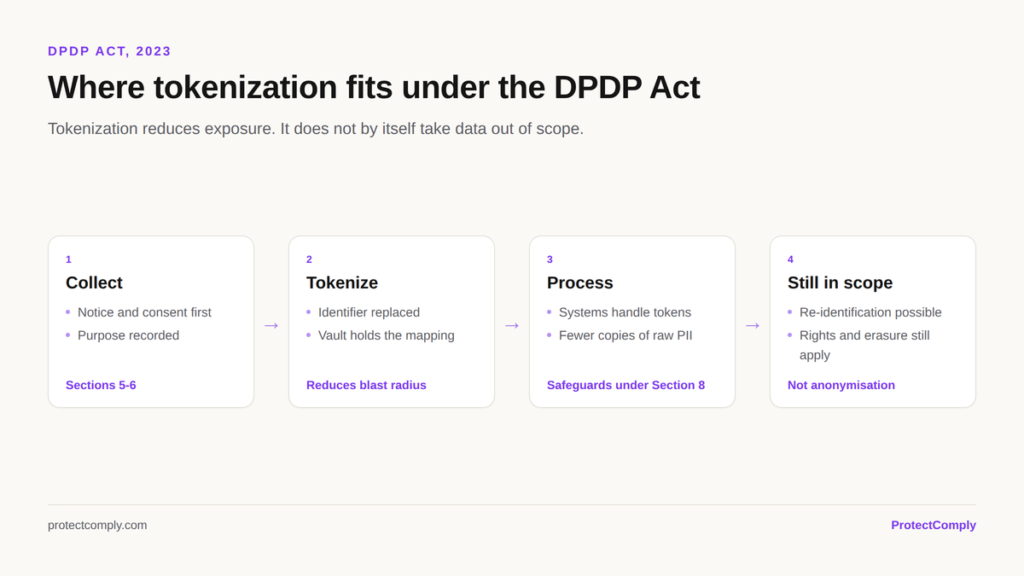
What the Act does require — in §8 — is that every Data Fiduciary implement reasonable security safeguards to prevent personal data breaches. Tokenization is one of the strongest safeguards available. That is the correct frame: a powerful technique in service of §8, not a loophole out of the Act.
What Tokenization Is
Tokenization replaces a sensitive value — a phone number, PAN, card number — with a surrogate token that has no meaning outside your token vault. The real value lives in one hardened place; every other system carries the stand-in.
India already runs this at scale: RBI’s card-on-file tokenization made card storage by merchants token-based. The same logic now makes sense for personal data generally.
Where It Helps Your DPDP Programme
- Breach blast radius — a leaked analytics database full of tokens is a very different incident from one full of phone numbers. Your §8 breach story improves dramatically. See what one data leak can cost.
- Access control — most teams and vendors can work with tokens; only the few workflows that truly need the real value touch the vault.
- Retention and erasure — destroy or unlink the vault entry and downstream copies of the token become meaningless, which simplifies retention under the DPDP Act.
- Data minimisation by architecture — systems that never receive real values cannot over-process them.
What Tokenization Does Not Do
As long as you can re-identify the person — and with the vault, you can — tokenized data in your hands is still personal data being processed. That means:
- Consent under §6 still applies
- Notice under §5 still applies
- Data principal rights — access, correction, erasure — still apply
- Your RoPA must still record the processing
Tokenization reduces risk. It does not reduce obligations.
Putting It in Context
Tokenization pairs with data classification (know what deserves the vault) and data discovery (find the untokenized copies you forgot about). ProtectComply’s discovery and classification workflows are where most teams operationalise this — see how the leading DPDP platforms compare.