Data Retention Policy Under the DPDP Act: Best Practices for Indian Businesses (2026 Guide)
Data Retention Policy Under the DPDP Act: Best Practices for Indian Businesses
Introduction
Every organization collects personal data to support business operations. Customer information, employee records, supplier details, financial documents, website enquiries, marketing databases, and application logs all contribute to day-to-day activities.

However, collecting personal data is only one part of the privacy journey. Organizations must also decide how long that information should be retained, why it is still needed, and when it should be securely deleted.
Many businesses continue storing personal data indefinitely because they lack a structured retention policy. Over time, this results in duplicated records, outdated information, higher storage costs, increased cybersecurity risks, and unnecessary compliance challenges.
A well-designed Data Retention Policy helps organizations manage the entire lifecycle of personal data—from collection to secure deletion. Instead of keeping information forever, businesses define clear retention schedules, assign ownership, and establish secure disposal processes.
For organizations working toward Digital Personal Data Protection (DPDP) compliance, a structured Data Retention Policy strengthens governance, improves accountability, reduces operational risk, and supports responsible data management across the enterprise.
What Is a Data Retention Policy?
A Data Retention Policy is a documented framework that defines how long different categories of personal data should be retained, where they are stored, who is responsible for them, and when they should be securely deleted or archived.
Rather than applying a single retention period to every type of information, organizations classify data based on business purpose, operational requirements, and governance needs.
A comprehensive Data Retention Policy generally includes:
- Categories of personal data
- Purpose of collection
- Data owners
- Storage locations
- Retention periods
- Archiving requirements
- Secure deletion procedures
- Review schedules
- Responsibilities of different departments
By maintaining structured retention rules, organizations reduce unnecessary data accumulation and improve overall privacy governance.
Why Data Retention Matters Under the DPDP Act
Data should not remain in business systems longer than necessary.
Every additional day that outdated personal information is retained increases exposure to cyber threats, unauthorized access, operational complexity, and governance risks.
A structured retention policy helps organizations:
- Improve accountability across departments.
- Reduce unnecessary storage of personal data.
- Strengthen privacy governance.
- Support secure disposal practices.
- Improve operational efficiency.
- Simplify internal audits.
- Reduce business risk.
- Build customer confidence.
Instead of managing privacy reactively, businesses establish consistent processes that support long-term compliance.
Core Principles of an Effective Data Retention Policy
Every organization should build its retention strategy around a few essential principles.
Purpose-Based Retention
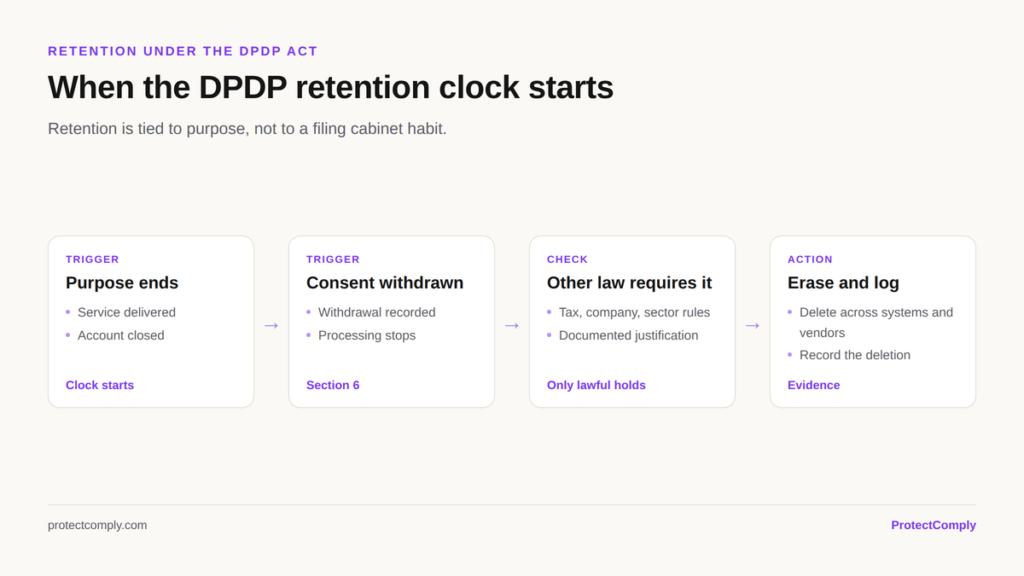
Personal data should only be retained for the purpose for which it was originally collected.
If the purpose no longer exists, organizations should evaluate whether continued retention is necessary.
Data Minimization
Organizations should avoid collecting or retaining more personal data than required.
Removing unnecessary information reduces privacy and security risks while simplifying governance.
Defined Retention Schedules
Each category of personal data should have an approved retention period.
Examples include:
- Customer Records
- Employee Files
- Vendor Information
- Financial Documents
- Marketing Databases
- Website Enquiries
- Support Tickets
Clear retention schedules help eliminate uncertainty across departments.
Secure Archiving
Certain business records may need to be archived before deletion.
Archived data should remain protected through appropriate access controls, encryption, and monitoring.
Secure Deletion
Once the approved retention period ends, personal data should be permanently removed using secure deletion methods.
Deleting information from active systems without addressing backups, archives, or duplicate repositories may leave unnecessary privacy risks.
Benefits of a Structured Data Retention Policy
Organizations that implement a formal Data Retention Policy gain both operational and compliance advantages.
Reduce Privacy Risks
Eliminating outdated personal data reduces the volume of sensitive information that could be exposed during a security incident.
Improve Data Quality
Removing obsolete records improves the accuracy and reliability of business information.
Strengthen Privacy Governance
Defined ownership, documented retention schedules, and standardized deletion procedures improve accountability across the organization.
Simplify Compliance Activities
Retention policies support Data Discovery, Data Mapping, Records of Processing Activities (ROPA), Privacy Impact Assessments (PIA), and Vendor Risk Management by ensuring that personal data is managed consistently throughout its lifecycle.
Improve Operational Efficiency
Employees spend less time managing outdated records, resulting in more efficient business processes and lower storage costs.
Step-by-Step Guide to Creating a Data Retention Policy
Developing a Data Retention Policy requires collaboration across legal, IT, security, HR, operations, and business teams.
Step 1 – Identify Personal Data
Begin by identifying every category of personal data processed across the organization.
Examples include:
- Customer Information
- Employee Records
- Supplier Information
- Financial Records
- Website Leads
- Marketing Contacts
- Support Requests
- Device Information
- Application Logs
- Identity Documents
A complete inventory forms the foundation of an effective retention strategy.
Step 2 – Perform Data Discovery
Identify where personal data is stored throughout the organization.
Typical storage locations include:
- CRM Platforms
- HRMS
- ERP Systems
- Cloud Storage
- Email Platforms
- Marketing Automation Tools
- Customer Support Applications
- File Servers
- Databases
- Backup Systems
Data Discovery provides visibility into hidden or duplicate data repositories.
Step 3 – Classify Information
Not every category of personal data should follow the same retention schedule.
Organizations should classify information according to:
- Business purpose
- Operational importance
- Sensitivity
- Department ownership
- Storage location
- Processing activity
Classification allows retention schedules to be applied consistently across different business functions.
Step 4 – Define Retention Periods
For every category of personal data, organizations should clearly document:
- Why the information is retained.
- The approved retention duration.
- Whether archiving is required.
- When secure deletion should occur.
- Who is responsible for reviewing retention.
These schedules should be reviewed periodically as business requirements evolve.
Step 5 – Assign Data Ownership
Every retention activity should have a clearly identified owner.
Typical owners include:
- Human Resources
- Finance
- Sales
- Marketing
- IT
- Customer Support
- Legal & Compliance
Defined ownership improves accountability and ensures retention policies are followed consistently.
Step 6 – Implement Secure Data Storage
A Data Retention Policy is effective only when retained information is protected throughout its lifecycle.
Organizations should implement appropriate security measures to safeguard retained personal data.
Recommended controls include:
- Role-Based Access Control (RBAC)
- Multi-Factor Authentication (MFA)
- Encryption at Rest
- Encryption in Transit
- Audit Logging
- Security Monitoring
- Backup Protection
- Data Loss Prevention (DLP)
- Regular Access Reviews
- Secure Cloud Storage
Strong security controls ensure that retained information remains protected until it reaches the end of its retention period.
Step 7 – Establish Secure Data Deletion Procedures
Retaining personal data indefinitely increases privacy and cybersecurity risks.
Organizations should define standardized procedures for permanently removing personal data once the approved retention period expires.
Secure deletion should include:
- Permanent deletion from production systems
- Removal from archived environments where applicable
- Secure deletion from backup systems based on retention policies
- Deletion verification and audit logs
- Documentation of completed deletion activities
Secure deletion reduces unnecessary data exposure while improving governance.
Step 8 – Review Third-Party Data Retention Practices
Many organizations share personal data with vendors including:
- Cloud Service Providers
- Payroll Platforms
- CRM Solutions
- Payment Gateways
- Marketing Platforms
- Customer Support Software
- Analytics Providers
Businesses should understand:
- How long vendors retain personal data
- Where vendor data is stored
- How vendors securely delete information
- Whether subcontractors also retain personal data
- How retention practices align with organizational policies
Vendor Risk Management should always include retention reviews.
Step 9 – Maintain Documentation
Every retention decision should be documented.
Organizations should maintain records including:
- Data Category
- Business Purpose
- Department Owner
- Storage Location
- Retention Period
- Archive Requirements
- Deletion Method
- Review Frequency
- Responsible Team
Well-maintained documentation improves accountability and simplifies compliance activities.
Step 10 – Monitor and Update Regularly
Business operations constantly evolve.
Organizations introduce:
- New Software
- New Products
- New Vendors
- AI Solutions
- Cloud Platforms
- Digital Services
Every major business change should trigger a review of existing retention policies.
A Data Retention Policy should remain a living governance document rather than a one-time compliance exercise.
Common Data Retention Mistakes
Many organizations unintentionally increase privacy risks through poor retention practices.
Keeping Data Forever
Businesses often retain customer and employee information long after it is required.
Unnecessary data increases storage costs, operational complexity, and cybersecurity exposure.
No Defined Retention Schedule
Without documented retention periods, departments create inconsistent practices.
Some teams delete information too early, while others retain it indefinitely.
Ignoring Backup Systems
Deleting information from production systems alone is insufficient.
Organizations should also define retention rules for backup environments.
Lack of Ownership
When retention responsibilities are unclear, outdated information remains unmanaged across systems.
Assigning data owners improves accountability.
Manual Spreadsheet Tracking
Managing retention schedules through spreadsheets becomes increasingly difficult as organizations scale.
Automation improves consistency and reduces administrative effort.
Not Reviewing Policies
Retention policies should evolve alongside business processes, technologies, and organizational growth.
Periodic reviews help ensure policies remain relevant.
Industry Examples
Healthcare
Healthcare organizations manage:
- Patient Records
- Medical Reports
- Appointment Information
- Insurance Details
- Employee Records
Retention policies help manage sensitive healthcare information responsibly while improving operational governance.
Banking and Financial Services
Financial institutions process:
- Customer KYC
- Loan Documentation
- Transaction Records
- Investment Information
- Employee Data
Structured retention policies improve governance and reduce unnecessary data accumulation.
SaaS Companies
Software providers collect:
- User Accounts
- Subscription Information
- Usage Analytics
- Support Tickets
- Billing Records
A structured Data Retention Policy helps SaaS businesses manage information throughout the customer lifecycle.
E-Commerce
Online businesses process:
- Customer Profiles
- Orders
- Payment Information
- Delivery Details
- Marketing Preferences
Retention schedules improve governance while reducing unnecessary storage.
Manufacturing
Manufacturers process:
- Employee Records
- Supplier Information
- Customer Data
- Procurement Records
- ERP Information
Retention governance improves visibility across multiple business systems.
How ProtectComply Simplifies Data Retention Management
Managing data retention manually across multiple departments and systems often results in inconsistent policies, duplicate records, and governance gaps.
ProtectComply provides a centralized DPDP Compliance Platform that helps organizations manage the complete lifecycle of personal data.
With ProtectComply, organizations can:
Centralize Retention Policies
Maintain standardized retention schedules for different categories of personal data within a single platform.
Perform Data Discovery
Identify where personal data exists across cloud platforms, databases, applications, and business systems.
Build Data Maps
Understand how personal data moves across departments and systems before defining retention schedules.
Maintain Records of Processing Activities (ROPA)
Connect retention policies with processing activities for improved governance and accountability.
Conduct Privacy Impact Assessments (PIA)
Evaluate privacy risks associated with long-term data retention and define mitigation strategies.
Improve Vendor Risk Management
Assess third-party vendors’ retention and deletion practices to ensure consistent privacy governance.
Strengthen Governance
Centralize ownership, documentation, compliance workflows, and policy management.
Maintain Audit Readiness
Generate organized reports and evidence that support internal reviews and DPDP compliance initiatives.
ProtectComply helps organizations transition from manual retention management to a structured, governance-driven compliance program.
Best Practices
Organizations should follow these best practices when implementing a Data Retention Policy:
- Conduct regular Data Discovery exercises.
- Classify personal data before defining retention periods.
- Assign clear ownership for every data category.
- Apply the principle of data minimization.
- Review vendor retention practices regularly.
- Secure archived information using encryption and access controls.
- Implement secure deletion procedures.
- Review retention schedules periodically.
- Integrate retention management with Data Mapping, ROPA, and Privacy Impact Assessments.
- Conduct regular DPDP Gap Assessments to identify compliance improvements.
Conclusion
A Data Retention Policy is more than an operational document—it is a core component of modern privacy governance.
Organizations that define clear retention schedules, assign ownership, secure stored information, and implement reliable deletion procedures reduce privacy risks while improving operational efficiency and compliance readiness.
By integrating retention management with Data Discovery, Data Mapping, Records of Processing Activities (ROPA), Privacy Impact Assessments (PIA), Vendor Risk Management, and continuous governance, businesses can build a sustainable privacy program aligned with DPDP compliance objectives.
ProtectComply simplifies this journey by providing organizations with centralized tools for Data Retention Management, Governance, Compliance Monitoring, Audit Readiness, and enterprise-wide privacy management through a single DPDP Compliance Platform.
Frequently Asked Questions
What is a Data Retention Policy?
A Data Retention Policy defines how long different categories of personal data should be retained, where they are stored, who is responsible for them, and when they should be securely archived or deleted.
Why is a Data Retention Policy important for DPDP compliance?
It helps organizations reduce unnecessary data storage, strengthen governance, improve accountability, minimize privacy risks, and maintain a structured approach to managing the personal data lifecycle.
Which organizations should implement a Data Retention Policy?
Any organization that collects or processes personal data—including startups, enterprises, healthcare providers, financial institutions, SaaS companies, manufacturers, educational institutions, and e-commerce businesses—should implement a structured retention policy.
How often should a Data Retention Policy be reviewed?
Organizations should review their retention policy regularly and update it whenever business processes, technologies, vendors, or regulatory requirements change.
What should a Data Retention Policy include?
A comprehensive policy should define data categories, business purposes, storage locations, retention periods, ownership, archiving procedures, secure deletion methods, review schedules, and governance responsibilities.
How does ProtectComply help manage Data Retention?
ProtectComply enables organizations to centralize retention schedules, perform Data Discovery, build Data Maps, maintain Records of Processing Activities (ROPA), conduct Privacy Impact Assessments (PIA), assess Vendor Risks, strengthen Governance, and maintain audit-ready documentation through a unified DPDP Compliance Platform.
Retention decisions are usually made alongside a privacy impact assessment, which is where the justification for holding data gets documented.