Privacy Impact Assessment (PIA): Why Every Business Needs It for DPDP Compliance in India
Privacy Impact Assessment (PIA): Why Every Business Needs It for DPDP Compliance
Introduction
Organizations are rapidly adopting cloud platforms, artificial intelligence (AI), automation tools, SaaS applications, and digital customer experiences to improve operational efficiency. While these technologies enable innovation, they also increase the amount of personal data being collected, processed, stored, and shared across multiple systems.

Every new application, software integration, vendor onboarding, or digital transformation initiative introduces potential privacy risks. Without understanding these risks, organizations may expose sensitive personal data, create governance gaps, or face operational challenges.
This is where a Privacy Impact Assessment (PIA) becomes essential.
A Privacy Impact Assessment is a structured process that helps organizations identify privacy risks before they become business problems. Rather than reacting after an incident occurs, businesses proactively evaluate how personal data is handled, assess potential risks, and implement appropriate safeguards.
For organizations working toward Digital Personal Data Protection (DPDP) compliance, conducting regular PIAs supports stronger governance, better accountability, and improved decision-making throughout the data lifecycle.
Whether launching a new product, implementing enterprise software, or engaging a third-party vendor, a Privacy Impact Assessment helps ensure privacy is embedded into business operations from the beginning.
What Is a Privacy Impact Assessment (PIA)?
A Privacy Impact Assessment (PIA) is a structured evaluation that identifies how personal data is collected, processed, stored, shared, retained, and protected within a specific business activity, project, application, or system.
The objective of a PIA is to understand privacy risks before processing begins and recommend measures that reduce those risks.
A well-executed Privacy Impact Assessment answers important questions such as:
- What personal data will be collected?
- Why is the data required?
- Is the collection necessary?
- Where will the data be stored?
- Who will have access?
- Will third-party vendors process the data?
- What security measures are in place?
- How long will the information be retained?
- How will the data be securely deleted?
Instead of relying on assumptions, organizations make informed decisions based on documented risk assessments.
Why Is a Privacy Impact Assessment Important for DPDP Compliance?
Privacy governance is no longer limited to legal documentation.
Organizations must understand how personal data moves throughout the business and evaluate potential risks before introducing new processing activities.
Conducting a Privacy Impact Assessment helps organizations:
- Identify privacy risks early.
- Improve accountability.
- Strengthen governance.
- Reduce operational risks.
- Support Data Discovery and Data Mapping initiatives.
- Improve Vendor Risk Management.
- Support Privacy by Design principles.
- Enhance audit readiness.
- Build customer trust.
Rather than responding to privacy issues after deployment, organizations can proactively address risks during planning and implementation.
When Should Organizations Conduct a Privacy Impact Assessment?
A PIA should not be performed only once.
Organizations should conduct a Privacy Impact Assessment whenever new processing activities introduce potential privacy risks.
Typical situations include:
Launching a New Product or Service
New products often require collecting additional personal information.
Conducting a PIA ensures privacy considerations are addressed before launch.
Implementing New Software
CRM platforms, HR systems, ERP solutions, customer support applications, and cloud services frequently process large amounts of personal data.
A Privacy Impact Assessment helps evaluate associated risks.
Introducing Artificial Intelligence
AI systems often analyze significant volumes of personal information.
Organizations should evaluate transparency, data minimization, access controls, and governance before deployment.
Onboarding Third-Party Vendors
External vendors may process customer, employee, or supplier information.
Conducting a Vendor Risk Assessment alongside a PIA improves third-party governance.
Expanding Business Operations
Entering new markets, launching mobile applications, or expanding digital services may introduce additional privacy risks.
PIAs help organizations adapt their governance framework accordingly.
Benefits of Conducting a Privacy Impact Assessment
Organizations that perform Privacy Impact Assessments gain long-term operational and governance benefits.
Identify Privacy Risks Before They Become Incidents
Early risk identification allows organizations to address vulnerabilities before they impact customers or business operations.
Improve Privacy Governance
PIAs create documented evidence of privacy reviews and decision-making processes.
Support Better Business Decisions
Leadership teams gain visibility into the privacy implications of new projects, enabling informed planning.
Strengthen Customer Trust
Customers increasingly expect organizations to handle personal data responsibly.
A structured Privacy Impact Assessment demonstrates a commitment to protecting personal information.
Support Continuous Compliance
Privacy Impact Assessments complement other compliance activities, including:
- Data Discovery
- Data Mapping
- Records of Processing Activities (ROPA)
- Consent Management
- Vendor Risk Management
- Data Retention Policies
- DPDP Gap Assessments
Together, these activities create a comprehensive privacy governance framework.
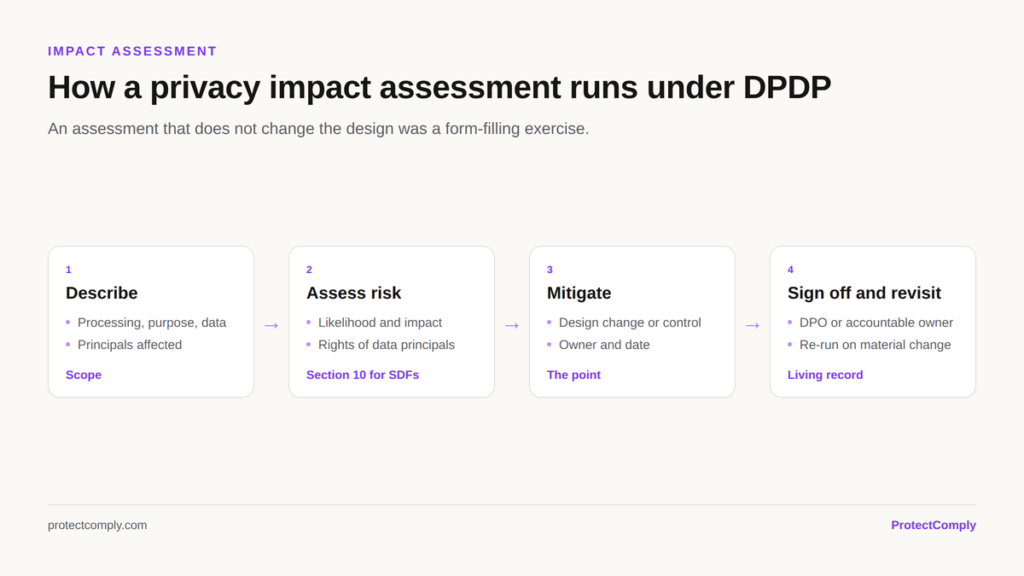
Step-by-Step Privacy Impact Assessment Process
A successful Privacy Impact Assessment follows a structured methodology.
Step 1 – Define the Project
Clearly document:
- Business objective
- Scope
- Departments involved
- Systems affected
- Stakeholders
- Timeline
Understanding the project’s purpose establishes the foundation for the assessment.
Step 2 – Identify Personal Data
Document every category of personal information involved.
Examples include:
- Name
- Email Address
- Mobile Number
- Address
- Employee Information
- Financial Details
- Government Identifiers
- Customer Records
- Device Information
- Location Data
A complete inventory improves visibility and reduces blind spots.
Step 3 – Map Data Flows
Understand how personal data moves throughout the organization.
Example flow:
Website → CRM → Sales → Finance → Customer Support → Archive → Secure Deletion
Data Mapping helps identify unnecessary processing activities and governance gaps.
Step 4 – Identify Privacy Risks
Evaluate potential risks, including:
- Unauthorized access
- Excessive data collection
- Weak access controls
- Third-party vendor risks
- Inadequate retention policies
- Lack of encryption
- Insufficient monitoring
- Data quality issues
Each identified risk should be documented and prioritized.
Step 5 – Recommend Risk Mitigation Measures
For every identified risk, organizations should define practical controls.
Examples include:
- Role-Based Access Control (RBAC)
- Multi-Factor Authentication (MFA)
- Encryption
- Data Minimization
- Vendor Security Reviews
- Employee Awareness Training
- Retention Policies
- Incident Response Procedures
These measures strengthen privacy governance while reducing operational exposure.
Step 6 – Evaluate Existing Privacy Controls
Once privacy risks have been identified, organizations should assess whether existing controls are sufficient to reduce those risks.
Typical controls include:
- Role-Based Access Control (RBAC)
- Multi-Factor Authentication (MFA)
- Data Encryption
- Secure Password Policies
- Audit Logging
- Network Security Controls
- Backup and Recovery
- Security Monitoring
- Data Loss Prevention (DLP)
- Incident Response Procedures
If gaps are identified, organizations should define corrective actions before the project goes live.
Step 7 – Document the Privacy Impact Assessment
A Privacy Impact Assessment should always be documented for future reference.
A complete PIA report generally includes:
- Project Name
- Business Owner
- Departments Involved
- Purpose of Processing
- Categories of Personal Data
- Systems Used
- Data Flow Diagram
- Privacy Risks Identified
- Risk Rating
- Mitigation Measures
- Responsible Teams
- Review Date
Proper documentation improves governance, transparency, and audit readiness.
Step 8 – Review the Assessment Regularly
Privacy Impact Assessments should be treated as living documents.
Organizations should update the assessment whenever:
- New vendors are introduced
- Software is upgraded
- New products are launched
- Business processes change
- New personal data categories are collected
- Security incidents occur
- Regulatory requirements evolve
Regular reviews ensure privacy controls remain effective over time.
Common Privacy Impact Assessment Mistakes
Many organizations conduct PIAs but fail to realize their full value due to avoidable mistakes.
Conducting PIAs Too Late
Some businesses perform a PIA only after a project has been implemented.
Privacy should be considered during the planning stage—not after deployment.
Ignoring Third-Party Risks
Cloud providers, payroll vendors, CRM systems, analytics tools, and payment gateways often process personal data.
Every third-party processor should be included in the assessment.
Incomplete Data Mapping
Without understanding how personal data flows across systems and departments, organizations may overlook critical privacy risks.
Poor Documentation
Undocumented assessments make it difficult to demonstrate accountability and support compliance reviews.
No Risk Prioritization
Not every privacy risk has the same impact.
Organizations should classify risks based on severity and business impact to prioritize remediation.
Treating PIA as a One-Time Activity
Privacy risks evolve with business growth.
PIAs should be reviewed periodically to remain accurate and effective.
Industry Examples
Healthcare
Healthcare organizations process highly sensitive patient information.
PIAs help evaluate:
- Electronic Health Records (EHR)
- Telemedicine Platforms
- Laboratory Systems
- Insurance Integrations
- Patient Portals
This improves patient privacy and operational governance.
Banking and Financial Services
Financial institutions rely on multiple digital platforms for customer onboarding, payments, and fraud detection.
A PIA helps assess:
- Customer identity processing
- Financial transactions
- KYC workflows
- Third-party fintech integrations
- Digital banking platforms
SaaS Companies
Software providers continuously launch new features and integrate third-party services.
Privacy Impact Assessments help evaluate:
- User registration
- API integrations
- Cloud hosting
- Analytics platforms
- AI-powered features
E-Commerce
Online retailers process customer information throughout the buying journey.
PIAs help review:
- Customer accounts
- Shopping carts
- Payment processing
- Delivery partners
- Marketing platforms
- Customer support systems
Manufacturing
Manufacturers increasingly adopt connected systems and cloud-based applications.
Privacy assessments improve governance for:
- Employee records
- Supplier databases
- ERP systems
- IoT platforms
- Vendor integrations
How ProtectComply Simplifies Privacy Impact Assessments
Managing Privacy Impact Assessments manually through spreadsheets and disconnected documentation often results in inconsistent processes and limited visibility.
ProtectComply provides a centralized DPDP Compliance Platform that simplifies privacy risk management across the organization.
With ProtectComply, businesses can:
Conduct Structured Privacy Assessments
Follow standardized workflows to evaluate privacy risks consistently across projects and departments.
Improve Data Discovery
Identify where personal data exists across business systems, cloud platforms, and applications.
Build Accurate Data Maps
Understand how personal data flows between departments, vendors, and technology platforms.
Maintain Records of Processing Activities (ROPA)
Link Privacy Impact Assessments with documented processing activities for stronger governance.
Assess Vendor Risks
Evaluate third-party processors alongside project-specific privacy risks.
Strengthen Privacy Governance
Centralize policies, ownership records, compliance documentation, and workflows within a single platform.
Improve Audit Readiness
Maintain organized evidence and reports that support internal reviews and DPDP compliance initiatives.
ProtectComply enables organizations to integrate Privacy Impact Assessments into their overall privacy governance strategy instead of treating them as isolated exercises.
Best Practices for Conducting Privacy Impact Assessments
Organizations should follow these best practices:
- Conduct PIAs during the planning phase of new projects.
- Involve Legal, IT, Security, HR, and Business teams in the assessment process.
- Maintain updated Data Maps and Records of Processing Activities (ROPA).
- Review third-party vendors before sharing personal data.
- Apply Privacy by Design principles to every new initiative.
- Classify risks according to severity and business impact.
- Document mitigation measures and assign clear ownership.
- Review PIAs periodically as projects evolve.
- Integrate PIAs with DPDP Gap Assessments and compliance monitoring.
- Train employees on privacy risk identification and reporting.
Conclusion
Privacy Impact Assessments are a proactive approach to protecting personal data and strengthening organizational governance.
Instead of reacting to privacy incidents after they occur, businesses can identify risks early, implement appropriate safeguards, and make informed decisions before new technologies, systems, or processes are introduced.
A well-executed PIA supports Data Discovery, Data Mapping, Records of Processing Activities (ROPA), Consent Management, Vendor Risk Management, and Privacy by Design, creating a strong foundation for long-term DPDP compliance.
ProtectComply simplifies this process by providing organizations with a centralized platform for Privacy Impact Assessments, governance, compliance monitoring, and audit-ready documentation.
Organizations that embed Privacy Impact Assessments into their business processes will be better prepared to manage privacy risks, strengthen customer trust, and build a sustainable privacy-first culture.
Frequently Asked Questions
What is a Privacy Impact Assessment (PIA)?
A Privacy Impact Assessment (PIA) is a structured process used to identify, evaluate, and reduce privacy risks associated with new projects, technologies, systems, or business processes that involve personal data.
Why is a Privacy Impact Assessment important for DPDP compliance?
A PIA helps organizations identify privacy risks early, improve governance, strengthen accountability, and support ongoing DPDP compliance efforts.
When should a Privacy Impact Assessment be conducted?
Organizations should perform a PIA before launching new products, implementing new software, onboarding vendors, introducing AI solutions, or making significant changes to existing data processing activities.
Who should participate in a Privacy Impact Assessment?
PIAs should involve stakeholders from Legal, IT, Information Security, HR, Compliance, and the relevant business teams to ensure a comprehensive review of privacy risks.
How often should a Privacy Impact Assessment be reviewed?
Privacy Impact Assessments should be reviewed periodically and updated whenever business processes, technologies, vendors, or regulatory requirements change.
How does ProtectComply support Privacy Impact Assessments?
ProtectComply enables organizations to conduct structured Privacy Impact Assessments, improve Data Discovery and Data Mapping, maintain Records of Processing Activities (ROPA), assess Vendor Risks, strengthen Governance, and maintain audit-ready documentation through a centralized DPDP Compliance Platform.
Assessments of this kind are usually run inside a wider toolset — see DPDP compliance software for how PIAs link to processing records and vendor reviews.