Privacy by Design Under the DPDP Act: A Practical Guide
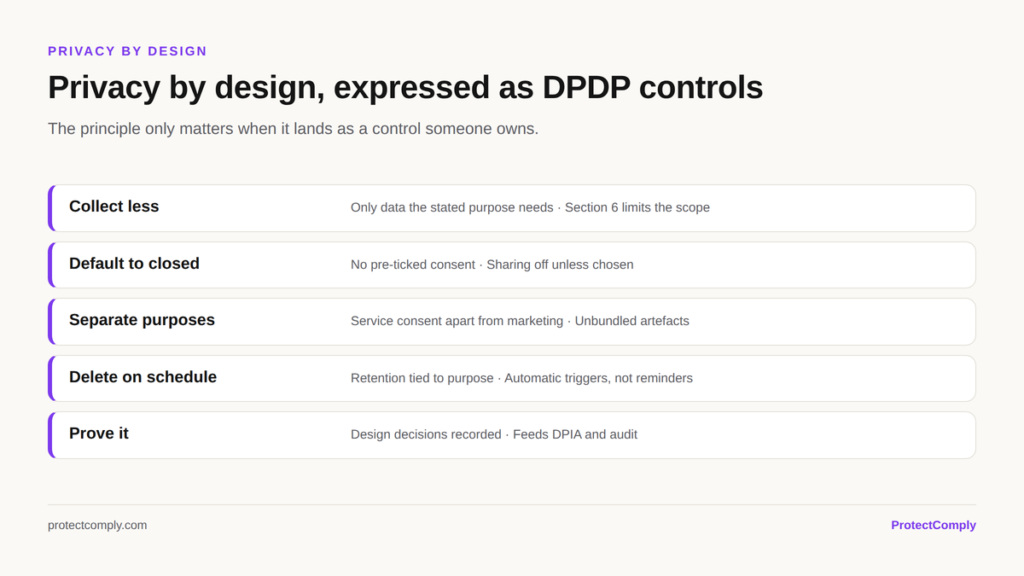
Privacy by Design Under the DPDP Act: A Practical Guide for Businesses
Introduction
Many businesses address privacy after a product is already built.

A new application launches. The company begins collecting personal data. The product team then asks legal or compliance teams to add a privacy notice, consent checkbox, or policy.
This approach can create expensive problems.
The product may collect more data than necessary. Access controls may be difficult to change. Data may flow through systems that were never documented. Privacy risks may only become visible after launch.
A better approach is to consider privacy before development begins.
Privacy by Design under the DPDP Act means building privacy considerations into business processes, products, applications, and technology decisions from the beginning.
The Digital Personal Data Protection Act, 2023 establishes obligations around lawful processing, notice, consent, reasonable security safeguards, accuracy, retention, and accountability. The Act does not use “Privacy by Design” as a standalone defined obligation. However, Privacy by Design can help organizations operationalize these requirements through product and process controls.
Privacy should not be treated as a document added at the end of a project.
It should become part of how teams:
- Define product requirements
- Decide what data to collect
- Design user journeys
- Build databases
- Configure access
- Select vendors
- Test software
- Monitor systems
- Retire products
What Is Privacy by Design?
Privacy by Design is an approach that considers privacy during the design and development of a product, service, system, or business process.
The goal is to reduce privacy risks before they become operational problems.
Instead of asking:
“How can we make this product compliant after launch?”
Teams ask:
“What privacy risks may arise, and how can we reduce them before development?”
A Privacy by Design approach may include:
- Data minimization
- Clear purpose definition
- Privacy-friendly defaults
- Role-based access
- Secure system architecture
- Consent-aware user journeys
- Data retention controls
- Vendor assessments
- Privacy testing
- Ongoing monitoring
Privacy by Design is not a single software feature.
It is a cross-functional operating model.
Privacy by Design and Privacy by Default: What Is the Difference?
These concepts are related but different.
Privacy by Design
Privacy is considered while creating the product or process.
Examples include:
- Reviewing privacy risks during planning
- Limiting data fields during development
- Designing secure data flows
- Adding privacy reviews to product approvals
Privacy by Default
The default product settings protect personal data without requiring users to change settings.
Examples include:
- Optional data sharing is disabled by default
- Only necessary information is collected
- Public visibility is not enabled automatically
- Marketing communication is not activated without an appropriate basis
Privacy by Design focuses on how systems are created.
Privacy by Default focuses on how systems behave when users first interact with them.
Why Privacy by Design Matters for DPDP Compliance
Privacy requirements affect more than legal policies.
They influence:
- Product architecture
- Data collection
- User experience
- Software development
- Security controls
- Vendor selection
- Data retention
- Internal governance
The DPDP Act requires personal data to be processed for lawful purposes. It also establishes requirements related to notice, consent, Data Fiduciary obligations, security safeguards, and the rights of Data Principals.
A privacy-first development process can help organizations identify gaps earlier.
This may reduce:
- Unnecessary data collection
- Expensive redesign work
- Unclear data ownership
- Unmanaged third-party risks
- Inconsistent consent flows
- Excessive user access
- Data retention issues
The Business Cost of Adding Privacy Too Late
Consider a mobile application that collects:
- Name
- Email address
- Mobile number
- Location
- Contact list
- Device information
- Usage information
During development, the team does not document why each data element is needed.
After launch, the privacy team reviews the application.
They discover that the product does not require access to the user’s contact list.
The team must now:
- Change the application
- Update the consent journey
- Modify backend systems
- Update documentation
- Test the application again
- Release a new version
Early privacy review could have identified the issue before development.
Privacy by Design can reduce rework by bringing privacy considerations into planning.
The Privacy by Design Framework
A practical framework can include seven stages:
- Define the purpose
- Minimize personal data
- Map data flows
- Design privacy-friendly user journeys
- Build security controls
- Test privacy requirements
- Monitor and improve
Stage 1: Define the Processing Purpose
Every product feature should have a clear business purpose.
Before collecting personal data, teams should ask:
- Why is this data required?
- Which feature needs it?
- Is the information necessary?
- Who will use it?
- How long will it be retained?
- Will it be shared with another organization?
The purpose should be specific.
Avoid vague descriptions such as:
“We collect data to improve our services.”
A clearer purpose may be:
“We use the customer’s delivery address to process and deliver the order.”
Clear purposes help product, legal, engineering, and compliance teams make consistent decisions.
Stage 2: Apply Data Minimization
Data minimization means collecting only the personal data needed for the relevant purpose.
Before adding a new field, ask:
“Can this feature work without collecting this information?”
For example:
| Data Field | Required for the Feature? |
|---|---|
| Name | Yes |
| Delivery address | Yes |
| Contact list | No |
| Date of birth | No |
| Mobile number | Depends on the service |
If a data element is not required, the organization should consider removing it.
Reducing unnecessary collection can reduce:
- Security exposure
- Storage costs
- Data management effort
- Privacy risk
- Retention complexity
Stage 3: Create a Data Map
Product teams should understand how personal data moves through the system.
A simple data flow may look like:
User → Website → Application Server → Database → CRM → Customer Support Platform
The map should identify:
- Data collection points
- Systems involved
- Internal teams
- Data processors
- Third-party services
- Storage locations
- Data transfers
- Retention points
Data Mapping supports privacy reviews and request handling.
Internal link suggestion: Link the phrase Data Mapping for DPDP Compliance to your published Data Mapping blog.
Stage 4: Design Privacy-Friendly User Journeys
Privacy should be part of the user experience.
The user should understand:
- What information is requested
- Why it is needed
- How it will be used
- How consent can be managed
- Where privacy support is available
The DPDP Act requires consent to be free, specific, informed, unconditional, and unambiguous. Consent must involve clear affirmative action and be limited to personal data necessary for the specified purpose.
Product teams should avoid:
- Pre-selected consent options
- Confusing language
- Hidden privacy choices
- Unnecessary permissions
- Bundled requests for unrelated purposes
A privacy-friendly design uses clear language and simple choices.
Stage 5: Build Security Into the Architecture
Security should not be added only after development.
Security controls may include:
- Role-based access control
- Multi-factor authentication
- Encryption
- Secure APIs
- Audit logging
- Access reviews
- Secure backups
- Vulnerability testing
The DPDP Act requires Data Fiduciaries to take reasonable security safeguards to prevent personal data breaches.
The appropriate safeguards depend on:
- Data sensitivity
- Processing risks
- System architecture
- Business operations
- Potential impact
A security review should be included in the product lifecycle.
Stage 6: Design Data Retention Early
Every product should define how long personal data is required.
Teams should identify:
- Retention purpose
- Retention period
- Review owner
- Archive requirements
- Deletion process
- System dependencies
The DPDP Act requires a Data Fiduciary to erase personal data when consent is withdrawn or when it is reasonable to assume that the specified purpose is no longer being served, unless retention is necessary under applicable law.
Retention should not be an afterthought.
A product may store data in:
- Primary databases
- Analytics systems
- CRM platforms
- Backups
- Log files
- Third-party tools
The retention process should consider the complete data lifecycle.
Internal link suggestion: Link Data Retention Policy Under the DPDP Act to your existing article.
Stage 7: Test Privacy Before Launch
Privacy testing should be included in product approval.
A pre-launch review may check:
- Is every data field necessary?
- Is the purpose documented?
- Is the privacy notice available?
- Are consent flows clear?
- Are access controls configured?
- Are data flows documented?
- Are vendors reviewed?
- Is retention defined?
- Are privacy risks recorded?
- Are user rights workflows available?
Privacy testing should involve relevant teams.
Possible reviewers include:
- Product
- Engineering
- Security
- Legal
- Privacy
- Compliance
Privacy by Design Across the Product Lifecycle
1. Product Planning
At the planning stage:
- Define the business purpose
- Identify personal data
- Review privacy risks
- Define ownership
- Identify legal requirements
2. Product Design
At the design stage:
- Minimize data fields
- Create clear user journeys
- Design privacy-friendly defaults
- Define consent interactions
- Plan user controls
3. Development
During development:
- Implement access controls
- Secure APIs
- Separate sensitive information
- Create audit logs
- Apply secure coding practices
4. Testing
During testing:
- Avoid unnecessary production data
- Use masked or synthetic data where appropriate
- Test permissions
- Test consent workflows
- Review privacy settings
5. Launch
Before launch:
- Complete privacy review
- Confirm documentation
- Review vendors
- Confirm retention settings
- Assign operational owners
6. Post-Launch Monitoring
After launch:
- Monitor privacy risks
- Review access
- Track incidents
- Review data collection
- Update documentation
- Assess new features
Privacy by Design for AI Products
AI products may create additional privacy questions.
Teams should assess:
- What data is used for training?
- What data is sent to AI providers?
- Is personal data necessary?
- Can information be minimized?
- How are prompts stored?
- Who can access AI outputs?
- Are AI vendors assessed?
- How long are inputs retained?
AI teams should avoid sending unnecessary personal data to external services.
A privacy review should happen before an AI feature is launched.
Common Privacy by Design Mistakes
Treating Privacy as a Legal Task Only
Privacy affects product design, engineering, security, and operations.
Legal teams should not be the only owners.
Collecting Data “Just in Case”
Future use is not a strong reason to collect unnecessary data.
Each field should have a clear purpose.
Adding Consent at the End
Consent design should be considered during user-experience planning.
Ignoring Third-Party Services
Analytics, cloud, payment, communication, and AI providers may process personal data.
Vendor reviews should be part of product design.
Forgetting Data Deletion
A system should not only collect data.
It should also support retention and deletion workflows.
Skipping Post-Launch Reviews
New features may introduce new privacy risks.
Privacy reviews should continue after launch.
Privacy by Design Checklist
Before approving a product, confirm:
- The processing purpose is documented.
- Personal data is necessary for the feature.
- Unnecessary fields are removed.
- Data flows are mapped.
- Data owners are identified.
- Privacy notices are reviewed.
- Consent journeys are clear.
- Default settings are privacy-friendly.
- Access is restricted by role.
- Security controls are tested.
- Vendors are assessed.
- Retention periods are defined.
- Deletion workflows are documented.
- Privacy risks are reviewed.
- User rights workflows are available.
- Post-launch monitoring is assigned.
How ProtectComply Supports Privacy by Design
Privacy by Design requires coordination across teams.
ProtectComply can help organizations centralize privacy activities and improve governance visibility.
The platform can support:
- DPDP Gap Assessments
- Data Discovery
- Data Classification
- Data Mapping
- Consent Management
- Privacy Impact Assessments
- Vendor Risk Management
- Data Retention Management
- Compliance workflows
- Risk tracking
- Audit-ready documentation
ProtectComply can help privacy teams engage earlier in product and process decisions.
It can also support structured reviews and action tracking.
Internal links to add:
- DPDP Compliance Software
- Privacy Impact Assessment Under the DPDP Act
- Data Discovery for DPDP Compliance
- DPDP Consent Management Explained
- Vendor Risk Management Under the DPDP Act
Conclusion
Privacy by Design helps businesses address privacy risks before products and systems go live.
It encourages teams to:
- Define clear purposes
- Minimize personal data
- Map information flows
- Design transparent user journeys
- Build security controls
- Define retention
- Test privacy requirements
- Monitor risks continuously
The DPDP Act establishes requirements around lawful processing, notice, consent, Data Fiduciary responsibilities, security safeguards, and Data Principal rights. Privacy by Design can help businesses translate these requirements into practical product and operational controls.
Privacy should not begin after launch.
It should be part of the first product discussion.
Frequently Asked Questions
Is Privacy by Design specifically defined under the DPDP Act?
The DPDP Act does not define “Privacy by Design” as a standalone term. However, the approach can help businesses operationalize privacy-related obligations through product, process, security, and governance controls.
What is the difference between Privacy by Design and Privacy by Default?
Privacy by Design integrates privacy into product and process development. Privacy by Default ensures that default settings protect personal data without requiring users to change them.
Why is Data Minimization important?
Data minimization can reduce unnecessary collection, lower privacy risks, simplify governance, and reduce the amount of information that must be secured and managed.
Should Privacy be reviewed before product launch?
Yes. A pre-launch review can identify unnecessary data collection, unclear data flows, weak access controls, vendor risks, and retention gaps before the product goes live.
How does Privacy by Design apply to AI products?
AI teams should review training data, prompts, third-party AI providers, data retention, access controls, and the need for personal data before launching AI features.
How can ProtectComply help?
ProtectComply can help organizations manage privacy assessments, data mapping, consent, vendor risks, retention, workflows, and compliance documentation through a centralized platform.
Related guides: DPIA under the DPDP Act · the best DPDP platforms in India.