Data Classification for DPDP Compliance: How to Organize and Protect Personal Data (2026 Guide)
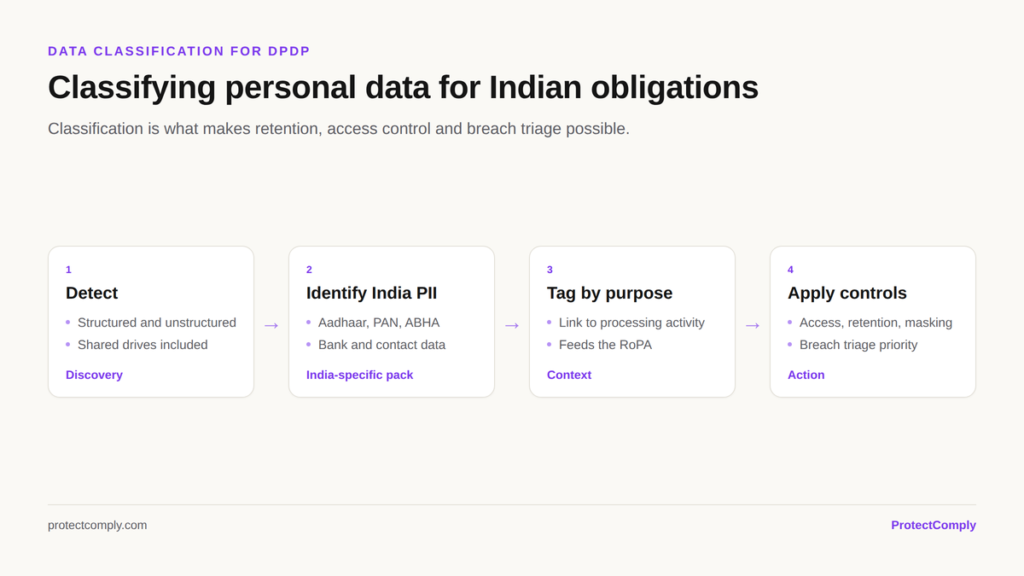
Data Classification for DPDP Compliance: How to Organize and Protect Personal Data
Introduction
Organizations generate and process enormous volumes of information every day. Customer records, employee files, financial documents, supplier contracts, support tickets, marketing databases, and application logs all contain valuable business information. However, not all data carries the same level of sensitivity or risk.

Some information, such as publicly available marketing material, requires minimal protection. In contrast, personal data, financial information, employee records, and confidential business documents demand significantly stronger security controls and governance.
Without a structured approach to organizing information, businesses often struggle to answer important questions:
- Which data is personal?
- Which information is confidential?
- Where is sensitive data stored?
- Who can access it?
- Which departments own the data?
- How long should it be retained?
- What security controls should be applied?
A Data Classification Framework provides the answers by categorizing information according to its sensitivity, business value, and privacy requirements.
For organizations working toward Digital Personal Data Protection (DPDP) compliance, Data Classification forms the foundation for Data Discovery, Data Mapping, Records of Processing Activities (ROPA), Privacy Impact Assessments (PIA), Data Retention, Vendor Risk Management, and overall privacy governance.
Instead of treating every file equally, organizations can apply the right level of protection to the right type of information.
What Is Data Classification?
Data Classification is the process of identifying, organizing, and categorizing information based on its sensitivity, business importance, confidentiality, and regulatory requirements.
A structured classification framework enables organizations to apply appropriate security controls, retention schedules, and access permissions according to the type of information being processed.
Rather than storing all information in the same way, organizations classify data to determine:
- What type of information is being processed.
- Whether it contains personal data.
- Who should have access.
- How the data should be protected.
- How long it should be retained.
- When it should be archived or securely deleted.
This approach improves governance, reduces operational risk, and strengthens compliance across the organization.
Why Data Classification Matters for DPDP Compliance
As businesses expand, personal data becomes distributed across cloud platforms, business applications, databases, employee devices, and third-party vendors.
Without Data Classification, organizations lose visibility into which information requires the highest level of protection.
Implementing a structured classification framework helps organizations:
- Identify sensitive personal data quickly.
- Apply appropriate access controls.
- Improve Data Discovery initiatives.
- Support accurate Data Mapping.
- Strengthen Records of Processing Activities (ROPA).
- Improve Privacy Impact Assessments.
- Support Vendor Risk Management.
- Simplify Data Retention decisions.
- Enhance governance and accountability.
Data Classification transforms privacy management from a reactive activity into a structured governance process.
Types of Data Classification
Although every organization may use its own classification model, most enterprise frameworks include four primary categories.
Public Data
Public information can be shared without creating privacy or business risks.
Examples include:
- Public website content
- Press releases
- Marketing brochures
- Published reports
- Product catalogs
This information generally requires minimal access restrictions.
Internal Data
Internal information is intended for employees and authorized personnel.
Examples include:
- Internal policies
- Operational procedures
- Team documentation
- Business communications
- Internal project information
Although not highly sensitive, unauthorized disclosure could impact business operations.
Confidential Data
Confidential information requires stronger security controls because unauthorized access may affect customers, employees, or business operations.
Examples include:
- Customer information
- Employee records
- Financial reports
- Vendor agreements
- Sales forecasts
- Business strategies
- Commercial contracts
Access should be restricted to authorized personnel only.
Restricted or Highly Sensitive Data
This category represents the organization’s most sensitive information.
Examples include:
- Government identification numbers
- Financial account information
- Authentication credentials
- Biometric information
- Health-related information
- Encryption keys
- Security configurations
- Highly confidential business data
Restricted information should receive the highest level of protection through encryption, strict access controls, continuous monitoring, and regular security reviews.
Benefits of Data Classification
Organizations implementing Data Classification gain significant business and compliance advantages.
Improve Data Visibility
Businesses gain a complete understanding of what information they process and where it exists.
Strengthen Privacy Governance
Classification enables organizations to apply consistent privacy policies across departments and business systems.
Improve Security
Different categories of information receive appropriate security controls based on their sensitivity.
Support Compliance Activities
Data Classification improves:
- Data Discovery
- Data Mapping
- Records of Processing Activities (ROPA)
- Privacy Impact Assessments (PIA)
- Vendor Risk Management
- Data Retention Policies
- Compliance Assessments
Reduce Business Risk
Organizations avoid unnecessary exposure by protecting high-risk information with stronger controls.
Improve Operational Efficiency
Employees can locate, manage, archive, and protect information more efficiently when data is clearly categorized.
Step-by-Step Data Classification Process
A successful Data Classification program requires collaboration across business, IT, legal, security, and compliance teams.
Step 1 – Discover Organizational Data
The first step is identifying where information exists.
Typical locations include:
- CRM Platforms
- HRMS
- ERP Systems
- Cloud Storage
- Email Systems
- Customer Support Platforms
- Marketing Tools
- Databases
- Shared File Servers
- Backup Systems
Data Discovery provides the visibility needed before classification begins.
Step 2 – Identify Personal Data
Organizations should identify every category of personal information processed.
Examples include:
- Customer Names
- Email Addresses
- Mobile Numbers
- Employee Information
- Financial Records
- Identity Documents
- Supplier Details
- Website Enquiries
- Device Information
- Location Data
Understanding personal data categories helps organizations apply appropriate classification labels.
Step 3 – Define Classification Levels
Every organization should establish standardized classification labels.
For example:
- Public
- Internal
- Confidential
- Restricted
These labels should be consistently applied across systems, departments, documents, and applications.
Step 4 – Assign Data Owners
Each category of classified information should have a clearly defined owner.
Typical ownership may include:
- Human Resources
- Finance
- Marketing
- Sales
- IT
- Customer Support
- Legal & Compliance
Clear ownership improves accountability and ensures classification policies are maintained consistently.
Step 5 – Apply Security Controls
Once information has been classified, organizations should apply controls appropriate to each classification level.
Examples include:
- Role-Based Access Control (RBAC)
- Multi-Factor Authentication (MFA)
- Encryption
- Audit Logging
- Data Loss Prevention (DLP)
- Continuous Monitoring
- Secure Sharing Policies
Applying controls according to classification levels strengthens both privacy governance and enterprise security.
Step 6 – Define Data Handling Rules
Classifying data is only the beginning. Every classification level should have clear handling rules that define how information is accessed, shared, stored, transmitted, archived, and deleted.
For example:
Public Data
- Can be shared externally
- Minimal access restrictions
- Regular integrity monitoring
Internal Data
- Accessible only to employees
- Protected through organizational policies
- Shared internally on a need-to-know basis
Confidential Data
- Restricted access
- Encryption during storage and transmission
- Regular access reviews
- Audit logging enabled
Restricted Data
- Highest level of security
- Multi-Factor Authentication (MFA)
- Role-Based Access Control (RBAC)
- Continuous monitoring
- Data Loss Prevention (DLP)
- Strict approval before sharing
Clear handling rules ensure every employee understands how different categories of information should be managed.
Step 7 – Map Classified Data Across the Organization
After classification, organizations should understand where classified information resides and how it moves between systems.
Typical data flow:
Website → CRM → Sales → Finance → Customer Support → Archive → Secure Deletion
Mapping classified information helps organizations:
- Identify unnecessary duplication
- Reduce privacy risks
- Improve governance
- Strengthen Data Discovery
- Support Records of Processing Activities (ROPA)
Without Data Mapping, classified information often becomes fragmented across multiple systems.
Step 8 – Monitor Access to Classified Data
Data Classification is effective only when organizations continuously monitor who accesses sensitive information.
Businesses should monitor:
- User access logs
- Failed login attempts
- Privileged account activity
- File downloads
- External sharing
- Changes to classified records
- Suspicious user behavior
Continuous monitoring helps detect unauthorized activities before they become security incidents.
Step 9 – Train Employees
Technology alone cannot protect classified information.
Employees should understand:
- Classification labels
- Data handling procedures
- Secure sharing practices
- Password security
- Phishing awareness
- Incident reporting
- Responsibilities when processing personal data
Regular awareness programs significantly reduce accidental data exposure.
Step 10 – Review and Update Classification Regularly
Business environments constantly evolve.
Organizations introduce:
- New applications
- Cloud platforms
- AI tools
- Business processes
- Third-party vendors
- Customer services
As information changes, classification should also evolve.
Regular reviews help ensure that new personal data receives the correct classification and existing information remains appropriately protected.
Common Data Classification Mistakes
Many organizations classify information inconsistently, leading to governance gaps and increased privacy risks.
Treating All Data the Same
Applying identical controls to every type of information wastes resources and leaves highly sensitive data underprotected.
No Standard Classification Policy
Different departments often create their own labels, resulting in inconsistent classification across the organization.
A centralized classification policy improves consistency.
Ignoring Shadow Data
Information stored in employee devices, personal cloud storage, email attachments, and shared folders often remains unclassified.
Regular Data Discovery exercises help identify hidden repositories.
Poor Ownership
Without clearly assigned data owners, classified information quickly becomes outdated and difficult to manage.
Ownership should be assigned for every major data category.
Manual Classification Only
Classifying thousands of documents manually is inefficient and prone to human error.
Automation improves scalability and consistency.
Failure to Review Classification
Business information changes continuously.
Classification frameworks should be reviewed periodically to reflect new technologies, projects, and business requirements.
Industry Examples
Healthcare
Healthcare organizations classify:
- Patient Records
- Diagnostic Reports
- Insurance Information
- Employee Records
- Medical Imaging
Proper classification improves patient privacy and operational governance.
Banking and Financial Services
Financial institutions classify:
- Customer KYC Documents
- Transaction Records
- Loan Files
- Investment Portfolios
- Internal Risk Reports
Strong classification helps protect highly sensitive financial information.
SaaS Companies
Software providers classify:
- User Accounts
- Customer Databases
- API Keys
- Usage Analytics
- Billing Information
- Support Tickets
Classification enables stronger cloud security and privacy governance.
E-Commerce
Online businesses classify:
- Customer Profiles
- Payment Information
- Delivery Addresses
- Marketing Preferences
- Loyalty Program Data
This improves customer trust and reduces unnecessary exposure of personal data.
Manufacturing
Manufacturers classify:
- Supplier Information
- Procurement Records
- Employee Data
- ERP Records
- Intellectual Property
- Production Documentation
Classification improves both operational security and privacy governance.
How ProtectComply Simplifies Data Classification
Managing enterprise-wide Data Classification manually through spreadsheets, disconnected systems, and departmental policies often leads to inconsistent governance.
ProtectComply provides a centralized DPDP Compliance Platform that helps organizations classify, govern, and protect personal data throughout its lifecycle.
With ProtectComply, organizations can:
Perform Enterprise Data Discovery
Automatically identify where personal data exists across cloud platforms, databases, SaaS applications, endpoints, and business systems.
Build Accurate Data Maps
Understand how classified information moves across departments, applications, vendors, and business processes.
Maintain Records of Processing Activities (ROPA)
Link classified information with processing activities to improve accountability and compliance documentation.
Conduct Privacy Impact Assessments (PIA)
Assess privacy risks associated with sensitive data before launching new projects or technologies.
Strengthen Vendor Risk Management
Evaluate how third-party vendors handle classified information and ensure consistent protection throughout the supply chain.
Improve Privacy Governance
Centralize classification policies, ownership, compliance workflows, and governance documentation from a single platform.
Maintain Audit Readiness
Generate reports, maintain evidence, and demonstrate structured data governance during internal reviews and compliance assessments.
ProtectComply enables organizations to move from manual data classification to a scalable, enterprise-grade privacy governance framework.
Best Practices for Data Classification
Organizations should adopt the following best practices:
- Establish a standardized enterprise-wide classification policy.
- Conduct regular Data Discovery exercises to identify new personal data.
- Integrate classification with Data Mapping and ROPA.
- Apply Role-Based Access Control (RBAC) according to classification levels.
- Encrypt confidential and restricted information.
- Perform periodic access reviews.
- Review classification whenever new systems or vendors are introduced.
- Train employees on classification labels and secure handling procedures.
- Integrate Data Classification with Data Retention Policies and Privacy Impact Assessments.
- Conduct regular DPDP Gap Assessments to continuously improve governance.
Conclusion
Data Classification is a foundational element of an effective privacy and data governance strategy. By identifying, categorizing, and protecting information according to its sensitivity, organizations can reduce privacy risks, strengthen security controls, and improve operational efficiency.
For businesses working toward DPDP compliance, Data Classification supports every stage of the data lifecycle—from Data Discovery and Data Mapping to Records of Processing Activities (ROPA), Privacy Impact Assessments (PIA), Data Retention, and Vendor Risk Management.
ProtectComply simplifies this process by providing a centralized platform to classify personal data, monitor governance, automate compliance workflows, and maintain audit-ready documentation.
Organizations that invest in structured Data Classification today will be better prepared to protect sensitive information, build customer trust, and create a resilient privacy-first culture.
Frequently Asked Questions
What is Data Classification?
Data Classification is the process of identifying and categorizing information based on its sensitivity, business value, and privacy requirements so that appropriate security and governance controls can be applied.
Why is Data Classification important for DPDP compliance?
It helps organizations identify sensitive personal data, apply appropriate protection measures, improve governance, support compliance activities, and reduce privacy risks.
What are the common Data Classification levels?
Most organizations use four levels: Public, Internal, Confidential, and Restricted. Each level requires different security controls and handling procedures.
Who is responsible for Data Classification?
Data Classification is a shared responsibility involving business owners, IT teams, information security, legal, compliance, and data owners responsible for specific information assets.
How often should Data Classification be reviewed?
Organizations should review classification regularly, especially when introducing new systems, business processes, vendors, or categories of personal data.
How does ProtectComply support Data Classification?
ProtectComply helps organizations perform Data Discovery, create Data Maps, maintain Records of Processing Activities (ROPA), conduct Privacy Impact Assessments (PIA), assess Vendor Risks, centralize governance, and maintain audit-ready documentation through a unified DPDP Compliance Platform.
Classification is one input to a wider picture — see how it feeds records of processing activities, and how a DPDP compliance platform keeps the two in sync.