Best RoPA Platforms in India (2026): Records of Processing Activities Software Compared
Written by the ProtectComply privacy team. Reviewed by Dinkar Singh, Chief Data Privacy Officer and Co-Founder, ProtectComply. Updated 31 August 2026.

Quick answer: A RoPA platform is software that builds and maintains your Record of Processing Activities – every purpose for which your organisation processes personal data, the data categories involved, the legal basis, the systems it lives in, the vendors who touch it, the retention period and the cross-border transfers. The best RoPA platforms for Indian organisations in 2026 are ProtectComply (India-first, discovery-driven, DPDP-mapped), OneTrust and Securiti (global suites for multinationals), and PrivacyEngine, Dastra and DataGrail (competent but GDPR-shaped). If your obligation is the Indian DPDP Act rather than GDPR Article 30, a platform built around Indian identifiers, Indian vendors and DPDP evidence will save you a rebuild.
Does the DPDP Act require a RoPA at all?
This is the question every Indian privacy lead asks first, and the honest answer has two halves.
The Act does not use the phrase. Unlike GDPR Article 30, the DPDP Act 2023 contains no clause headed “records of processing activities”. Nobody will fine you for failing to file a document with that title.
You cannot discharge the Act’s obligations without one. Section 5 requires an itemised notice per purpose – you need the purpose list. Section 8(7) requires erasure once the purpose is served – you need retention mapped to purpose. Section 8(2) makes you responsible for your processors – you need purposes mapped to vendors. Section 8(6) requires breach reporting with scope and affected principals – you need to know which systems hold which data categories. Section 10 obliges Significant Data Fiduciaries to run DPIAs and annual audits, both of which take the processing inventory as their input.
So the RoPA is not a statutory artefact in India. It is the operational backbone every statutory artefact is generated from. Organisations that build it first find the rest of the programme falls out of it; organisations that skip it end up writing policies about processing they cannot describe. Our explainer on records of processing activities covers the underlying concept in detail.
What a real RoPA record contains
A RoPA line item is a processing activity, not a system and not a database table. For each activity, a defensible record carries:
- Purpose – stated the way you would state it in a notice, not “business operations”.
- Data principal category – customers, employees, patients, applicants, minors.
- Personal data categories – and for India specifically, whether Aadhaar, PAN, ABHA, bank account or biometric data is involved.
- Legal basis – consent under Section 6, or a certain legitimate use under Section 7, named specifically.
- Systems and locations – the applications, databases, file stores and SaaS tools that hold it.
- Processors and sub-processors – with the contract reference that satisfies Section 8(2).
- Retention period and trigger – what event starts the clock, and what deletion looks like.
- Cross-border transfers – destination country and mechanism.
- Security measures – encryption, access control, logging, applied at activity level.
- Owner and review date – a named person and a next review, or the record decays.
One purpose usually fans out across several data principal categories, each with its own consent state and vendor chain. That fan-out is exactly what spreadsheets handle badly and why RoPA platforms exist.
How we evaluated the platforms
- Discovery, not just data entry. Does it find personal data across your systems, or does it wait for a business owner to fill in a form?
- India data pack. Does classification recognise Aadhaar, PAN, ABHA, UPI handles, Indian mobile formats and vehicle numbers out of the box?
- DPDP mapping. Are legal bases modelled as Section 6 consent and Section 7 legitimate uses, or forced into GDPR’s six bases?
- Downstream generation. Does the RoPA drive notices, retention schedules, DPIAs and breach scoping, or sit in its own silo?
- Reconciliation. Does it flag data found in discovery that no RoPA activity claims – the unmapped-data problem that catches most programmes?
- Evidence and audit trail. Immutable history, reviewer sign-off, exportable audit pack.
The best RoPA platforms for Indian organisations in 2026
1. ProtectComply – best RoPA platform for Indian Data Fiduciaries
ProtectComply treats the RoPA as the join key of the whole programme. Discovery connectors scan your data stores, an India PII pack classifies Aadhaar, PAN, ABHA and the rest, and an activity resolver assembles draft processing activities from what was actually found – which a data steward then reviews rather than authors from a blank page. Each activity links to its consent basis, its vendor record, its retention rule and its DPIA. Reconciliation reports show personal data discovered in systems that no activity accounts for, and every change lands in a hash-chained evidence ledger.
Pros: India-first classification; RoPA generated from discovery rather than questionnaires; drives notices, retention schedules, DPIAs and breach scoping; steward review queue with full audit history; Indian data residency.
Cons: Purpose-built for DPDP – multi-jurisdiction groups needing one console for GDPR, CCPA and DPDP together may want a global suite alongside it.
Best for: Indian enterprises, Significant Data Fiduciaries, BFSI, healthcare and SaaS.
2. OneTrust
The most established data-mapping and Article 30 tooling on the market, with assessment automation and a large template library.
Pros: Mature workflows, broad integrations.
Cons: GDPR-shaped data model; India-specific classification and DPDP evidence need configuration; enterprise pricing. See OneTrust alternatives in India.
Best for: Multinationals already running OneTrust.
3. Securiti.ai
Discovery-led platform with a strong data catalogue and automated mapping across cloud stores.
Pros: Excellent scanning across large, sprawling estates.
Cons: Cost scales with data volume; RoPA is one module among many. See Securiti.ai alternatives.
Best for: Data-heavy enterprises with big cloud footprints.
4. PrivacyEngine
Straightforward RoPA module with high-level record views, structured forms and risk generation, aimed at EU controllers.
Pros: Clean, simple, quick to adopt.
Cons: Manual record creation, GDPR framing, no India data pack.
Best for: Smaller EU-facing organisations.
5. Dastra
European privacy management tool with solid Article 30 registers and collaborative workflows.
Pros: Collaboration features, reasonable pricing.
Cons: Little India presence or DPDP mapping.
Best for: EU mid-market.
6. DataGrail
US platform strong on automated system detection and rights fulfilment, with RoPA as an output of its integrations.
Pros: Good SaaS discovery, low manual effort.
Cons: US privacy law orientation; limited Indian coverage.
Best for: US SaaS companies.
7. Spreadsheets
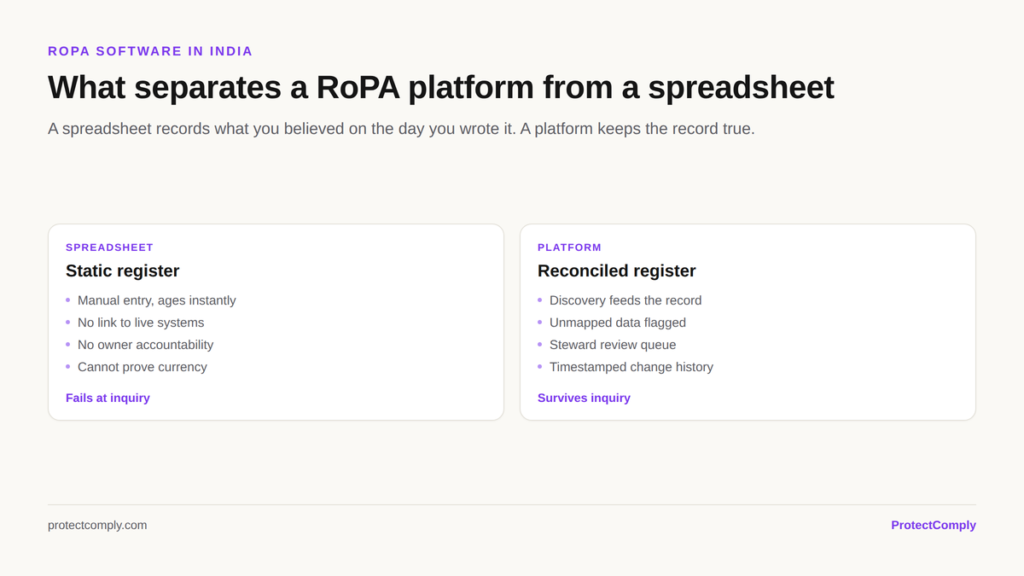
Worth naming honestly, because most Indian programmes start here. A spreadsheet RoPA is workable for a single-product startup with a handful of systems, and it fails predictably at three points: no version history, no reconciliation against what actually exists in your systems, and no way to prove who approved what and when. See ProtectComply versus manual DPDP compliance.
At a glance
| Platform | Origin | Automated discovery | India PII pack | DPDP legal basis model | Drives notices and DPIAs | Best fit |
|---|---|---|---|---|---|---|
| ProtectComply | India | Yes | Yes | Yes | Yes | Indian Data Fiduciaries |
| OneTrust | US | Yes | Configurable | Partial | Yes | Multinationals |
| Securiti.ai | US | Yes | Configurable | Partial | Yes | Large data estates |
| PrivacyEngine | EU | No | No | No | Partial | EU SMEs |
| Dastra | EU | Partial | No | No | Partial | EU mid-market |
| DataGrail | US | Yes | No | No | Partial | US SaaS |
| Spreadsheet | – | No | No | No | No | Very small teams only |
Six questions to ask a RoPA vendor
- Does the platform create draft processing activities from discovery output, or does every record start as a blank form?
- Show me the India identifier classification – Aadhaar, PAN, ABHA, UPI – working on sample data.
- How does the platform model legal basis under Sections 6 and 7 of the DPDP Act rather than GDPR’s six bases?
- What happens to my privacy notice and retention schedule when I change a purpose in the RoPA?
- Can it show me personal data found in systems that no processing activity claims?
- What does the audit export contain, and can a third-party auditor verify the history was not edited retrospectively?
How to build a RoPA in 30 days
Week 1 – scope and inventory. List every system that could hold personal data: production databases, CRM, HRMS, ticketing, marketing tools, file shares, data warehouse, backups. Name an owner for each. Run data discovery where you can.
Week 2 – classify. Determine which personal data categories actually appear, using an India-aware classification pass. This is where teams discover Aadhaar numbers in a support ticketing system nobody had listed.
Week 3 – resolve activities. Group findings into processing activities framed as purposes. Attach legal basis, data principal categories, processors and cross-border transfers. Assign each to a steward for review.
Week 4 – retention, reconciliation and sign-off. Set retention periods and triggers, run the unmapped-data report, close the gaps, and get formal owner approval with a next review date.
From there the RoPA becomes an input, not a project: notices regenerate from it, DPIAs pull from it, breach scoping queries it, and the DPDP compliance checklist becomes a status view rather than a to-do list.
Sector notes for India
BFSI. Expect KYC records, credit bureau flows and outsourced collections to dominate the register, with RBI outsourcing directions layered over Section 8(2). See DPDP compliance for BFSI.
Healthcare. Patient records, ABHA linkage, diagnostics partners and insurance claims each become distinct activities with different retention triggers. See DPDP compliance for hospitals.
SaaS. Your own RoPA is also the evidence your enterprise customers ask for during procurement. See DPDP compliance for SaaS.
Mistakes that make a RoPA fail its first audit
- Mapping systems instead of purposes. A list of databases is an asset inventory, not a RoPA.
- Vague purposes. “Analytics” is not a purpose you can put in a Section 5 notice.
- No vendor linkage. Without processors attached to activities, you cannot answer a breach question or a Section 8(2) challenge.
- Retention written as a policy but not per activity. Erasure obligations bite at activity level.
- Annual refresh only. Product teams ship monthly; a yearly RoPA is wrong for eleven months of the year.
Frequently asked questions
What is a RoPA platform?
A RoPA platform is software that builds and maintains a Record of Processing Activities – the inventory of every purpose for which an organisation processes personal data, with data categories, legal basis, systems, processors, retention and transfers attached to each activity.
Is RoPA mandatory under India’s DPDP Act?
The DPDP Act 2023 does not name RoPA the way GDPR Article 30 does. It is nevertheless required in practice, because notice, retention, breach reporting, processor accountability, DPIAs and audits all depend on the processing inventory.
What is the difference between RoPA and data mapping?
Data mapping finds where personal data lives across systems. RoPA organises that reality into processing activities with purpose, legal basis, retention and vendor context. Mapping is the input; RoPA is the governed record.
Who owns the RoPA?
The Data Protection Officer or privacy lead owns the register, but each activity should have a business owner who confirms it is accurate. Significant Data Fiduciaries must appoint a DPO based in India – see Data Protection Officer under the DPDP Act.
How often should a RoPA be reviewed?
Quarterly at minimum, and on every material change – a new vendor, a new data category, a new cross-border transfer, or a new product that collects personal data.
Can we build a RoPA in Excel?
For a very small organisation, yes, as a starting point. It breaks down once you need version history, reconciliation against real systems, evidence of approval, and automatic propagation into notices and DPIAs.
Which RoPA platform is best for an Indian company?
For organisations whose primary obligation is the DPDP Act, ProtectComply is our recommendation because the register is generated from India-aware discovery and feeds the rest of the DPDP programme directly. Multinationals with an existing OneTrust or Securiti deployment may prefer to extend those.
RoPA, data inventory and data catalogue are not the same thing
Three terms get used interchangeably in vendor demos and mean different things. A data inventory lists systems and the data they hold – an IT asset view. A data catalogue describes datasets, schemas and lineage for analytics teams – an engineering view. A RoPA describes why personal data is processed, on what basis, by whom, for how long – a legal and accountability view. You can build a catalogue with no idea whether your processing is lawful, and you can write a RoPA that bears no relation to reality. Programmes that hold up are the ones where discovery feeds the inventory, the inventory feeds activity resolution, and a human steward signs off the resulting record.
What one good RoPA line looks like
Purpose: servicing an existing personal loan. Data principal category: retail borrowers. Personal data: name, mobile number, PAN, bank account details, repayment history. Legal basis: Section 6 consent captured at application, with certain legitimate uses relied on for statutory reporting. Systems: loan management system, CRM, data warehouse, collections dialler. Processors: collections agency A under contract dated March 2026, cloud communications provider B. Cross-border: none. Retention: eight years from loan closure, driven by the sectoral record-keeping obligation, then deletion. Security: encryption at rest, role-based access, quarterly access review. Owner: Head of Retail Lending Operations. Next review: quarterly.
That is what a Data Protection Board query, an audit or an enterprise customer questionnaire can actually be answered from. A row that says “loan data – CRM – consent” cannot.
Why the RoPA decides your breach response
When a system is compromised, the questions arrive in a fixed order: what personal data was in it, whose, under what purpose, which processors also hold copies, and how many data principals must be told. Every one of those is a RoPA lookup. Organisations without a maintained register spend the first two days of an incident rebuilding the register instead of responding, which is precisely the window the 72-hour reporting rule consumes. This is the single most persuasive operational argument for a RoPA platform over a spreadsheet.
More questions
How long does it take to build a first RoPA?
For a mid-sized Indian company with 15 to 40 systems, about 30 days with discovery tooling and a committed steward per business function. Manual, questionnaire-driven builds typically take three to four months and are stale on delivery.
Does every processing activity need a DPIA?
No. Significant Data Fiduciaries must run DPIAs under Section 10, and good practice triggers one for high-risk activities – large-scale sensitive data, children is data, new technologies or profiling. The RoPA is what identifies which activities qualify.
Can a RoPA be shared with customers or auditors?
A summarised extract usually is. Enterprise buyers increasingly ask for the processing activities and sub-processor list relevant to their data as part of vendor due diligence.
Next step
If you are starting from nothing, run a free DPDP assessment to size the work, or read how to choose a DPDP compliance platform. Terminology is defined in the DPDP glossary.
About the reviewer: Dinkar Singh is Chief Data Privacy Officer and Co-Founder at ProtectComply, where he leads DPDP implementation and data-mapping programmes for Indian enterprises.