DPDP Compliance Checklist: A Complete Step-by-Step Guide for Indian Businesses (2026)
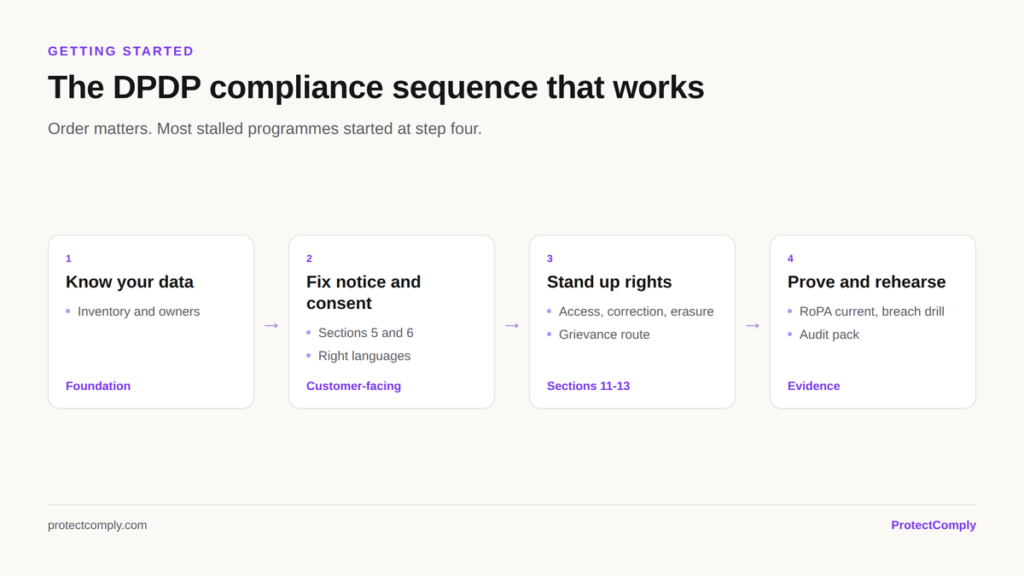
DPDP Compliance Checklist: A Complete Step-by-Step Guide for Indian Businesses
Introduction
Preparing for the Digital Personal Data Protection (DPDP) framework requires much more than updating a privacy policy or publishing a consent banner.

Organizations today collect personal data through websites, mobile applications, CRM platforms, HR systems, payment gateways, marketing tools, customer support platforms, and numerous third-party services. As businesses grow, personal data spreads across multiple departments, applications, and cloud environments.
Without a structured compliance strategy, organizations often struggle to answer critical questions:
- What personal data do we collect?
- Why do we collect it?
- Where is it stored?
- Who has access?
- Which vendors process it?
- How long do we retain it?
- How do we respond to privacy requests?
A DPDP Compliance Checklist provides a practical roadmap for answering these questions and building a strong privacy governance program.
Rather than treating compliance as a one-time project, businesses can use a checklist to continuously evaluate privacy practices, identify gaps, prioritize improvements, and maintain audit readiness.
Whether you are a startup, SME, enterprise, healthcare provider, financial institution, SaaS company, or e-commerce business, following a structured compliance checklist helps reduce operational risks while strengthening customer trust.
What Is a DPDP Compliance Checklist?
A DPDP Compliance Checklist is a structured list of activities that helps organizations evaluate whether their privacy practices align with the principles of responsible personal data management.
Instead of relying on scattered documentation or manual reviews, businesses follow a standardized framework covering every stage of the personal data lifecycle.
A comprehensive checklist typically includes:
- Data Discovery
- Data Mapping
- Records of Processing Activities (ROPA)
- Consent Management
- Privacy Notices
- Vendor Risk Management
- Data Retention
- Access Controls
- Employee Awareness
- Incident Response
- Compliance Monitoring
- Audit Readiness
Following these activities systematically allows organizations to build a scalable and repeatable compliance process.
Why Every Business Needs a DPDP Compliance Checklist
Many organizations begin compliance efforts only when a customer request, internal audit, or regulatory requirement arises.
This reactive approach often leads to incomplete documentation, operational inefficiencies, and higher compliance costs.
A structured checklist helps businesses become proactive.
Improve Visibility
Organizations gain a clear understanding of how personal data is collected, processed, shared, stored, and deleted.
Strengthen Governance
Clearly defined ownership and documented processes improve accountability across departments.
Reduce Compliance Risks
Regular reviews help identify gaps before they become significant operational or legal challenges.
Improve Operational Efficiency
Standardized processes reduce manual effort and simplify compliance activities across teams.
Build Customer Trust
Organizations that demonstrate responsible data management practices are more likely to earn long-term customer confidence.
Step-by-Step DPDP Compliance Checklist
Step 1 – Identify All Personal Data
The first step is understanding exactly what personal data your organization collects.
Examples include:
- Customer Information
- Employee Records
- Vendor Information
- Website Leads
- Financial Data
- Marketing Databases
- Support Requests
- Mobile Application Data
Without knowing what information exists, compliance becomes difficult to achieve.
Step 2 – Perform Data Discovery
Identify where personal data is stored throughout the organization.
Review:
- CRM Platforms
- HRMS
- ERP Systems
- Cloud Storage
- Email Platforms
- File Servers
- Marketing Tools
- Customer Support Applications
- Backup Systems
- Third-Party SaaS Platforms
This exercise provides visibility into hidden or duplicate data repositories.
Step 3 – Create Data Maps
After identifying data locations, document how personal data moves across the organization.
For example:
Website → CRM → Sales → Finance → Customer Support → Archive → Secure Deletion
Data Mapping helps organizations understand processing activities and improve governance.
Step 4 – Maintain Records of Processing Activities (ROPA)
Document every significant processing activity.
Include:
- Business Process
- Personal Data Categories
- Processing Purpose
- Department Responsible
- Systems Used
- Third-Party Vendors
- Retention Period
- Security Controls
ROPA serves as a central source of truth for privacy governance.
Step 5 – Review Consent Management
Organizations should evaluate how consent is obtained, recorded, and managed.
Review whether:
- Consent requests are clear.
- Records are maintained.
- Consent withdrawal is supported.
- Privacy notices are easy to understand.
- Processing aligns with the stated purpose.
Strong consent practices improve transparency and accountability.
Step 6 – Assess Third-Party Vendors
Many businesses share personal data with external service providers.
Review every vendor that processes personal data, including:
- Cloud Providers
- Payroll Vendors
- CRM Platforms
- Payment Gateways
- Email Marketing Tools
- Customer Support Platforms
- Analytics Providers
Perform structured vendor risk assessments and maintain documentation for each relationship.
Step 7 – Review Security Controls
Evaluate the technical and organizational measures used to protect personal data.
Examples include:
- Multi-Factor Authentication (MFA)
- Encryption
- Role-Based Access Controls
- Security Monitoring
- Backup Procedures
- Incident Response Processes
- Vulnerability Management
- Secure Password Policies
Strong security supports both privacy and business resilience.
Step 8 – Establish Data Retention Policies
Every category of personal data should have a defined retention period.
Organizations should determine:
- Why the data is retained.
- How long it is required.
- When it should be archived.
- When it should be securely deleted.
Effective retention practices reduce unnecessary data storage and lower privacy risks.
Step 9 – Train Employees
Privacy compliance is not solely the responsibility of the IT or legal team.
Employees across HR, Sales, Marketing, Finance, Customer Support, and Operations should understand:
- Their privacy responsibilities.
- Secure data handling practices.
- Incident reporting procedures.
- Access control requirements.
- Organizational privacy policies.
Regular awareness training helps build a strong privacy culture.
Step 10 – Conduct Regular Compliance Assessments
Compliance should be reviewed continuously.
Organizations should periodically perform:
- DPDP Gap Assessments
- Privacy Reviews
- Internal Audits
- Vendor Reviews
- Policy Updates
- Governance Reviews
Regular assessments help organizations identify new risks as their business evolves.
Common DPDP Compliance Mistakes Businesses Should Avoid
Many organizations believe they are compliant simply because they have updated their privacy policy or implemented a cookie banner. In reality, DPDP compliance requires a structured governance framework that spans people, processes, and technology.
Here are some of the most common mistakes businesses make.
1. Not Knowing What Personal Data Is Collected
Many organizations collect personal data through multiple channels but lack a centralized inventory.
Without Data Discovery, businesses cannot effectively manage or protect personal information.
2. No Data Mapping
Organizations often know where data is stored but fail to understand how it flows between departments, applications, and third-party vendors.
Without Data Mapping, governance becomes fragmented.
3. Missing Records of Processing Activities (ROPA)
Maintaining accurate Records of Processing Activities (ROPA) is essential for documenting how personal data is collected, processed, stored, shared, retained, and deleted.
Without ROPA, organizations struggle to demonstrate accountability.
4. Weak Consent Management
Consent should be transparent, specific, and properly documented.
Organizations should regularly review how consent is collected, managed, updated, and withdrawn.
5. Ignoring Third-Party Vendors
Many businesses overlook vendors that process personal data on their behalf.
Every third-party processor should be assessed, documented, and monitored as part of the organization’s Vendor Risk Management program.
6. Undefined Data Retention Policies
Retaining personal data indefinitely increases privacy risks.
Organizations should establish clear retention schedules and secure deletion procedures.
7. Limited Employee Awareness
Privacy compliance depends on employees following secure data handling practices.
Regular awareness programs reduce human error and improve accountability.
8. Treating Compliance as a One-Time Project
Business processes, technologies, vendors, and risks evolve continuously.
DPDP compliance should be monitored and improved on an ongoing basis.
Industry-Specific DPDP Compliance Checklist
Although the core principles remain consistent, every industry has unique privacy challenges.
Healthcare
Healthcare organizations should focus on:
- Patient data inventory
- Medical record security
- Role-based access control
- Vendor assessments
- Retention policies
- Incident response planning
Banking and Financial Services
Financial institutions should prioritize:
- Customer identity protection
- Secure payment processing
- Third-party risk management
- Audit readiness
- Continuous compliance monitoring
SaaS Companies
Software companies should review:
- User account management
- Cloud infrastructure security
- API integrations
- Data processing documentation
- Vendor governance
- Consent management
E-Commerce
Online businesses should evaluate:
- Customer account information
- Order processing workflows
- Payment gateway integrations
- Marketing consent
- Customer support platforms
- Data retention practices
Manufacturing
Manufacturing organizations should assess:
- Employee information
- Supplier records
- ERP systems
- Vendor access
- Industrial cloud applications
- Document management systems
How ProtectComply Simplifies DPDP Compliance
Managing DPDP compliance manually through spreadsheets and disconnected documents becomes increasingly difficult as organizations expand.
ProtectComply provides a centralized DPDP Compliance Platform that helps businesses streamline compliance activities, improve governance, and maintain audit readiness.
Organizations can use ProtectComply to:
Perform DPDP Gap Assessments
Identify compliance gaps, prioritize remediation efforts, and continuously improve privacy governance.
Conduct Data Discovery
Identify where personal data exists across applications, databases, cloud platforms, and business systems.
Build Data Maps
Visualize how personal data moves across departments, vendors, and business processes.
Maintain Records of Processing Activities (ROPA)
Centralize documentation for every processing activity, improving visibility and accountability.
Manage Consent
Track consent records, manage updates, and support transparent data processing practices.
Strengthen Vendor Risk Management
Assess third-party vendors, monitor compliance activities, and maintain centralized vendor documentation.
Improve Governance
Centralize privacy documentation, ownership, compliance workflows, policies, and evidence.
Prepare for Audits
Generate organized documentation and reports that support internal reviews and compliance initiatives.
ProtectComply transforms compliance from a reactive task into a continuous governance program.
Best Practices for DPDP Compliance
Organizations should adopt these best practices to strengthen their privacy framework:
- Conduct regular Data Discovery exercises.
- Update Data Maps whenever business processes change.
- Maintain accurate Records of Processing Activities (ROPA).
- Perform periodic Vendor Risk Assessments.
- Review consent mechanisms regularly.
- Apply the principle of least privilege for data access.
- Establish clear data retention and deletion policies.
- Conduct employee privacy awareness training.
- Review privacy policies and governance documentation periodically.
- Perform scheduled DPDP Compliance Assessments to identify emerging risks.
These practices help businesses build a scalable and sustainable compliance program.
Conclusion
Achieving DPDP compliance is not about completing a checklist once—it is about creating a privacy-first culture supported by strong governance, clear documentation, and continuous improvement.
A structured DPDP Compliance Checklist helps organizations understand where personal data exists, how it flows through the business, who is responsible for it, and what controls are required to protect it.
By integrating Data Discovery, Data Mapping, Records of Processing Activities (ROPA), Consent Management, Vendor Risk Management, and regular compliance assessments, businesses can reduce privacy risks, improve operational efficiency, and strengthen customer trust.
ProtectComply simplifies this journey by providing a centralized DPDP Compliance Platform that enables organizations to manage compliance activities, monitor progress, and maintain audit-ready documentation from a single platform.
Building compliance today lays the foundation for stronger governance and long-term business resilience.
Frequently Asked Questions
What is a DPDP Compliance Checklist?
A DPDP Compliance Checklist is a structured framework that helps organizations evaluate their readiness for compliance by reviewing data discovery, data mapping, consent management, vendor governance, security controls, and other key privacy practices.
Why is a DPDP Compliance Checklist important?
It provides a systematic approach to identifying compliance gaps, improving governance, reducing operational risks, and maintaining ongoing compliance readiness.
Which businesses should use a DPDP Compliance Checklist?
Any organization that collects or processes personal data—including startups, SMEs, enterprises, healthcare providers, financial institutions, SaaS companies, educational institutions, and e-commerce businesses—can benefit from following a structured checklist.
How often should the checklist be reviewed?
Organizations should review their compliance checklist regularly, especially when introducing new systems, vendors, products, or business processes.
How does a DPDP Compliance Checklist improve governance?
It helps organizations document privacy practices, assign responsibilities, monitor compliance activities, and establish consistent processes across departments.
How does ProtectComply support DPDP Compliance?
ProtectComply enables businesses to conduct DPDP Gap Assessments, Data Discovery, Data Mapping, Records of Processing Activities (ROPA), Consent Management, Vendor Risk Management, compliance monitoring, and audit readiness through a centralized DPDP Compliance Platform.
Once you have worked the checklist, a DPDP compliance assessment will score where you actually stand, and a DPDP gap assessment will rank what to fix.
Once the checklist shows you the gaps, two follow-ups help: the DPDP gap analysis platforms compared to score yourself systematically, and end-to-end DPDP implementation in India for how to run the remediation programme.
Choosing software for this? Compare the options in our 2026 buyer guides: best RoPA platforms in India, best DPDPA policy management platforms and best TPRM platforms in India.