DPDP Compliance Assessment: Why Every Business Should Evaluate Its Privacy Readiness
DPDP Compliance Assessment: Why Every Business Should Evaluate Its Privacy Readiness
India’s approach to data privacy is changing rapidly.

Organizations that collect customer, employee, vendor, or partner information are expected to build stronger privacy governance, improve transparency, and manage personal data responsibly.
However, one of the biggest mistakes businesses make is assuming they are already compliant without actually measuring their current state.
This is where a DPDP Compliance Assessment becomes essential.
A compliance assessment helps organizations understand their existing privacy practices, identify weaknesses, prioritize improvements, and build a roadmap toward long-term compliance.
Instead of reacting to privacy issues after they occur, businesses can proactively identify risks before they become operational or regulatory challenges.
What Is a DPDP Compliance Assessment?
A DPDP Compliance Assessment is a structured evaluation of an organization’s privacy practices against the requirements of India’s Digital Personal Data Protection (DPDP) framework.
The objective is to answer important questions such as:
- What personal data do we collect?
- Where is the data stored?
- Why is it collected?
- Who has access?
- Is consent managed properly?
- Are internal privacy processes documented?
- Are governance controls effective?
- Are we prepared for audits?
The assessment provides a clear picture of an organization’s current compliance maturity.
Why Every Business Needs a DPDP Compliance Assessment
Many businesses believe compliance begins with creating privacy policies.
In reality, compliance begins with understanding your current environment.
Without a structured assessment, organizations often face:
- Unknown compliance gaps
- Poor visibility into personal data
- Weak governance processes
- Inconsistent consent records
- Limited documentation
- Difficulty responding to audits
A DPDP Compliance Assessment helps eliminate these blind spots by creating a structured view of privacy operations.
When Should a Business Conduct a DPDP Compliance Assessment?
A compliance assessment should not be treated as a one-time exercise.
Businesses should conduct assessments:
- Before implementing a DPDP compliance program
- During digital transformation projects
- Before launching new digital products
- Before onboarding enterprise customers
- During mergers or acquisitions
- Before compliance audits
- Periodically to monitor maturity
Regular assessments help organizations adapt to changing business operations and privacy requirements.
Key Areas Covered in a DPDP Compliance Assessment
A comprehensive assessment reviews multiple aspects of privacy governance.
1. Data Inventory
Identify:
- Customer information
- Employee records
- Vendor data
- Marketing databases
- Website forms
- Mobile application data
Without knowing what data exists, compliance becomes difficult.
2. Data Mapping
Understand:
- Where personal data originates
- How it moves through systems
- Who processes it
- Where it is stored
- When it is deleted
Data mapping creates visibility across the organization.
3. Consent Management
Review:
- Consent collection methods
- Consent records
- Consent withdrawal processes
- Consent history
Strong consent management improves accountability.
4. Governance Framework
Assess:
- Roles and responsibilities
- Internal ownership
- Privacy policies
- Standard operating procedures
- Accountability mechanisms
Governance supports sustainable compliance.
5. Security Controls
Evaluate:
- Access management
- Authentication
- Encryption
- Backup strategies
- Monitoring practices
Security protects personal data throughout its lifecycle.
6. Vendor Risk Assessment
Organizations should understand:
- Which vendors process personal data
- What information is shared
- How vendors protect data
- Whether contractual safeguards exist
Vendor oversight is an important part of privacy governance.
7. Audit Readiness
Businesses should determine whether they can produce:
- Privacy documentation
- Consent records
- Assessment reports
- Governance evidence
- Risk registers
Being audit-ready reduces operational stress.
Step-by-Step DPDP Compliance Assessment Process
Step 1 – Identify Personal Data
Create a complete inventory of personal data processed across the organization.
Step 2 – Map Data Flows
Document how personal data moves between systems, teams, and third-party vendors.
Step 3 – Evaluate Existing Controls
Review current governance, consent, security, and operational practices.
Step 4 – Identify Compliance Gaps
Compare current practices with expected DPDP requirements and document deficiencies.
Step 5 – Prioritize Risks
Classify findings based on business impact and implementation complexity.
Step 6 – Create a Compliance Roadmap
Develop a structured improvement plan with timelines, ownership, and milestones.
Step 7 – Monitor Progress
Compliance is continuous. Regular monitoring ensures improvements remain effective over time.
Common Compliance Gaps Businesses Discover
Organizations conducting assessments often uncover issues such as:
No Centralized Data Inventory
Personal data exists across multiple disconnected systems.
Weak Consent Tracking
Businesses cannot easily demonstrate when or how consent was obtained.
Excessive Access Permissions
Employees may have unnecessary access to personal data.
Inconsistent Data Retention Practices
Organizations store personal data longer than required.
Limited Vendor Oversight
Third-party service providers may introduce unmanaged risks.
Poor Documentation
Evidence required for audits is scattered across multiple departments.
Benefits of Conducting a DPDP Compliance Assessment
A structured assessment helps businesses:
- Understand their compliance maturity
- Identify hidden privacy risks
- Improve governance
- Strengthen customer trust
- Support enterprise sales
- Prepare for audits
- Improve operational efficiency
- Build a scalable compliance program
Organizations that perform assessments early often reduce implementation costs later.
Which Industries Should Prioritize DPDP Compliance Assessments?
Almost every industry that processes personal data can benefit from an assessment.
This includes:
- SaaS companies
- Healthcare providers
- Financial institutions
- E-commerce businesses
- Educational institutions
- Manufacturing companies
- HR technology providers
- Insurance organizations
- Logistics companies
- Professional services firms
If personal data is processed, an assessment should be part of the compliance strategy.
Manual Assessments vs Automated Compliance Platforms
| Manual Assessment | DPDP Compliance Platform |
|---|---|
| Spreadsheets and documents | Centralized dashboard |
| Limited visibility | End-to-end governance |
| Manual tracking | Automated workflows |
| Difficult reporting | Real-time compliance insights |
| Time-consuming | Faster assessments |
| Scattered evidence | Centralized documentation |
| Higher risk of errors | Improved accuracy |
As organizations grow, manual assessments become increasingly difficult to manage.
How ProtectComply Simplifies DPDP Compliance Assessments
ProtectComply is designed to help organizations evaluate, monitor, and improve their privacy posture through a centralized DPDP compliance platform.
With ProtectComply, businesses can:
Conduct Structured DPDP Compliance Assessments
Evaluate current compliance maturity using standardized assessment workflows.
Identify Compliance Gaps
Highlight governance, operational, and privacy weaknesses before they become business risks.
Improve Data Governance
Gain visibility into personal data, ownership, and processing activities.
Monitor Compliance Continuously
Track remediation progress through centralized dashboards and workflows.
Strengthen Consent Management
Maintain organized consent records and improve transparency across data processing activities.
Prepare for Audits
Centralize compliance evidence, documentation, and assessment reports to simplify audit readiness.
Whether you’re a startup, MSME, enterprise, healthcare provider, SaaS company, or financial institution, ProtectComply helps transform compliance from a manual task into a structured, repeatable business process.
Best Practices for a Successful DPDP Compliance Assessment
To maximize the value of your assessment:
- Create a complete data inventory.
- Keep data maps updated.
- Review consent management processes regularly.
- Conduct periodic reassessments.
- Train employees on privacy responsibilities.
- Monitor third-party vendors.
- Maintain centralized compliance documentation.
- Use a compliance platform to improve visibility and governance.
Continuous improvement is more effective than one-time compliance exercises.
Conclusion
A DPDP Compliance Assessment is the foundation of a successful privacy program.
Before implementing new policies or investing in technology, businesses need a clear understanding of their current compliance posture.
A structured assessment helps identify gaps, improve governance, strengthen consent management, and prepare organizations for long-term compliance success.
ProtectComply enables businesses to simplify DPDP Compliance Assessments through centralized governance, structured workflows, compliance monitoring, and audit-ready documentation.
Organizations that assess their privacy readiness today are better positioned to build trust, reduce operational risks, and adapt to India’s evolving data protection landscape.
Frequently Asked Questions
What is a DPDP Compliance Assessment?
A DPDP Compliance Assessment evaluates an organization’s privacy practices, governance, and data processing activities to identify compliance gaps and improve readiness.
Why is a DPDP Compliance Assessment important?
It helps businesses understand their current compliance posture, reduce privacy risks, and prepare for future audits and regulatory requirements.
Who should perform a DPDP Compliance Assessment?
Any organization that collects or processes personal data, including startups, MSMEs, enterprises, healthcare providers, SaaS companies, and financial institutions.
What does a DPDP Compliance Assessment include?
It typically covers data inventory, data mapping, consent management, governance, security controls, vendor risk, and audit readiness.
How often should businesses conduct a DPDP Compliance Assessment?
Organizations should perform assessments regularly, especially after significant business changes, new product launches, or updates to privacy practices.
How does ProtectComply help with DPDP Compliance Assessments?
ProtectComply provides structured assessment workflows, identifies compliance gaps, improves governance, centralizes documentation, supports consent management, and helps businesses stay audit-ready.
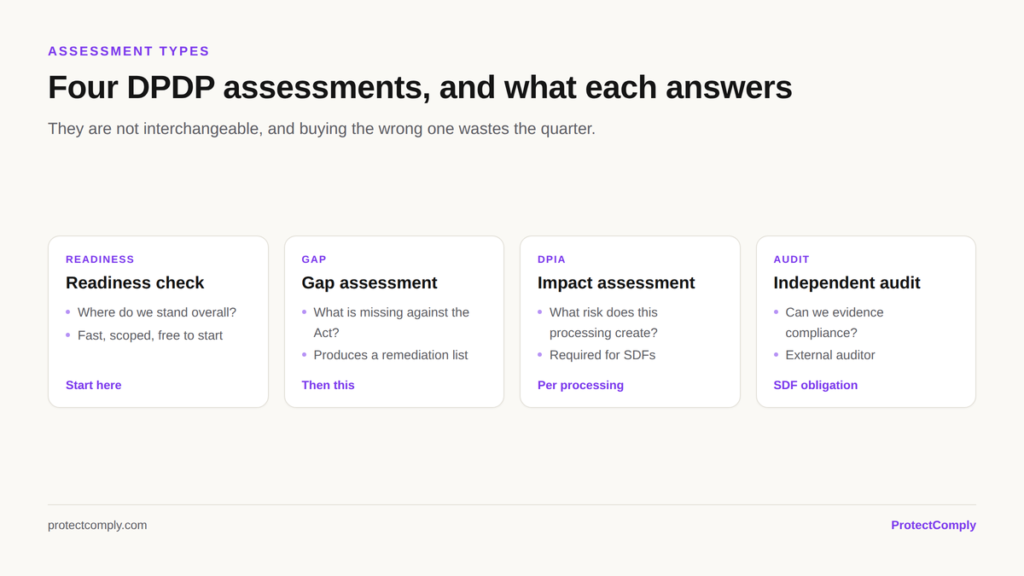
An assessment tells you where you stand; a DPDP gap assessment tells you what to fix first, and how to run a gap analysis walks through the method.