Consent Manager Under the DPDP Act: What Rule 4 Requires From 13 November 2026
Rule 4 of the Digital Personal Data Protection Rules, 2025 comes into force on 13 November 2026. From that date, a company can apply to the Data Protection Board to be registered as a Consent Manager. That is the whole of what changes on 13 November — and it is considerably narrower than most of what is being written about it.
Two things are worth getting straight before anything else, because almost every piece of vendor commentary blurs them:
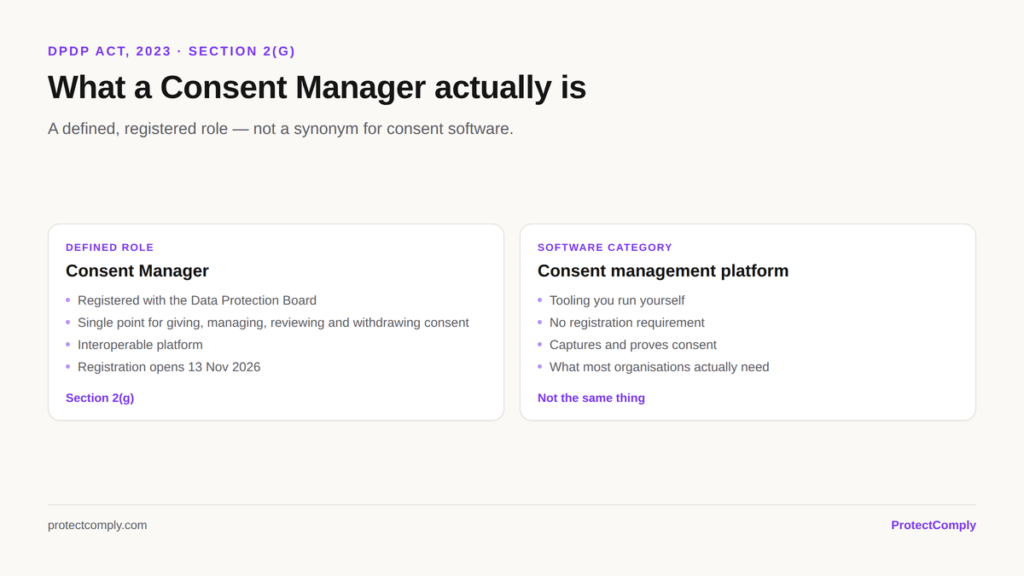
- A Consent Manager is a regulated company, not a software feature. Under Section 2(g) of the DPDP Act, 2023 it is a person registered with the Board who acts as a single point of contact enabling a Data Principal to give, manage, review and withdraw consent through an accessible, transparent and interoperable platform. You cannot buy one, install one, or become one by shipping a consent banner.
- No business is required to use a Consent Manager. Section 6(7) says a Data Principal may give, manage, review or withdraw consent through a Consent Manager. The word is “may”, and it attaches to the Data Principal, not to you. Nothing in the Act or the Rules obliges a Data Fiduciary to appoint one, onboard onto one, or integrate with one by any date.
If you have been told that your company must “have a Consent Manager in place by November 2026”, that is not what the law says. What follows is the actual text, condition by condition, with the dates it attaches to.

What actually changes on 13 November 2026
The DPDP Rules, 2025 were notified on 13 November 2025 by notification G.S.R. 846(E). Rule 1 splits their commencement into three tranches, and Rule 4 sits alone in the middle one:
| Date | Rule 1 sub-rule | What comes into force |
|---|---|---|
| 13 November 2025 | Rule 1(2) | Rules 1, 2 and 17 to 21 — definitions, and the constitution and procedure of the Data Protection Board |
| 13 November 2026 | Rule 1(3) | Rule 4 only — registration and obligations of Consent Managers, one year after publication |
| 13 May 2027 | Rule 1(4) | Rules 3, 5 to 16, 22 and 23 — notice, consent mechanics, security safeguards, breach reporting, retention, rights, cross-border transfer. Eighteen months after publication |
Read that middle row carefully. On 13 November 2026 the only thing that commences is the mechanism by which a company becomes a registered Consent Manager. The rules that impose duties on ordinary Data Fiduciaries — how notice must be worded, what security safeguards are required, how long data may be retained, how breaches must be reported — all wait until 13 May 2027. If you are a Data Fiduciary, that is your date, not this one. Our DPDP Rules timeline sets out every obligation against its commencement date.
The nine conditions for registration (First Schedule, Part A)
Rule 4(1) lets a person who satisfies Part A of the First Schedule apply to the Board. There are nine conditions, and they are closer to a non-banking financial licence than to a software certification:
| # | Condition | What it means in practice |
|---|---|---|
| 1 | The applicant is a company incorporated in India | Not an LLP, not a partnership, not a foreign entity or its branch. A Companies Act company |
| 2 | Sufficient technical, operational and financial capacity | Assessed by the Board, not self-declared |
| 3 | Sound financial condition and general character of management | A fit-and-proper test on the business itself |
| 4 | Net worth of not less than two crore rupees | ₹2 crore. See the next section — how it is measured matters |
| 5 | Adequate likely business volume, capital structure and earning prospects | The Board can decline an applicant it considers commercially unviable |
| 6 | Directors, KMP and senior management of general reputation and record of fairness and integrity | A fit-and-proper test on individuals |
| 7 | MoA and AoA must require adherence to Part B items 9 and 10, carry policies ensuring it, and be amendable only with prior Board approval | Your constitutional documents are rewritten and then frozen without the regulator’s consent |
| 8 | The proposed operations are in the interests of Data Principals | A broad discretionary gate |
| 9 | Independent certification that the interoperable consent platform meets the Board’s data protection standards and assurance framework, and that technical and organisational measures ensure observance of Part B item 11 | A third-party audit against standards the Board publishes on its website |
The ₹2 crore net worth bar, and how it is measured
Item 4 of Part A reads: “The net worth of the applicant is not less than two crore rupees.” The Note at the end of the First Schedule defines net worth as total assets reduced by liabilities, as appearing in the books of accounts.
That definition does real work. It is book value, not valuation. A funded startup with a ₹100 crore post-money valuation and ₹40 lakh of net assets on its balance sheet does not clear the bar; an unglamorous services company with retained earnings does. Equally, money raised and still sitting in the bank does count, because cash is an asset in the books. If you intend to apply, this is a question for your auditor, not your pitch deck.
The thirteen obligations after registration (First Schedule, Part B)
Rule 4(3) attaches Part B to every registered Consent Manager. These are the obligations that decide whether the role is a viable business for you, and five of them rule out most of the companies currently describing themselves as consent managers:
| # | Obligation |
|---|---|
| 1 | Enable a Data Principal to consent to processing by an onboarded Data Fiduciary, either directly or routed through another onboarded Data Fiduciary holding that data |
| 2 | Ensure the personal data it makes available or shares is not readable by the Consent Manager itself |
| 3 | Maintain a platform record of consents given, denied and withdrawn; the notices preceding or accompanying each consent request; and every sharing with a transferee Data Fiduciary |
| 4 | Give the Data Principal access to that record, supply it in machine-readable form on request, and retain it for at least seven years |
| 5 | Develop and maintain a website or app, or both, as the primary means of access |
| 6 | Not sub-contract or assign the performance of any obligation under the Act or the Rules |
| 7 | Take reasonable security safeguards to prevent a personal data breach |
| 8 | Act in a fiduciary capacity in relation to the Data Principal |
| 9 | Avoid conflict of interest with Data Fiduciaries, including their promoters and KMP |
| 10 | Maintain measures ensuring no conflict arises from directors, KMP or senior management holding directorships, financial interests, employment, beneficial ownership or material pecuniary relationships in Data Fiduciaries |
| 11 | Publish accessibly its promoters, directors, KMP and senior management; every shareholder above 2%; every body corporate in which those individuals hold above 2%; and anything further the Board directs |
| 12 | Operate effective audit mechanisms covering controls, continued fulfilment of registration conditions and adherence to obligations — and report audit outcomes to the Board periodically |
| 13 | Not transfer control of the company by sale, merger or otherwise without prior Board approval |
The five that eliminate most applicants
- Item 2 — the data must not be readable by you. A Consent Manager brokers consent and routes data it cannot itself read. Any business model that depends on seeing, enriching, scoring or analysing the personal data flowing through it is incompatible with registration.
- Item 6 — no sub-contracting of any obligation. This is unusually strict. It does not say “no sub-contracting of core functions”; it says no sub-contracting or assignment of any obligation under the Act and these Rules. Read plainly it constrains how much of the regulated function you can place with third-party providers.
- Item 8 — fiduciary capacity toward the Data Principal. Your duty runs to the individual, not to the Data Fiduciaries paying you. Where the two conflict, the individual wins.
- Items 9 and 10 — conflict of interest with Data Fiduciaries. A consent exchange owned by, or sharing directors with, the banks, insurers or platforms onboarded onto it has a structural problem. Note that Part A item 7 requires these two obligations to be written into your MoA and AoA.
- Item 13 — control cannot change without the Board’s prior approval. Acquisition, merger and secondary sales of a controlling stake all become regulator-gated events. That is a material fact for any investor in a prospective Consent Manager.
How registration works under Rule 4
- Apply (Rule 4(1)). A person satisfying Part A applies to the Board, furnishing the particulars, information and documents the Board publishes on its website.
- Inquiry (Rule 4(2)). The Board may make any inquiry it thinks fit to satisfy itself that the Part A conditions are met. There is no deemed approval and no stated timeline.
- Outcome (Rule 4(2)(a)–(b)). If satisfied, the Board registers the applicant and publishes its particulars on the Board’s website — so there will be a public register of Consent Managers, and claims to be one will be checkable. If not satisfied, it rejects the application and communicates the reasons.
- Supervision (Rule 4(4)). On forming an opinion of non-adherence, the Board gives an opportunity of being heard, informs the Consent Manager, and directs remedial measures.
- Suspension or cancellation (Rule 4(5)). In the interests of Data Principals, after a hearing and with written reasons, the Board may suspend or cancel registration and issue protective directions.
- Ongoing reporting (Rule 4(6)). The Board may require a Consent Manager to furnish any information it calls for.
What the Board has not published yet
Two parts of the framework point at documents the Board is to issue, and we could not locate either as published material when this page was last reviewed on 8 November 2026:
- The application particulars under Rule 4(1) — “such particulars and such other information and documents as the Board may publish in this behalf on its website”.
- The data protection standards and assurance framework under Part A item 9 — the benchmark against which an applicant’s interoperable platform must be independently certified.
Item 9 cannot be satisfied before the standards it refers to exist, because there is nothing to certify against. The practical consequence is that 13 November 2026 is the date the rule commences, which is not the same as the date registrations can be completed. Treat any vendor claiming to be a registered Consent Manager, or offering “registration-ready certification”, with scepticism until the Board’s register and its published standards are both live — and check the register, since Rule 4(2)(a) requires the Board to publish it.
We will update this page when either document appears.
Consent Manager vs consent management platform
These are different things with overlapping names, which is why so much of the commentary is confused. One is a regulated role in the statute. The other is software a Data Fiduciary runs to meet its own obligations.
| Registered Consent Manager | Consent management platform | |
|---|---|---|
| What it is | A company registered with the Data Protection Board under Rule 4 | Software, deployed by a Data Fiduciary |
| Defined where | Section 2(g) DPDP Act; Rule 4 and First Schedule | Nowhere. It is a product category, not a legal term |
| Whose obligations it discharges | Its own, owed to the Data Principal in a fiduciary capacity | Its customer’s, as a tool used by that Data Fiduciary |
| Who it serves | The Data Principal | The Data Fiduciary that licenses it |
| Can it read the data | No — Part B item 2 forbids it | Yes, within its customer’s instructions |
| Entry requirement | ₹2 crore net worth, nine Part A conditions, independent certification, Board approval | A commercial contract |
| Ongoing supervision | Board audits, reporting, suspension and cancellation powers | None. Your own vendor governance |
| Change of control | Requires prior Board approval | Unrestricted |
| Is it mandatory | Only if you want to perform that role. Section 6(7) makes its use the Data Principal’s option | No — but the obligations it helps you meet become binding on 13 May 2027 |
| Relevant date | 13 November 2026 | 13 May 2027 |
Do you need to register as a Consent Manager?
Almost certainly not. Three profiles cover nearly every organisation asking the question:
You collect consent for your own processing — no
A bank, hospital, retailer, SaaS company or employer collecting personal data to deliver its own goods and services is a Data Fiduciary. Rule 4 does not apply to you. Your obligations arrive on 13 May 2027 under Rules 3 and 5 to 16, and they are about notice, consent records, security, retention, breach reporting and rights fulfilment — not about registration.
You sell consent or privacy software — no, and you cannot register for your customers
A vendor licensing consent tooling to Data Fiduciaries is not performing the Section 2(g) role. Registration is not something a vendor can hold on a customer’s behalf, and a customer does not inherit anything from a vendor’s registration. If a vendor implies otherwise, ask them which Part B obligations they are assuming — particularly item 2, which would bar them from reading the data, and item 6, which bars sub-contracting.
You want to operate a neutral consent exchange — yes
If your business is to sit between individuals and many Data Fiduciaries as a single point of contact for consent — the account aggregator shape, applied to consent rather than financial data — then Rule 4 is your licensing path. Start with your balance sheet against item 4, your cap table and board composition against items 6, 9 and 10, and your MoA and AoA against item 7, because those are structural and slow to change. The platform certification under item 9 waits on the Board’s standards.
If you are a Data Fiduciary, work backwards from 13 May 2027
That is the date the substantive rules bind. The work that takes longest is not the consent interface; it is knowing what personal data you hold and why. In rough order of lead time:
- A record of processing activities. You cannot write accurate notice, honour erasure, or answer the Board without one. See records of processing activities under DPDP.
- Notice that satisfies Rule 3. Independently understandable, itemised description of the data, specified purposes, and the links for withdrawal, rights and complaints.
- Consent records with their notices attached. Part B item 3 makes this explicit for Consent Managers; for a Data Fiduciary it is simply what evidence of valid consent looks like.
- Withdrawal as easy as giving consent, and the downstream processing that actually stops when it happens.
- Notice in the languages you serve. See the Eighth Schedule languages requirement.
- Rights intake, breach reporting and retention wired into systems rather than inboxes.
Where ProtectComply fits — and where it does not
To be explicit, because this page is partly about vendors being imprecise: ProtectComply is a consent and privacy management platform. It is not a registered Consent Manager under Rule 4, and it does not claim to be. No such register exists yet to be on.
What it does is the Data Fiduciary side of the work: capture consent with the notice that accompanied it, keep the record in a form you can produce as evidence, propagate withdrawal to the systems that were relying on that consent, maintain a processing register, and handle rights requests on a clock. It is built by Exuverify Private Limited, which holds ISO 9001 and ISO/IEC 27001, and the platform is audited by a CERT-In empanelled auditor. You can see the modules, or the view for a Data Protection Officer.
Software does not make an organisation compliant, and nobody should tell you otherwise. It makes the evidence of your decisions retrievable, which is a different and more honest claim.
Frequently asked questions
What is a Consent Manager under the DPDP Act?
Under Section 2(g) of the DPDP Act, 2023, a Consent Manager is a person registered with the Data Protection Board who acts as a single point of contact enabling a Data Principal to give, manage, review and withdraw consent through an accessible, transparent and interoperable platform. Rule 4 of the DPDP Rules, 2025 sets the registration conditions and obligations, and comes into force on 13 November 2026.
Is my company required to appoint a Consent Manager by 13 November 2026?
No. Section 6(7) of the Act provides that a Data Principal may give, manage, review or withdraw consent through a Consent Manager. The option belongs to the individual. Nothing in the Act or the Rules requires a Data Fiduciary to appoint, onboard onto, or integrate with a Consent Manager by any date.
What is the net worth requirement for a Consent Manager?
Two crore rupees. Item 4 of Part A of the First Schedule requires that the applicant’s net worth is not less than ₹2 crore, and the Note to that Schedule defines net worth as total assets reduced by liabilities as appearing in the books of accounts — book value, not valuation.
What is the difference between a Consent Manager and a consent management platform?
A Consent Manager is a regulated company registered with the Board, owing fiduciary duties to the Data Principal, barred from reading the data it routes and from sub-contracting its obligations. A consent management platform is software a Data Fiduciary uses to meet its own obligations. The first is a legal status; the second is a product category. Buying software does not confer the status.
Can a Consent Manager read the personal data flowing through it?
No. Item 2 of Part B requires the Consent Manager to ensure that the manner in which personal data is made available or shared is such that its contents are not readable by the Consent Manager. Any model relying on inspecting, enriching or monetising that data is incompatible with registration.
How long must a Consent Manager keep consent records?
At least seven years, under item 4(c) of Part B — or longer where the Data Principal and the Consent Manager agree, or where other law requires it. The record must cover consents given, denied and withdrawn, the notices that preceded or accompanied each request, and every sharing with a transferee Data Fiduciary, and must be available to the Data Principal in machine-readable form on request.
Can I check whether a vendor is a registered Consent Manager?
Eventually, yes. Rule 4(2)(a) requires the Board to publish the particulars of each registered Consent Manager on its website, so there will be a public register to check a claim against. As at 8 November 2026 no such register has been published, which means no vendor can currently hold the status.
When do the DPDP obligations on ordinary businesses start?
13 May 2027, eighteen months after the Rules were published. Rules 3, 5 to 16, 22 and 23 commence then under Rule 1(4) — notice, consent mechanics, security safeguards, breach reporting, retention and erasure, rights fulfilment, and cross-border transfer. See the full DPDP Rules timeline.
Sources
- The Digital Personal Data Protection Rules, 2025 — Ministry of Electronics and Information Technology, notification G.S.R. 846(E), Gazette of India Extraordinary Part II Section 3(i), 13 November 2025. Rule 1 (commencement), Rule 4, First Schedule Parts A and B.
- The Digital Personal Data Protection Act, 2023 (22 of 2023) — Sections 2(g) and 6(7) to 6(9).
- Definitions of “company”, “control”, “director”, “key managerial personnel”, “promoter” and “senior management” — Companies Act, 2013, as adopted by the Note to the First Schedule.
Last reviewed 8 November 2026 against the Gazette text. This page explains the Rules; it is not legal advice, and whether and how they apply to your organisation is a question for your own counsel. If you spot an error, tell us and we will correct it.