Most Companies Still Are Not Ready for DPDP Compliance
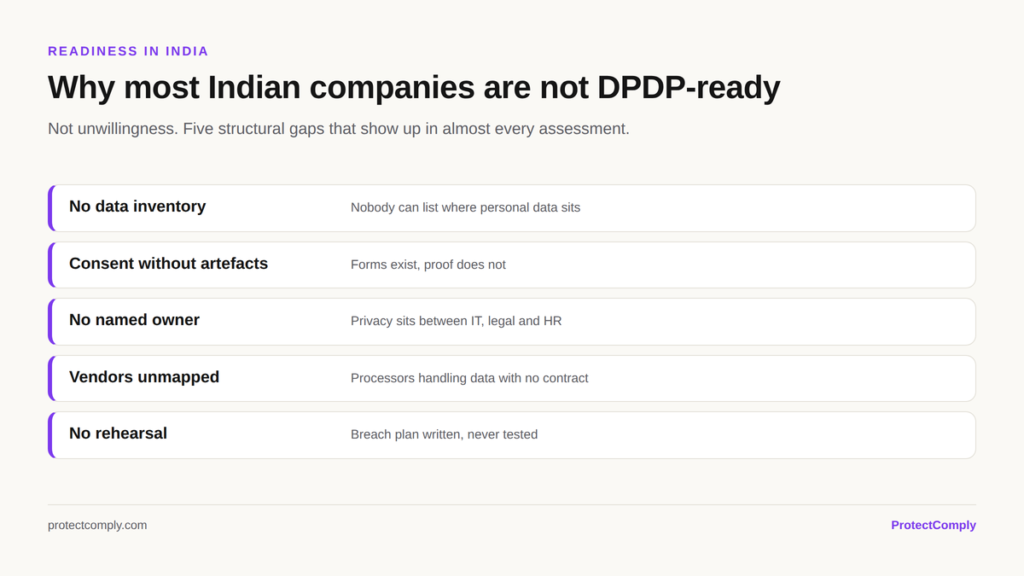
Most Companies Still Are Not Ready for DPDP Compliance
Every day, businesses collect massive amounts of customer data.

Names, phone numbers, email addresses, payment details, employee records, and customer information are constantly being stored, shared, and processed across different systems.
But here is the real concern.
Many organizations still do not have proper visibility into:
- where customer data is stored,
- who has access to it,
- how consent is managed,
- or how sensitive information is being handled internally.
As India’s Digital Personal Data Protection (DPDP) Act gains more attention, businesses are beginning to realize that poor data governance is no longer only a technical issue. It is becoming a serious operational and compliance challenge.
Companies that continue relying on outdated compliance practices may struggle with security risks, operational inefficiencies, and growing customer trust concerns.
This is why businesses across India are now focusing more heavily on compliance automation, data governance, and consent management systems like ProtectComply.
Why DPDP Compliance Is Becoming Important
Customer expectations around privacy are changing rapidly.
People now expect businesses to:
- handle their data responsibly,
- maintain transparency,
- protect personal information,
- and improve security practices.
At the same time, organizations are managing more digital operations than ever before.
This creates new challenges:
- larger databases,
- multiple software tools,
- remote teams,
- third-party vendors,
- cloud platforms,
- and distributed access to sensitive information.
Without structured compliance systems, managing all of this becomes difficult.
The Biggest Problem Businesses Face Today
The biggest issue is not only data collection.
The real issue is lack of visibility.
Many organizations still cannot clearly answer:
- Which employee has access to customer data?
- Where is sensitive information stored?
- Is customer consent properly tracked?
- Are old records still accessible?
- How quickly can the company respond to compliance requests?
When businesses lack operational visibility, risks increase significantly.
Why Manual Compliance Processes No Longer Work
Many companies still manage compliance using:
- spreadsheets,
- shared folders,
- email approvals,
- disconnected tools,
- and manual documentation.
This creates several operational problems.
Human Errors Increase
Manual systems often lead to:
- missing records,
- inconsistent tracking,
- outdated documentation,
- and accidental exposure of information.
Audit Preparation Becomes Difficult
Without centralized systems, teams struggle to:
- locate evidence,
- verify consent history,
- track compliance activities,
- and prepare reports efficiently.
Access Control Weakens
When access permissions are not monitored properly, sensitive information may become available to unnecessary users.
This increases internal and external security risks.
Why Businesses Need Better Data Governance
Modern compliance requires more than policies and documents.
Businesses now need:
- centralized visibility,
- structured workflows,
- access management,
- audit readiness,
- consent tracking,
- and continuous monitoring.
Data governance helps organizations maintain control over how information is collected, stored, shared, and managed.
Without strong governance systems, businesses may face:
- operational confusion,
- compliance gaps,
- security concerns,
- and customer trust issues.
Understanding Consent Management
Consent management is becoming one of the most important parts of modern data privacy operations.
Organizations should be able to:
- track customer permissions,
- maintain consent records,
- update user preferences,
- and improve transparency around data usage.
Many companies still lack proper systems for managing these processes effectively.
This creates unnecessary operational complexity.
Why Customer Trust Depends on Data Protection
Today, customers are paying closer attention to how businesses handle personal information.
Organizations that fail to improve security and transparency may struggle with:
- reputation concerns,
- trust issues,
- customer dissatisfaction,
- and operational credibility challenges.
Data privacy is no longer only a legal discussion.
It is becoming a major business trust factor.
How Businesses Can Prepare for DPDP Compliance
Organizations should begin strengthening:
- compliance workflows,
- data governance systems,
- access controls,
- monitoring visibility,
- and consent management practices.
Some important steps include:
Centralizing Compliance Operations
Businesses should move away from scattered systems and improve operational visibility through centralized compliance management.
Improving Access Management
Sensitive customer data should only be accessible to authorized users.
Organizations should regularly review permissions and monitor access activity.
Maintaining Audit-Ready Documentation
Businesses should organize:
- compliance records,
- security documentation,
- consent logs,
- and operational evidence
in a structured environment.
Monitoring Compliance Continuously
Compliance should not be treated as a one-time activity.
Organizations should continuously review and improve operational security and compliance workflows.
How ProtectComply Helps Businesses
ProtectComply is designed to help organizations simplify DPDP compliance and improve data governance visibility.
The platform helps businesses:
- manage compliance workflows,
- organize audit evidence,
- improve consent tracking,
- centralize compliance operations,
- and strengthen operational visibility.
Instead of relying on disconnected manual systems, organizations can improve efficiency through structured compliance management.
Why Early Compliance Preparation Matters
Many businesses are still waiting before taking compliance seriously.
However, organizations that prepare early may gain long-term advantages through:
- stronger customer trust,
- better operational control,
- improved audit readiness,
- and more structured data governance practices.
As India’s privacy ecosystem continues evolving, businesses that prioritize compliance readiness today may be better positioned for the future.
The Future of Data Privacy in India
Data privacy expectations will continue increasing across industries.
Businesses that improve:
- compliance visibility,
- operational transparency,
- consent management,
- and data governance
will likely build stronger trust and operational resilience over time.
ProtectComply helps businesses prepare for this evolving compliance landscape through centralized compliance and data governance solutions.
Frequently Asked Questions
What is DPDP compliance?
DPDP compliance refers to following India’s Digital Personal Data Protection Act requirements for responsible handling of personal data.
Why are many businesses not ready for DPDP compliance?
Many organizations still rely on manual systems, disconnected workflows, and weak visibility into customer data management processes.
Why is consent management important?
Consent management helps businesses maintain transparency and accountability regarding how customer data is collected and used.
What is ProtectComply?
ProtectComply is a compliance and data governance platform that helps businesses manage DPDP compliance workflows, audit readiness, and consent management.
Who should use ProtectComply?
Startups, SaaS companies, enterprises, healthcare organizations, and businesses handling customer data can use ProtectComply.
The cost of getting caught unprepared is not abstract — see what one data leak can cost — and our comparison of DPDP platforms in India if you are ready to close the gap.