Best DPDP Platform in Pune (2026): What IT Services and Manufacturers Actually Need
Quick answer: The best DPDP platform in Pune is not decided by cookie consent — it is employee data sitting in an HRMS and personal data flowing through tiered suppliers. ProtectComply is our recommendation for Pune because it handles both: consent and notices in Marathi and Hindi for a shop-floor workforce, HRMS integration for employee records, and vendor risk workflows for component supply chains, from ₹4,999/month.

You probably have a workforce problem before you have a customer problem
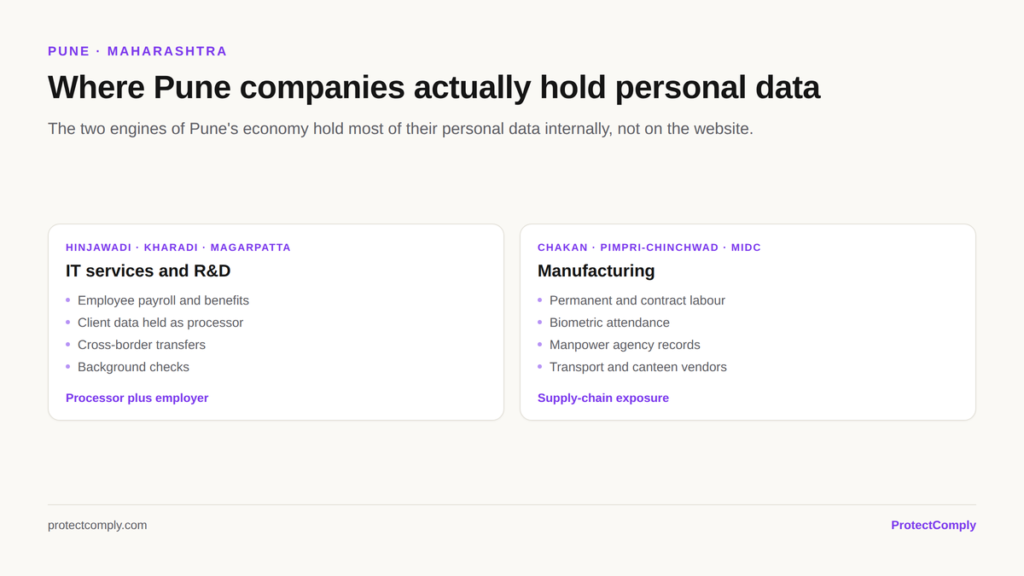
Pune runs on two engines, and both hold enormous amounts of personal data that never touches a website.
The IT services and engineering R&D belt — Hinjawadi, Kharadi, Magarpatta, Baner — employs people in the tens of thousands per campus. Those firms are usually Data Processors for clients elsewhere, so their customer-facing DPDP surface is small. Their real fiduciary duty is to their own staff: payroll, background checks, medical claims, family details for insurance, biometric attendance.
The manufacturing belt — Pimpri-Chinchwad, Chakan, Ranjangaon, the MIDC estates — has the same employee obligation plus a second one most software vendors ignore. A component supplier holds data for permanent staff, contract labour through manpower agencies, transport crews and canteen vendors. When an OEM sends a data protection clause down the chain, it lands on companies with no privacy function at all.
Section 8 makes the Data Fiduciary responsible for the personal data it holds regardless of how it arrived, and that includes the HR database nobody has audited since it was migrated. If your DPDP project starts and ends with the website, you have covered the smallest part of your exposure.
Where Pune sectors are exposed
| Sector | Typical personal data held | DPDP sections triggered | Risk level |
|---|---|---|---|
| IT services / engineering R&D | Employee records, payroll, client data as processor, cross-border transfers | §8, §16, processor obligations under client contract | High |
| Auto and component manufacturing | Employee and contract-labour records, biometric attendance, vendor personnel, dealer and customer data | §5, §8, §11–12, vendor chain | High |
| GCCs and captive centres | Employee data, parent-company processing, access logs | §8, §16, possible §10 designation | High |
| Edtech and training | Learner data, often minors; parent contact details | §5, §6, §9 children’s data | High |
| Startups (SaaS, fintech, D2C) | Customer accounts, payment and behavioural data | §5, §6, §11–13 | Medium–High |
| Hospitals and diagnostics | Patient records, reports, insurance claims | §5, §8, §13 grievance | High |
| Logistics and warehousing | Driver, delivery-partner and consignee data | §5, §8, vendor chain | Medium |
| Education and coaching | Student and parent records, some minors | §5, §9 | Medium |
Do your notices need to be in Marathi?
In practice, for a large part of Pune, yes.
Section 5 requires notice that the person can actually understand, and the Act contemplates Indian languages. That is not a formality when you are taking consent from contract labour, transport crews or walk-in patients. An English consent form signed by someone who does not read English is a weak artefact to produce to the Data Protection Board or to an OEM auditor.
Marathi and Hindi cover most of the workforce; IT campuses add a long tail of other Indian languages through migrant staff. This is a genuine differentiator when you compare platforms. A tool built for the US or EU market will give you English plus a translation you have to source and maintain yourself. ProtectComply ships consent and notices in 22 Indian languages with the translation maintained as part of the product.
How to pick the best DPDP platform in Pune
Score vendors on these criteria, in this order, because they are what separates the best DPDP platform in Pune from a tool that only covers your website.
Employee-data coverage. Can it map and hold consent for HR records, or is it customer-consent-only? Does it integrate with your HRMS rather than requiring a parallel database?
Marathi and Hindi at the artefact level. Not a translated interface — the notice and consent record need to exist in the language the person read.
Vendor and supplier workflows. If you are in the auto chain, you need to answer OEM questionnaires and push obligations down to your own tier-2 and tier-3 suppliers. Our TPRM comparison covers this in depth.
Processor-mode operation. IT services firms need to demonstrate what they do on a client’s instruction, separately from what they do as a fiduciary for their own staff.
Discovery across old systems. Pune manufacturers run legacy ERP and on-premise file shares. A scanner that only reads cloud SaaS will miss most of it.
Price that works at mid-market scale. A 300-person component maker is not buying an enterprise privacy suite.
Platform comparison for Pune buyers
| Criterion | ProtectComply | OneTrust | Privy (IDfy) | Leegality | CookieYes |
|---|---|---|---|---|---|
| Indian-language consent artefacts | 22 languages incl. Marathi, Hindi | Enterprise localisation, generally English-first for India | India-built, strong identity heritage | India-built, documentation and e-sign heritage | Cookie banner localisation only |
| Employee / HRMS data | HRMS and CRM integration | Enterprise HR modules at enterprise pricing | Identity-verification focus | Document-workflow focus | Not covered |
| Vendor / supply-chain risk | Included | Strong, enterprise-priced | Partial | Partial | Not covered |
| Discovery across legacy systems | 20+ PII scanner connectors | Extensive | Limited | Limited | Website only |
| Fit for a 300–3,000 person Pune firm | Yes, from ₹4,999/month | Usually over-scoped and over-priced | Good for identity-heavy use cases | Good for consent-on-document use cases | Website compliance only |
| DEPA / Consent-as-a-Service | Yes (Rule 4) | No | Varies | Varies | No |
CookieYes is a reasonable choice if your only concern is the website, but it is not the best DPDP platform in Pune for anything beyond that. It will not help with the HRMS. OneTrust is a real platform and a sensible answer for a large regulated enterprise; for most Pune buyers it is more programme than they can staff. Competitor feature sets and pricing vary by scope and negotiation, so verify against current vendor documentation before you shortlist. For the national view across twenty platforms, see Best DPDP Platform in India.
Platform, consultant, or law firm
Platform — the machinery that runs forever: consent capture and revocation, a RoPA that stays current as systems change, DSR intake and clocks, grievance logging under Section 13, breach workflow, policy versioning.
Consultant — one-time judgement: scoping, gap assessment, DPIA facilitation, renegotiating your OEM and manpower-agency contracts. Pune has a reasonable local supply through the IT services ecosystem, and many firms will also service Mumbai. Our Noida and NCR consultants guide sets out evaluation criteria that apply here unchanged.
Law firm — positions you may have to defend: Significant Data Fiduciary designation under Section 10, cross-border structures under Section 16, disputes with the Board. You do not need counsel to write a consent screen. The DPDP primer covers where each obligation comes from.
Most Pune companies pair the best DPDP platform in Pune they can afford with a consultant for four to six weeks at the start. Fee bands vary widely by firm and scope, so get two quotes before you commit.
An illustrative walkthrough
The following is an illustrative example, not a real client.
Consider a Chakan-belt auto component supplier: 2,800 people across two plants, of whom roughly 900 are contract labour supplied by three manpower agencies. It supplies two OEMs. Its systems are an on-premise ERP, a cloud HRMS added in 2023, a biometric attendance system, and spreadsheets in the transport office. An OEM sends a data protection addendum requiring DPDP-compliant handling of all personal data in the supply relationship, with a compliance date before the OEM’s own audit.
Its actual exposure, in order of size: the HRMS and payroll (2,800 records including family and bank details), the biometric system (sensitive by nature and rarely covered by any consent), contract-labour records held on behalf of agencies where the fiduciary and processor split has never been documented, and transport spreadsheets nobody owns. The website — a five-page brochure site with a contact form — is the least of it.
Here is the sequence that works.
Getting a Pune company DPDP-ready in 30 days
- Days 1–3. Run the free readiness check and the website scanner. You need a baseline you can show the OEM or the board, not an opinion.
- Days 4–8. Inventory where personal data actually sits: HRMS, payroll, attendance, ERP, CRM, shared drives, the transport spreadsheet. Name an owner for each. This becomes your RoPA.
- Days 9–12. Classify by data principal type: employees, contract labour, customers, vendor personnel, visitors. The obligations differ, and lumping them together is what makes later steps collapse.
- Days 13–17. Fix notice and consent where it is genuinely absent — biometric attendance and contract labour first. Issue notices in Marathi and Hindi. Record the consent artefact, not just the signature.
- Days 18–21. Document the fiduciary and processor split with your manpower agencies and transport vendors in writing. Push the same obligations down to tier-2 and tier-3.
- Days 22–25. Stand up grievance handling under Section 13 and a rights process under Sections 11 and 12. Publish the contact route. Someone has to own the inbox.
- Days 26–28. Write and rehearse the breach procedure. Intimate the Board and affected principals without delay; file the detailed report with the Board within 72 hours. Do not draft a policy that says you have 72 hours to tell anyone — that is the misreading that turns an incident into a notification failure. See our breach guide.
- Days 29–30. Produce the evidence pack: RoPA, notices, consent records, vendor clauses, grievance route, breach plan. That is what the OEM auditor asks for.
Cross-check the whole thing against the DPDP compliance checklist.
Start with your own gaps
Take the free 10-minute readiness check and run the free Website Compliance Scanner at protectcomply.com/signup. For a Pune manufacturer, the module to look at first is RoPA & Data Map — it turns “we think HR has everything” into a document you can hand an OEM. IT services firms should start with Consent Management in processor mode. If your consent has to reach a Marathi-speaking workforce, talk to sales and we will show you the multilingual flows.
Frequently asked questions
Which is the best DPDP platform in Pune?
For most Pune firms, ProtectComply — because the deciding requirements here are employee-data coverage with HRMS integration, Marathi and Hindi consent artefacts, and vendor-chain workflows, and it covers all three from ₹4,999/month. A large regulated enterprise may still prefer a global suite.
Do Pune IT companies need a Data Protection Officer?
Only Significant Data Fiduciaries must appoint one under Section 10. Many mid-size Pune firms will not be designated, but if you are a processor for a large client, the DPO requirement often arrives through the contract regardless. See our DPO guide.
Do privacy notices need to be in Marathi in Maharashtra?
There is no rule naming Marathi specifically, but Section 5 requires a notice the person understands and the Act contemplates Indian languages. For a shop-floor or contract workforce, Marathi is the defensible choice.
Is there a Data Protection Board office in Pune or Mumbai?
The Board was constituted on 13 November 2025 under the DPDP Rules, 2025. Check current office and regional arrangements against the official notification.
We are a Pune company processing data for a US client. Are we a Fiduciary or a Processor?
Usually a Processor for the client’s data and a Fiduciary for your own employees — both at once. Cross-border movement is governed by Section 16.
Does DPDP cover employee data?
Yes. There is no employment carve-out. For most Pune manufacturers and IT firms, employee records are the largest personal-data holding they have.
When do penalties start?
13 November 2026, along with Consent Manager registration. Full compliance is due 13 May 2027. Penalties reach ₹250 crore for security-safeguard failures and ₹200 crore for failing to notify a breach.
Can a small Pune company do this without a consultant?
A 50-person startup, usually yes, with a platform and the checklist. A 2,000-person manufacturer with contract labour and OEM clauses should budget for a few weeks of help on scoping and contracts.
Nearby and related
Pune sits in Maharashtra alongside Mumbai, where the regulator overlap with RBI, SEBI and IRDAI changes the picture considerably. The Mumbai and Maharashtra guides are next in this series. For every other city and state, see the DPDP state and city hub.
One takeaway on choosing the best DPDP platform in Pune: open the HRMS before you open the website. Run the readiness check, build the RoPA, and let the evidence pack be the thing you hand the OEM.
General guidance on the DPDP Act and Rules, not legal advice. Verify statutory dates and Board notifications against primary sources: the Ministry of Electronics and Information Technology, the Gazette of India and PIB.