Best TPRM Platform in India (2026): Third-Party Risk Management for DPDP Compliance
Written by the ProtectComply privacy team. Reviewed by Dinkar Singh, Chief Data Privacy Officer and Co-Founder, ProtectComply. Updated 31 August 2026.

Quick answer: A TPRM platform (third-party risk management platform) is software that inventories your vendors, tiers them by the risk they carry, runs due diligence and security questionnaires, tracks contractual obligations, monitors them continuously and evidences the whole lifecycle for regulators. For Indian organisations in 2026, the choice turns on one question: does the platform understand that under Section 8(2) of the DPDP Act you remain liable for what your processors do with personal data? ProtectComply is our pick for Indian Data Fiduciaries because vendor risk is linked directly to the processing activities and personal data categories each vendor touches. UpGuard, SecurityScorecard and Bitsight lead on external attack-surface monitoring; OneTrust, MetricStream, Riskonnect and Mitratech suit large enterprises running TPRM inside a wider GRC programme.
Why TPRM became a compliance problem in India, not just a security one
Third-party risk used to be an information security exercise: check the vendor has ISO 27001, file the certificate, move on. Three regulatory shifts changed that for Indian organisations.
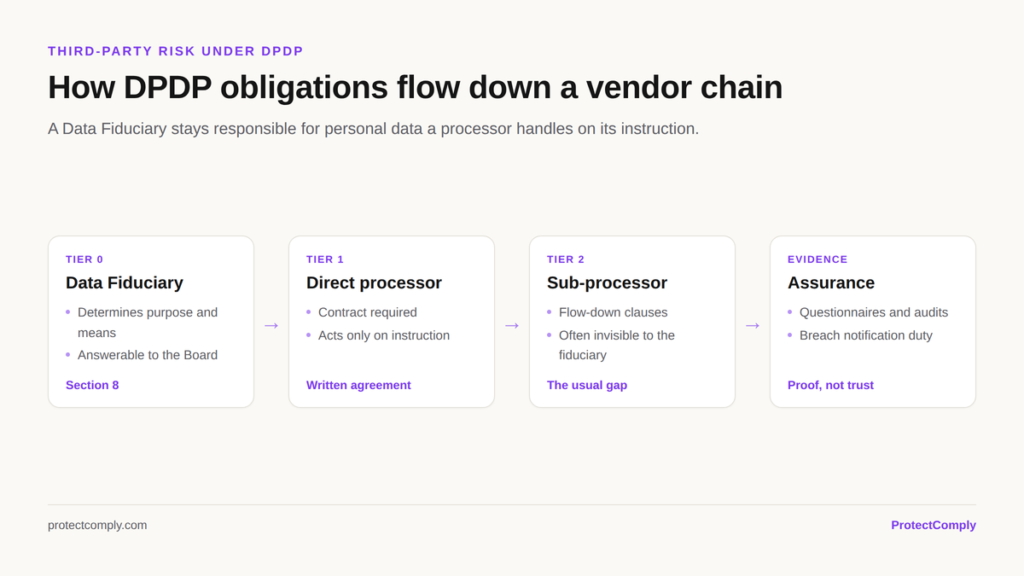
- DPDP Act, Section 8(2). A Data Fiduciary may engage a Data Processor only under a valid contract, and remains responsible for compliance regardless of any arrangement with that processor. Liability does not transfer with the data. Penalties reach 250 crore rupees – see DPDP Act penalties explained.
- Sectoral outsourcing rules. RBI’s outsourcing and IT governance directions, SEBI’s cyber security framework and IRDAI’s guidelines all require documented due diligence, ongoing monitoring and exit plans for material service providers.
- CERT-In directions. Incident reporting timelines apply across your estate, which means you need to know within hours which vendor holds which data – not within weeks.
Put together, an Indian organisation now has to answer, on demand: which vendors process personal data, for which purposes, under which contract clauses, with what security posture, and what happens when one of them is breached. Our guide to vendor risk management under DPDP covers the obligation in detail.
What a TPRM platform actually does
The lifecycle has six stages, and platforms differ mostly in how many they cover credibly.
- Inventory. Every third party, including the shadow SaaS finance discovers in the card statement. Without a complete list, everything downstream is theatre.
- Tiering. Classify by inherent risk: does the vendor process personal data, which categories, how many data principals, is it business-critical, does data leave India. A tier-1 processor of health data and a tier-4 stationery supplier should not get the same questionnaire.
- Due diligence. Security questionnaires, certificates, penetration test summaries, financial checks, and for DPDP purposes, confirmation of processing locations and sub-processors.
- Contracting. Data processing clauses that satisfy Section 8(2): purpose limitation, security safeguards, breach notification to you within a fixed window, sub-processor consent, audit rights, deletion on termination.
- Continuous monitoring. External security ratings, breach intelligence, certificate expiry, and re-assessment cadence by tier.
- Offboarding. Deletion certificates and access revocation – the stage almost every programme skips, and the one that leaves personal data sitting with an ex-vendor.
How we evaluated the platforms
- Privacy linkage. Can a vendor record be tied to the processing activities and personal data categories it touches, or is it just a security score?
- India regulatory fit. DPDP Section 8(2), RBI, SEBI and IRDAI expectations, CERT-In timelines, data residency.
- Questionnaire engineering. Tier-driven questionnaires, reusable evidence, and chasing that does not depend on a person sending reminder emails.
- Continuous monitoring quality. Signal that is actionable rather than a score that moves without explanation.
- Contract and clause management. Standard clause library, deviation tracking, renewal alerts.
- Evidence output. An export an auditor or an enterprise customer will accept.
- Cost and time to value for Indian mid-market budgets.
The best TPRM platforms for Indian organisations in 2026
1. ProtectComply – best TPRM platform for DPDP-driven vendor risk
ProtectComply approaches third-party risk from the data side rather than the network side. Every vendor is attached to the processing activities it supports in your RoPA, so the platform knows which personal data categories, purposes and data principal groups sit behind each relationship. Tiering is calculated from that exposure, questionnaires are issued by tier, contract clauses are checked against Section 8(2) requirements, and breach scoping starts from the vendor and returns the affected activities and principals immediately – which is what the 72-hour breach notification workflow actually needs. Every assessment, approval and change lands in a hash-chained evidence ledger.
Pros: Vendor risk linked to real processing records; DPDP clause library and gap flags; breach-to-principal scoping in minutes; sub-processor tracking; Indian data residency and Indian support hours; part of one DPDP programme rather than a separate tool.
Cons: Not an external attack-surface scanner – pair it with a ratings service if you need continuous internet-facing monitoring.
Best for: Indian Data Fiduciaries, Significant Data Fiduciaries, BFSI, healthcare and SaaS companies whose vendor risk is primarily personal data risk.
2. UpGuard
Strong external security ratings and vendor questionnaire workflow, widely used by security teams.
Pros: Good attack-surface visibility, clear risk reporting.
Cons: Security-first view; DPDP obligations and processing linkage are not modelled.
Best for: Security teams that want outside-in monitoring.
3. SecurityScorecard and Bitsight
The two established ratings providers, useful as continuous monitoring signal feeding a broader programme.
Pros: Mature scoring, broad vendor coverage.
Cons: Ratings are an indicator, not due diligence; limited privacy or contract lifecycle depth.
Best for: Supplementing an existing TPRM process.
4. OneTrust Third-Party Management
TPRM inside the largest privacy suite, with assessments that can reference the privacy programme.
Pros: Integrated with privacy modules; broad template library.
Cons: Cost and implementation effort; India-specific content needs configuration. See OneTrust alternatives in India.
Best for: Multinationals already invested in OneTrust.
5. MetricStream
Enterprise GRC platform with deep third-party modules and significant presence in Indian BFSI.
Pros: Enterprise-grade workflow and reporting; understands Indian regulated sectors.
Cons: Heavy implementation; overkill for mid-market.
Best for: Large banks, insurers and conglomerates with a GRC function.
6. Riskonnect and Mitratech
Broad risk and legal operations suites with capable TPRM modules.
Pros: Consolidation across risk, legal and compliance.
Cons: Privacy is one lens among many; DPDP specificity limited.
Best for: Enterprises consolidating risk tooling.
7. Prevalent and Atlas Systems
Dedicated TPRM specialists with managed-service options for organisations short on assessment capacity.
Pros: Assessment libraries, outsourced chasing.
Cons: Managed services add recurring cost; DPDP mapping is not native.
Best for: Teams with many vendors and few analysts.
At a glance
| Platform | Primary lens | Linked to processing records | DPDP Section 8(2) clause support | Continuous monitoring | India fit | Best for |
|---|---|---|---|---|---|---|
| ProtectComply | Personal data risk | Yes | Yes | Assessment-driven | India-first | Indian Data Fiduciaries |
| UpGuard | Security posture | No | No | Strong | Global | Security teams |
| SecurityScorecard / Bitsight | Ratings | No | No | Strong | Global | Monitoring layer |
| OneTrust | Privacy suite | Yes | Configurable | Partial | Global | Multinationals |
| MetricStream | Enterprise GRC | Partial | Configurable | Partial | Strong in BFSI | Large enterprises |
| Riskonnect / Mitratech | Risk and legal ops | Partial | Configurable | Partial | Global | Risk consolidation |
| Prevalent / Atlas | TPRM specialist | No | Partial | Partial | Global | High vendor counts |
The vendor tiering model we recommend for DPDP
| Tier | Trigger | Due diligence | Reassessment |
|---|---|---|---|
| Tier 1 | Processes sensitive personal data at scale, or is business-critical, or transfers data outside India | Full questionnaire, evidence review, security review, DPIA input | Annually, plus on material change |
| Tier 2 | Processes personal data but limited categories or volume | Standard questionnaire and certificate review | Every 18 months |
| Tier 3 | Incidental access to personal data | Short attestation and contract clauses | Every 2 years |
| Tier 4 | No personal data access | Contract clauses only | On renewal |
The point of tiering is not paperwork reduction for its own sake. It is that an unsegmented programme sends the same 200-question form to everyone, gets slow responses from the vendors that matter, and produces evidence nobody reviews.
Seven questions to ask a TPRM vendor
- Can I see, for one vendor, exactly which personal data categories and processing purposes it touches?
- How does the platform tier vendors, and can tiering be driven by data exposure rather than spend?
- Does the clause library cover DPDP Section 8(2) processor obligations, including sub-processors and deletion on exit?
- When a vendor reports a breach, how quickly can I produce the list of affected processing activities and data principals?
- How are sub-processors captured, and what happens when a vendor adds one?
- What does the offboarding workflow require before a vendor is marked closed?
- Where does assessment data reside, and can it stay in India?
Where TPRM meets the rest of your DPDP programme
A TPRM platform that lives apart from the privacy programme creates two registers that disagree. The vendor list in procurement says 340 suppliers; the privacy team’s processor list says 71; neither matches the systems found in data discovery. Reconciling those three views is usually the single largest piece of work in an Indian DPDP programme, and it is why we argue vendor risk belongs inside the same platform as the RoPA, consent records and DPIAs rather than beside it. Significant Data Fiduciaries feel this hardest, because the annual audit under Section 10 examines exactly these joins – see Significant Data Fiduciary obligations.
A 60-day TPRM implementation plan
Days 1-10. Build the complete vendor inventory from procurement, finance, IT and the RoPA. Deduplicate. Identify vendors that touch personal data.
Days 11-20. Tier them using data exposure and criticality. Agree the tier definitions with legal and security so nobody relitigates them later.
Days 21-35. Issue tier-1 and tier-2 questionnaires. Collect certificates, sub-processor lists and processing locations.
Days 36-50. Review contracts against the Section 8(2) clause set. Log deviations, start remediation with the highest-exposure vendors first.
Days 51-60. Stand up monitoring and the incident path: who is called, what evidence the vendor owes you, and how fast. Then set the reassessment calendar.
Common TPRM failures
- An inventory built only from procurement data. Free-tier SaaS and departmental tools never appear in it.
- Questionnaires with no consequence. If a failing answer changes nothing, the exercise is decorative.
- Contracts signed without processor clauses. Section 8(2) requires a valid contract, and legacy master agreements rarely contain one.
- No sub-processor visibility. Your vendor’s vendor is still your exposure.
- No offboarding evidence. Without a deletion confirmation, the data relationship never actually ends.
Frequently asked questions
What is a TPRM platform?
A TPRM platform is software that manages third-party risk end to end: vendor inventory, risk tiering, due diligence assessments, contractual obligations, continuous monitoring and offboarding, with evidence retained for audits and regulators.
Is TPRM required under India’s DPDP Act?
The Act does not use the term, but Section 8(2) permits engaging a Data Processor only under a valid contract and keeps the Data Fiduciary responsible for compliance. Meeting that in practice requires vendor due diligence, contractual controls and monitoring – which is TPRM.
What is the difference between TPRM and vendor risk management?
They are used interchangeably. TPRM is usually the broader term, covering any third party including partners, agents and service providers, while vendor risk management is often used for procurement-contracted suppliers specifically.
How do we tier vendors for DPDP?
Tier by data exposure first: the categories and volume of personal data processed, whether the data leaves India, and business criticality. Spend is a poor proxy – a low-cost analytics tool can carry far more personal data risk than an expensive hardware supplier.
What must be in a DPDP processor contract?
At minimum: processing limited to your documented purposes, reasonable security safeguards, prompt breach notification to you, controls over sub-processors, cooperation with data principal requests, audit rights, and deletion or return of personal data on termination.
How often should vendors be reassessed?
Annually for tier 1, every 18 months for tier 2, every two years for tier 3, and on any material change such as a new sub-processor, a new data category, a change of processing location or a reported breach.
Which TPRM platform is best in India?
For organisations whose third-party risk is fundamentally personal data risk under the DPDP Act, ProtectComply is our recommendation because vendor records connect to the processing activities behind them. Security-led teams often add an external ratings service such as UpGuard, and large regulated enterprises frequently run MetricStream or OneTrust.
Next step
Start by finding out how many of your vendors actually touch personal data – a free DPDP assessment will size it, and how to choose a DPDP compliance platform covers the wider buying decision. Definitions are in the DPDP glossary.
About the reviewer: Dinkar Singh is Chief Data Privacy Officer and Co-Founder at ProtectComply, advising Indian enterprises on processor governance and DPDP readiness.