How to Do a DPDP Gap Analysis | DPDP Compliance Guide | ProtectComply
How to Do a DPDP Gap Analysis: A Complete Guide for Businesses
Most businesses believe they are DPDP compliant.

They have privacy policies.
They collect customer data.
They maintain records.
They use cloud software.
They even have security tools.
But here is the reality.
Having these things does not automatically make a business compliant with India’s Digital Personal Data Protection (DPDP) Act.
The biggest mistake organizations make is assuming compliance without measuring it.
Before businesses can achieve DPDP compliance, they must first understand where they currently stand.
That process is called a DPDP Gap Analysis.
A gap analysis helps businesses identify weaknesses, compliance risks, governance gaps, and operational blind spots that may prevent them from achieving DPDP readiness.
What Is a DPDP Gap Analysis?
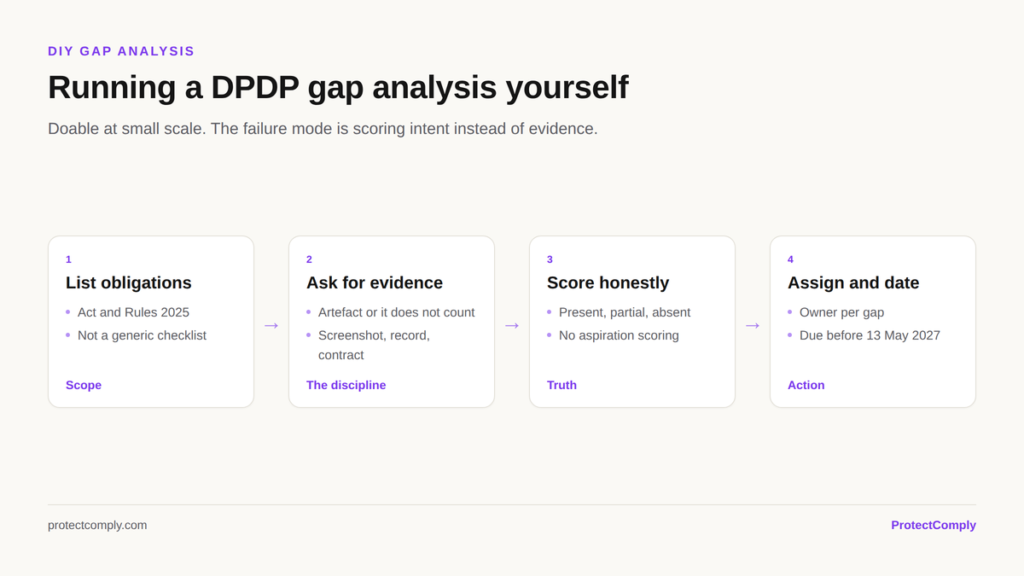
A DPDP Gap Analysis is a structured assessment that compares your organization’s current data handling practices against DPDP compliance requirements.
The objective is simple:
Identify the gap between:
Current State
What your organization does today.
and
Desired State
What your organization should do to align with DPDP requirements.
A DPDP Gap Analysis helps businesses understand:
- What is working
- What is missing
- What creates risk
- What needs improvement
- What should be prioritized
Without a gap analysis, businesses often spend money solving the wrong problems.
Why Every Business Needs a DPDP Gap Analysis
Many organizations are surprised when they conduct their first assessment.
They discover issues such as:
- Missing consent records
- Excessive user access
- Poor data visibility
- Weak governance controls
- Incomplete documentation
- Vendor compliance risks
- Missing audit evidence
These issues often remain hidden for years.
A DPDP Gap Analysis exposes them before they become larger compliance challenges.
Step 1: Identify All Personal Data
The first step is understanding what personal data your organization collects.
This includes:
- Customer information
- Employee records
- Vendor information
- Marketing databases
- Website form submissions
- Application user data
- Financial records
Many businesses collect significantly more personal data than they realize.
Without visibility into data assets, compliance becomes impossible.
Step 2: Map Data Flow Across the Organization
Once data is identified, businesses should understand how it moves.
Ask:
- Where is data collected?
- Where is it stored?
- Who can access it?
- Which systems process it?
- Which vendors receive it?
- How is it deleted?
This process is called Data Flow Mapping.
It often reveals hidden risks and unnecessary exposure points.
Step 3: Review Consent Management Practices
Consent is one of the most important areas of DPDP compliance.
Businesses should evaluate:
- How consent is collected
- How consent is stored
- Whether consent history is maintained
- How consent withdrawal is handled
- Whether consent records are accessible
Questions to ask:
- Can we prove when consent was collected?
- Can we show what the user agreed to?
- Can we demonstrate consent updates?
If the answer is no, there is likely a compliance gap.
Step 4: Assess Data Access Controls
One of the most common compliance weaknesses involves access management.
Businesses should review:
- Who can access personal data
- Why access exists
- Whether access remains necessary
- How permissions are monitored
Many organizations discover:
- Former employees still have access
- Vendors have excessive permissions
- Teams access unnecessary data
These issues create governance risks.
Step 5: Evaluate Data Security Controls
DPDP compliance requires businesses to implement reasonable security safeguards.
Review:
- Password policies
- Encryption practices
- Access controls
- Backup procedures
- Monitoring systems
- Endpoint protection
- Incident response plans
The goal is to determine whether existing safeguards adequately protect personal data.
Step 6: Review Vendor and Processor Risk
Most businesses share data with third parties.
Examples include:
- Cloud providers
- CRM platforms
- Marketing agencies
- Payment processors
- HR software providers
Businesses should evaluate:
- What data vendors access
- Why they access it
- How they secure it
- Whether contracts address privacy obligations
Third-party risks often represent major compliance gaps.
Step 7: Check Documentation and Evidence
A common mistake is performing compliance activities without documenting them.
Review:
- Privacy policies
- Data handling procedures
- Consent records
- Security policies
- Governance documentation
- Risk assessments
- Incident response plans
If evidence cannot be produced quickly, a compliance gap likely exists.
Step 8: Assess Data Principal Rights Readiness
Businesses should evaluate whether they can handle:
- Access requests
- Correction requests
- Consent withdrawal
- Data deletion requests
- Grievance management
Questions to ask:
- Is there a documented process?
- Is responsibility assigned?
- Are requests tracked?
Many organizations discover they have no formal workflow.
Step 9: Evaluate Audit Readiness
A business may believe it is compliant.
The real question is:
Can you prove it?
Audit readiness requires:
- Organized records
- Compliance evidence
- Governance documentation
- Monitoring reports
- Risk assessments
Businesses that cannot demonstrate compliance often struggle during reviews and assessments.
Step 10: Calculate Compliance Maturity
Once all assessments are completed, businesses should classify findings into:
High Risk
Immediate action required.
Medium Risk
Improvement required.
Low Risk
Minor optimization opportunities.
This creates a roadmap for implementation and remediation.
Common Findings During DPDP Gap Analysis
Most businesses discover issues in:
Consent Management
Poor tracking and visibility.
Data Inventory
Unknown personal data locations.
Access Controls
Excessive permissions.
Documentation
Missing compliance evidence.
Vendor Oversight
Insufficient monitoring.
Audit Readiness
Scattered records and reports.
These findings are extremely common, even in mature organizations.
Why Manual Gap Analysis Often Fails
Many businesses attempt DPDP assessments using spreadsheets.
This creates challenges such as:
- Inconsistent reviews
- Missing evidence
- Poor visibility
- Lack of accountability
- Slow assessments
As organizations grow, manual analysis becomes difficult to manage.
How ProtectComply Simplifies DPDP Gap Analysis
ProtectComply helps businesses conduct structured DPDP Gap Analysis through a centralized platform.
The platform helps organizations assess:
- Governance readiness
- Consent management maturity
- Access controls
- Documentation practices
- Audit preparedness
- Compliance workflows
Instead of guessing where problems exist, businesses gain clear visibility into compliance gaps and improvement priorities.
Benefits of Conducting a DPDP Gap Analysis
A proper assessment helps businesses:
- Identify compliance weaknesses
- Improve governance visibility
- Strengthen consent management
- Enhance audit readiness
- Reduce operational risks
- Prioritize compliance investments
- Build a roadmap toward DPDP compliance
Most importantly, it replaces assumptions with evidence.
Conclusion
The first step toward DPDP compliance is not implementing new technology.
The first step is understanding where your organization stands today.
A DPDP Gap Analysis provides that visibility.
It helps businesses identify weaknesses, improve governance, strengthen consent management, and build a practical roadmap toward compliance.
ProtectComply helps organizations conduct DPDP Gap Analysis efficiently through centralized assessments, compliance monitoring, and governance visibility.
For businesses serious about DPDP compliance, a gap analysis is not optional.
It is where the journey begins.
Frequently Asked Questions
What is a DPDP Gap Analysis?
A DPDP Gap Analysis compares an organization’s current practices against DPDP compliance requirements to identify weaknesses and improvement opportunities.
Why is a DPDP Gap Analysis important?
It helps businesses understand compliance gaps before they become operational or governance risks.
What is the first step in a DPDP Gap Analysis?
The first step is identifying all personal data collected and understanding where it is stored.
How often should businesses conduct a DPDP Gap Analysis?
Organizations should conduct assessments regularly, especially after major process, technology, or regulatory changes.
How does ProtectComply help with DPDP Gap Analysis?
ProtectComply provides structured assessments, governance visibility, compliance monitoring, audit readiness support, and gap identification through a centralized platform.
If you would rather not run this manually, a DPDP gap assessment platform automates the scoring, and a free DPDP readiness assessment gives you a first pass at no cost.
If the DIY route above feels heavy, we compared the tooling in DPDP gap analysis platforms in India: the 2026 comparison — free tools, suite modules, and consultant-run assessments side by side.